


SaaS penetration testing is not just web application testing with a different label. A SaaS product usually combines a browser-based application, APIs, cloud infrastructure, tenant data, SSO, integrations, admin tooling, support workflows, and business logic that changes constantly. Testing only the visible application can miss the risks that matter most.
This guide explains what SaaS penetration testing covers, how it differs from a standard web application pentest, which vulnerabilities matter most, and how SaaS companies should approach testing for SOC 2, customer assurance and real risk reduction.
What is SaaS penetration testing?
SaaS penetration testing is a security assessment of a software-as-a-service product and the systems that support it. Unlike a narrow web application pentest, a SaaS pentest usually needs to evaluate the full product attack surface: web application, APIs, tenant boundaries, authentication flows, authorization logic, cloud infrastructure, integrations, admin tooling, support workflows, and sometimes mobile or desktop clients.
SaaS penetration testing may include elements of several types of penetration tests — typically web application, API, cloud, and external infrastructure testing — but it is not the same as any single one of them.
The goal is to understand whether an attacker could access customer data, abuse business logic, cross tenant boundaries, escalate privileges, compromise accounts, manipulate workflows, or use one part of the platform to reach another. That’s why a strong SaaS security assessment tests the product as attackers would experience it: as a connected system.
How SaaS pentesting differs from a standard web application pentest
A standard web application penetration test focuses on a web application and its exposed functionality. That is still an important part of SaaS security testing, but it is not enough for most SaaS products.
SaaS platforms usually introduce additional risk because they are multi-tenant, API-driven, cloud-hosted, integration-heavy, and continuously changing. They often include customer workspaces, role-based access control, billing logic, SSO, OAuth integrations, background jobs, admin panels, support impersonation, data exports, audit logs, and cloud-managed services.
That means SaaS pentesting has to answer questions that a basic web app test may not cover deeply enough:
Can one tenant access another tenant’s data? Can a user change object IDs or API parameters to reach resources they do not own? Can a low-privilege user access admin functions through the API? Can support tooling bypass customer controls? Can cloud storage expose files outside the application? Can SSO, invitations, billing, or integrations be abused to escalate access?
In SaaS environments, the highest-impact findings often come from broken assumptions between layers. The application assumes the API enforces access control. The API assumes the UI hides privileged actions. The cloud storage layer assumes the application has already checked authorization. The support tool assumes employees only use it for legitimate reasons. A SaaS pentest should challenge those assumptions.
What does a SaaS penetration test cover?
The exact scope depends on the product architecture, customer data flows, and business risk. A simple SaaS application may only need web, API, and external infrastructure testing. A mature platform may require a broader scope that includes cloud services, SSO, integrations, internal admin tooling, mobile clients, and tenant-isolation testing.
These are the areas that matter most:
Web application security
The web application is still the main user-facing surface for many SaaS products. Web application penetration testing typically covers authentication, session management, authorization, input validation, access control, file uploads, data exposure, error handling, security headers, workflow abuse, and OWASP Top 10 risks such as cross-site scripting, SQL injection, server-side request forgery, and broken access control.
For SaaS products, authenticated testing is essential. Many meaningful findings only appear after login, when penetration testers can exercise real user roles, account settings, billing flows, exports, admin features, and workspace-level functionality.
A scanner can find some common web issues. It will not understand whether a user in one customer workspace can access another customer’s report, bypass a subscription boundary, or trigger a privileged workflow in an unintended state.
API security
APIs are often the real attack surface of a SaaS product. SaaS platforms use APIs for the web interface, mobile apps, third-party integrations, partner access, internal services, automation, and data export. If API authorization fails, attackers may not need to compromise the front end at all.
API penetration testing should cover broken object-level authorization, broken function-level authorization, weak authentication, excessive data exposure, mass assignment, injection vulnerabilities, rate limiting weaknesses, insecure pagination or filtering, undocumented endpoints, legacy endpoints, and business logic abuse.
The most important API question in SaaS is usually not “does this endpoint work?” It is “who should be allowed to do this, against which object, in which tenant, and under what business condition?”
That is why useful API testing requires context: roles, tenants, example objects, API documentation, Postman collections, OpenAPI or Swagger files, and accounts with different permission levels.
Multi-tenant isolation
Multi-tenant isolation is one of the defining risks of SaaS security.
SaaS platforms serve multiple customers on shared infrastructure while promising that each customer’s data, users, settings, files, and workflows remain separate. A single tenant-isolation failure can expose data across customers and create a much larger blast radius than a single-account vulnerability.
Testing tenant isolation means actively trying to cross those boundaries. Pen testers may manipulate object IDs, workspace IDs, organization IDs, API parameters, export functions, invitations, file paths, search features, reporting endpoints, background jobs, and admin functions to see whether one tenant can access another tenant’s resources.
Common failures include missing ownership checks, improperly scoped database queries, IDOR/BOLA vulnerabilities, authorization enforced in the UI but not the API, shared storage paths, weak tenant scoping in background tasks, and internal tooling that can access customer data without proper restrictions.
This is where automated tools are insufficient and manual testing techniques are especially important. Tenant isolation issues are usually context-specific and depend on understanding how the application is supposed to behave.
Authentication, SSO, and OAuth
Authentication and identity flows are critical in SaaS environments because customers often connect the product to their own identity providers and internal access models.
A SaaS pentest should review login, registration, password reset, MFA, session handling, invitation flows, account linking, SAML, OAuth, OpenID Connect, SSO configuration, role mapping, SCIM provisioning, and tenant membership changes.
Common issues include weak password reset flows, insecure invitation logic, broken account linking, OAuth misconfiguration, overbroad OAuth scopes, weak session invalidation, MFA bypasses, privilege changes that do not invalidate sessions, and SSO role-mapping mistakes that grant unintended access.
These security flaws can be subtle. A flow may look secure in isolation but fail when combined with invitations, workspace switching, billing roles, SSO provisioning, or account recovery.
Admin and support tooling
SaaS products often include internal tooling for support, billing, customer success, fraud review, debugging, impersonation, data correction, and administrative operations.
These tools are high-value targets because they frequently have privileged access to customer data or production workflows. They may also receive less security attention than the customer-facing product.
SaaS pen testing should evaluate whether admin and support tooling is properly authenticated, authorized, logged, segmented, and restricted. It should also test whether support impersonation, customer lookup, data exports, role changes, billing adjustments, and account recovery workflows can be abused.
The key question is not only whether external attackers can reach these tools. It is whether a compromised employee account, overly broad internal role, weak support workflow, or missing approval step could create customer impact.
Cloud infrastructure and storage
Most SaaS products run on cloud infrastructure. That makes cloud security part of SaaS security.
A SaaS pen test may need to include cloud IAM, storage permissions, managed databases, queues, serverless functions, Kubernetes clusters, logs, secrets, CI/CD pipelines, and external infrastructure. If the product stores or processes customer data in AWS, Azure, or Google Cloud, cloud configuration and cloud attack paths can directly affect SaaS risk.
Cloud issues that matter for SaaS include exposed storage buckets, overly permissive IAM roles, leaked access keys, public snapshots, weak security groups, insecure metadata access, secrets in build pipelines, overexposed Kubernetes services, and logging gaps.
Blaze’s 2025 penetration testing data found that cloud security assessments had the highest average vulnerability density of any assessment type, with 14.40 vulnerabilities per project. That is especially relevant for SaaS companies, because their products often depend heavily on cloud infrastructure and managed services.
Integrations and webhooks
SaaS products rarely operate alone. They connect to identity providers, payment processors, CRMs, ticketing systems, chat platforms, code repositories, analytics tools, data warehouses, and customer environments.
Each integration creates trust relationships and data flows that need to be tested.
A SaaS pentest should review OAuth scopes, token storage, webhook signature validation, callback URLs, integration permissions, third-party app installation flows, import/export features, error handling, and whether integrated services can be abused to access data or trigger privileged actions.
Webhook and integration flaws are often missed because they sit between teams: part application security, part API security, part business logic, and part third-party risk.
Business logic and workflow abuse
Business logic vulnerabilities are one of the clearest reasons SaaS pentesting cannot be reduced to automated scanning.
These issues occur when the application works as designed, but the design can be abused. Examples include bypassing subscription limits through direct API calls, exporting data without the same authorization checks as the UI, skipping approval steps in multi-stage workflows, reusing invitation links, manipulating billing states, abusing trial-to-paid transitions, or changing role assignments in unexpected sequences.
There may be no CVE, no missing patch, and no scanner signature. The tester needs to understand the intended workflow, then find where the application fails under adversarial use.
For SaaS companies, these findings are often among the most valuable because they map directly to customer data exposure, privilege abuse, fraud, revenue loss, or compliance impact.
Common vulnerabilities found in SaaS penetration tests
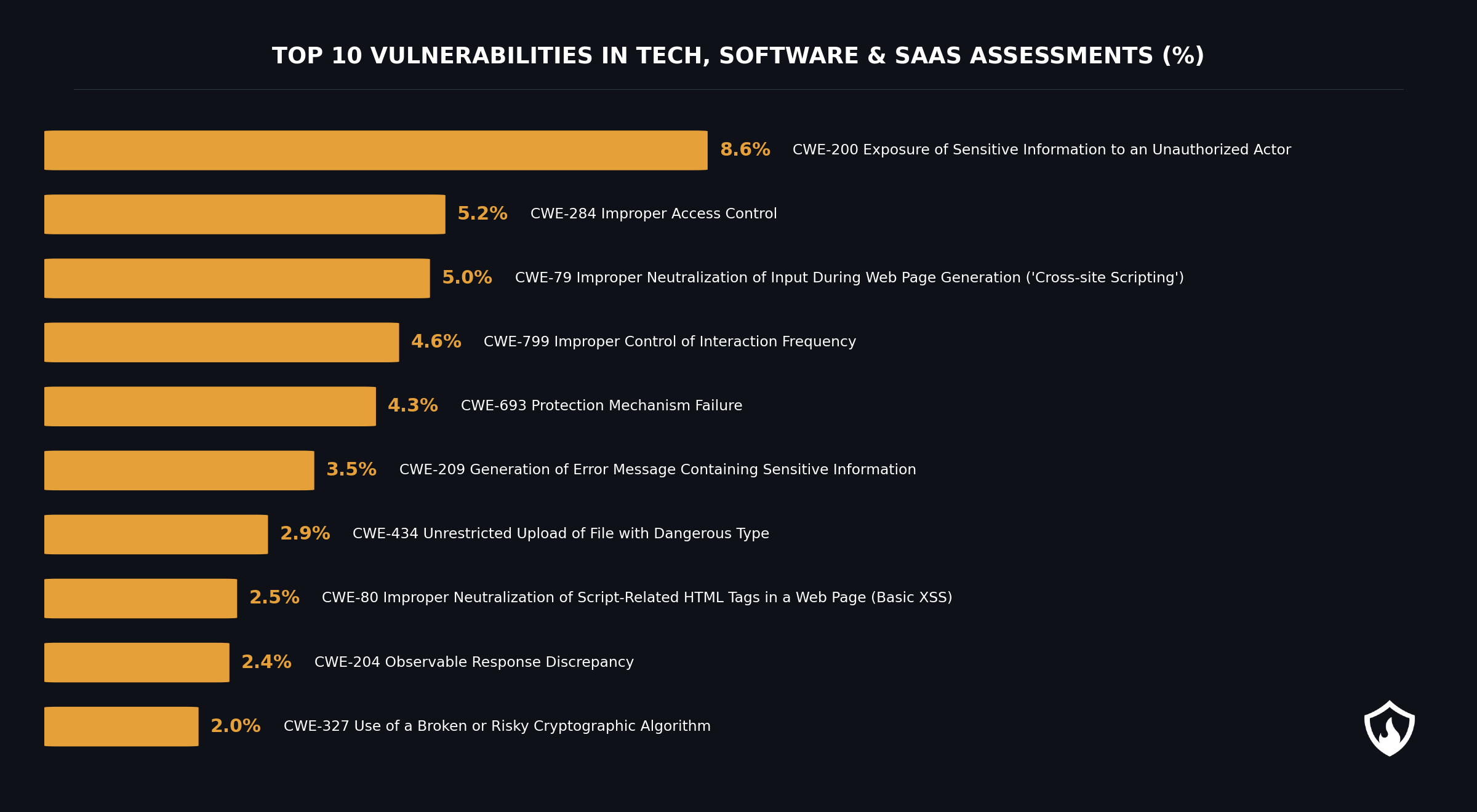
SaaS vulnerabilities vary by product, but the same patterns appear repeatedly in real assessments. The most serious findings are rarely isolated technical bugs. They usually involve broken assumptions about users, tenants, roles, APIs, cloud services, and internal workflows.
For a deeper breakdown of recurring issues we see in SaaS assessments, read our guide to common SaaS vulnerabilities found in penetration tests based on our security assessments of SaaS applications.
Broken access control
Broken access control is one of the most common and highest-impact SaaS findings. It includes users accessing objects, features, tenants, reports, files, exports, or admin functions they should not be able to reach. In SaaS products, broken access control often appears as IDOR, BOLA, missing tenant checks, weak role enforcement, or authorization applied only in the UI.
Tenant isolation failures
Tenant isolation failures occur when one customer can access or influence another customer’s data, configuration, files, reports, users, or workflows.
These vulnerabilities are especially serious because SaaS products are built around shared infrastructure, and one weak boundary can affect many customers.
APIs often expose the same business actions as the user interface, but with fewer guardrails. A role that cannot perform an action in the UI may still be able to call the underlying endpoint directly.
API authorization gaps commonly affect object access, admin actions, export functions, hidden endpoints, internal APIs, and legacy functionality.
Authentication and identity flaws
SaaS identity flows are complex. Issues may appear in SSO, OAuth, password reset, invitation logic, MFA, account linking, session handling, SCIM provisioning, and role mapping. A small mistake in identity logic can allow account takeover, unauthorized tenant access, or privilege escalation.
Cloud and storage misconfigurations
SaaS data often lives in cloud storage, managed databases, queues, logs, analytics systems, or backups. Weak storage permissions, overbroad IAM roles, exposed snapshots, or leaked secrets can bypass the application layer entirely.
Insecure admin and support workflows
Internal tools can create serious risk when they allow support impersonation, customer data access, role changes, billing changes, or account recovery without sufficient controls, logging, approval, or segmentation.
Business logic abuse
Business logic flaws occur when attackers abuse intended functionality in unintended ways. In SaaS products, these often affect billing, subscriptions, exports, integrations, approvals, invitations, and workflow state transitions.
SaaS penetration testing for SOC 2 and enterprise security reviews
Many SaaS companies first request penetration testing because of SOC 2, ISO 27001, enterprise procurement, vendor risk assessments, cyber insurance, or customer security reviews.
That is understandable. Buyers want evidence that the product has been tested by an independent third party. Auditors and security reviewers often ask when the last penetration test was performed, what was in scope, what was found, and whether findings were remediated.
SOC 2 does not universally require penetration testing for every company. However, many auditors and enterprise customers expect evidence that relevant security controls have been tested. For SaaS companies, a recent pentest report is often one of the clearest ways to support that conversation.
The important point is that regulatory compliance should not define the entire scope by itself. A SaaS pentest should cover the systems that actually store, process, transmit, or provide access to customer data. That may include the web application, APIs, cloud infrastructure, external assets, authentication flows, admin tooling, integrations, and tenant-isolation controls.
A narrow test may satisfy a checkbox but still miss the risk that an enterprise customer actually cares about.
Black box, gray box, or white box for SaaS pentesting?
Most SaaS penetration tests are strongest as gray box or white box assessments.
Black box testing can show what an unauthenticated external attacker can discover, but it usually provides limited coverage for SaaS products because the most important risks appear after login and across user roles, tenants, APIs, and workflows.
Gray box testing is the most common model. The testing team receives test accounts, user roles, limited documentation, API details, and enough context to test realistic authenticated scenarios. This is usually the best balance between realism, efficiency, and depth.
White box testing gives security engineers deeper access to architecture diagrams, source code, infrastructure details, API documentation, cloud configuration context, and full test environments. It is useful when the goal is maximum depth, complex authorization review, or high-assurance testing before enterprise adoption, funding, or major release.
For SaaS companies, the key is not the label. The key is whether pentesters have enough access and context to test tenant boundaries, role permissions, API authorization, SSO flows, admin tooling, and business logic properly.
How often should SaaS companies conduct penetration testing?
Most SaaS companies should perform penetration testing at least annually, especially when SOC 2, ISO 27001, enterprise customer reviews, or cyber insurance are part of the business context.
But annual testing is a baseline, not a complete strategy for actively developed products.
SaaS companies should consider additional testing after major releases, authentication or authorization changes, new APIs, new integrations, cloud architecture changes, tenant model changes, admin/support tooling changes, major infrastructure migrations, security incidents, or before important enterprise procurement cycles.
High-growth SaaS companies, fintech platforms, healthtech products, AI-enabled SaaS, and companies handling sensitive customer data may benefit from more frequent targeted testing or a PTaaS model.
The right SaaS pentesting frequency should follow product velocity and business risk. A company shipping every week should not rely solely on a once-a-year assessment to validate its most important attack surfaces.
How to prepare for a SaaS penetration test
Good preparation makes a SaaS pentest more effective. The goal is not to overwhelm the pentesting team with every internal document. The goal is to provide enough context so pentesters can focus on validating meaningful attack paths rather than reconstructing the product from scratch.
Before the engagement, prepare the application URL, test environment details, user roles, tenant structure, test accounts, API documentation, OpenAPI or Swagger files, Postman collections, authentication flows, SSO or OAuth details, architecture diagrams, cloud components in scope, admin/support workflows, integrations, webhook documentation, data sensitivity notes, production safety constraints, and escalation contacts.
If tenant isolation is in scope, provide at least two test tenants with multiple user roles. If API testing is in scope, provide working authentication and example requests. If cloud infrastructure is in scope, provide architecture context and define what testing is allowed in production. If admin tooling is in scope, define what actions pentesters may perform and how activity will be monitored.
How to choose a SaaS penetration testing provider
SaaS pentesting requires more than generic web application testing experience. A strong SaaS pentest provider should understand multi-tenant architecture, API authorization, cloud infrastructure, SSO and OAuth, business logic, admin/support tooling, integrations, SOC 2 expectations, and remediation workflows. They should be able to test authenticated user journeys, reason about tenant boundaries, validate impact, and explain findings in a way that engineering, security, and business stakeholders can act on.
Ask potential providers how they test tenant isolation, how they approach API authorization, whether they can assess cloud components, how they handle retesting, if they provide detailed reports, and whether they can support customer assurance or compliance-driven timelines.
The best SaaS pentest provider is not the one that promises the broadest scan. It is the one that understands where SaaS risk actually lives. For a thorough guide to choosing a penetration testing provider, read our article on the subject.
Conclusion
SaaS penetration testing is not just about finding web application vulnerabilities. It is about testing the full product attack surface: web application, APIs, tenant boundaries, cloud infrastructure, identity flows, integrations, admin tooling, and business logic.
That is where the highest-impact SaaS risks usually live. Not in one isolated endpoint or one missing patch, but in the way systems, roles, services, and workflows trust each other.
For SaaS companies preparing for SOC 2, selling to enterprise customers, handling sensitive data, or releasing new features quickly, penetration testing should be scoped around real attack paths and customer data exposure, not just a checklist.
FAQ
What does a SaaS penetration test cover?
A SaaS penetration test typically covers the web application, APIs, tenant isolation, authentication, authorization, SSO/OAuth flows, admin and support tooling, cloud infrastructure, storage, integrations, webhooks, and business logic. The exact scope depends on the product architecture and customer data flows.
How is SaaS penetration testing different from a standard web application pentest?
A standard web application pentest focuses mainly on the browser-based application. SaaS penetration testing looks at the product as a connected system, including APIs, tenant boundaries, cloud services, identity flows, integrations, admin tooling, and customer data paths.
Do SaaS companies need API penetration testing?
Usually, yes. APIs are often the main attack surface for SaaS platforms. They power the web interface, mobile apps, integrations, internal services, and automation. API authorization flaws can expose customer data even when the user interface appears secure.
How often should a SaaS company perform penetration testing?
At a minimum, many SaaS companies test annually for compliance and customer assurance. Actively developed SaaS products should also test after major releases, authentication or authorization changes, new APIs, new integrations, cloud architecture changes, or significant security incidents.
Is vulnerability scanning enough for SaaS security?
No. Vulnerability scanning is useful for identifying known issues, exposed services, outdated software, and common misconfigurations. It does not replace manual penetration testing, especially for SaaS risks such as tenant isolation, API authorization, business logic, SSO flows, and workflow abuse.