


Determining the ideal SaaS and fintech pentest frequency is a recurring challenge for many organizations, especially mid-market ones. Compared to early-stage startups, they usually manage larger and more complex environments and handle more sensitive data. At the same time, they often lack the dedicated security resources and program maturity found in large enterprises. For these organizations, relying solely on the “annual check-the-box” approach to penetration testing is insufficient.
This guide is for professionals such as Chief Information Security Officers (CISOs), Compliance Managers, and Engineering Leaders, who operate within the dynamic environments of mid-market Software-as-a-Service (SaaS) and Financial Technology (Fintech) companies. It goes beyond minimum compliance to establish a strategic framework for security testing frequency, answering the critical question: how often should we do penetration testing?
Why Pentesting Frequency Matters
The core issue with infrequent penetration testing is the concept of Security Drift. In a modern, agile development environment, code is deployed multiple times a day, new APIs are integrated weekly, and significant infrastructure changes are constant. A comprehensive pentest provides a high-fidelity snapshot of security posture at a single point in time.
However, the moment the report is delivered, the environment begins to change. The gap between the tested state and the live production state – the Security Drift – grows rapidly. For organizations with high deployment velocity, this drift can introduce critical, exploitable vulnerabilities within weeks or even days. This way, infrequent security testing can provide a false sense of security, leaving a significant window of exposure that adversaries are keen to exploit.
The relevance of frequent testing is also amplified in regulated and risk-sensitive environments. SaaS providers handling sensitive customer data and fintech organizations processing financial transactions are often expected to demonstrate not only that tests are performed, but that they are conducted in a manner proportional to risk and change.
Factors That Influence SaaS and Fintech Pen Testing Frequency
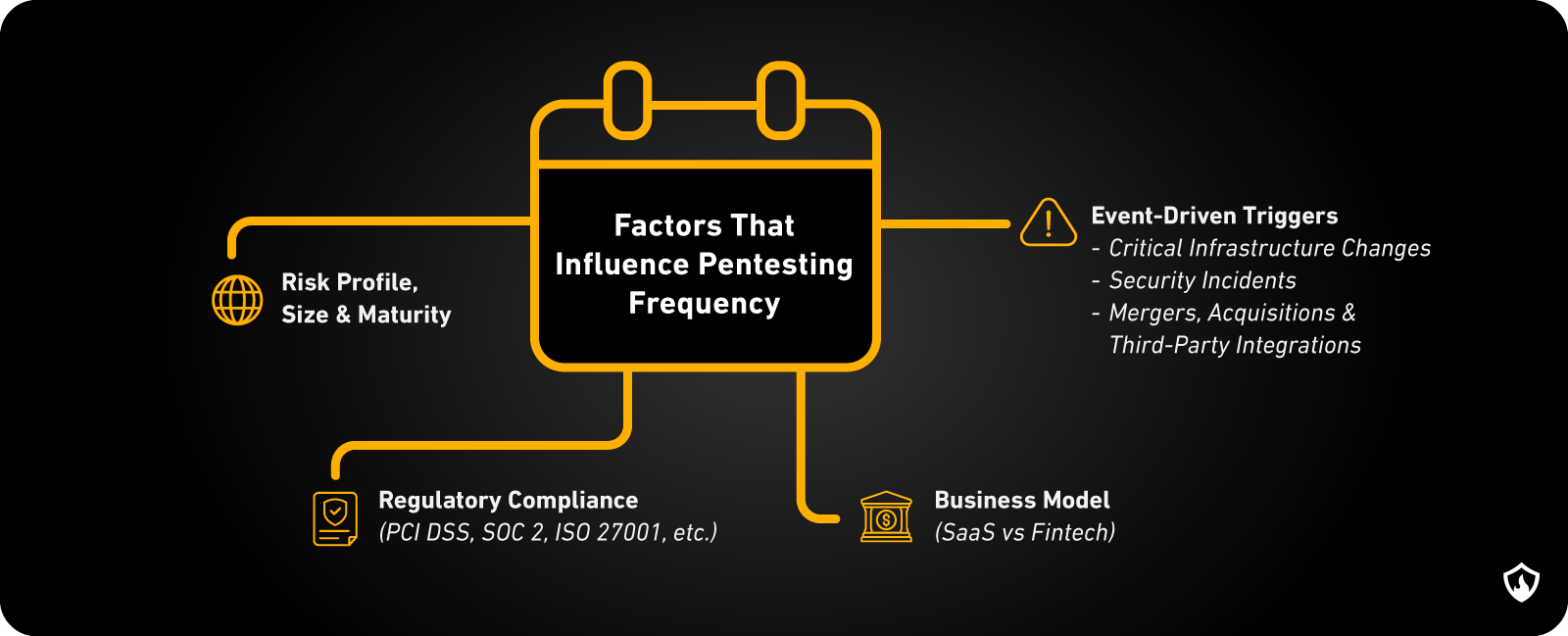
Risk Profile, Size, and Maturity of the Organization
An organization’s risk profile is one of the primary drivers of how often penetration testing is required. This includes the sensitivity of the data being processed, the potential impact of a security failure, and the attractiveness of the organization’s systems to external attackers. Mid-market organizations often operate systems that are business-critical and externally accessible.
The size of the organization also affects the recommended penetration testing frequency, but not in a linear way. As organizations grow, systems tend to become more complex, with multiple applications, services, and environments in scope. Increased complexity can introduce new attack paths and dependencies that warrant more frequent pen testing. At the same time, size alone does not determine maturity: smaller teams may have strong security practices.
Security maturity is another factor that influences the ideal pentest frequency. Organizations with established secure development practices, automated testing, and continuous security monitoring may be better positioned to target penetration testing around high-risk changes. Less mature programs may require more regular testing to compensate for gaps in preventive and detective controls.
Regulatory Compliance
Frameworks and standards such as PCI DSS, SOC 2, and ISO 27001 reference penetration testing as part of security assurance, often establishing minimum expectations around pen testing frequency or triggering conditions.
However, compliance requirements are typically designed to define a baseline rather than an optimal security testing strategy. Some organizations interpret these requirements as a fixed schedule, such as annual pen testing, even when documentation emphasizes risk-based approaches.
| Framework | Sector | Requirements | Minimum Frequency |
| PCI DSS | Fintech, Retail, E-commerce (Card Data Processors) | Requires penetration testing of network and applications | Annually and after any significant change |
| DORA (EU) | Financial entities operating in the EU | Requires periodic security testing and advanced testing for critical entities | Varies by entity type. Threat-Led Penetration Testing (TLPT) at least every 3 years |
| SOC 2 | SaaS companies, tech providers and cloud-based service providers | Requires frequent security assessments (usually pentesting) | At least annual testing or after major system changes |
| FCA (UK) | Fintech, Banking and Insurance in the UK | Expects firms to conduct risk-based and regular penetration tests | Risk-based (often quarterly/ bi-annually) |
| ISO 27001 | Organizations in highly regulated, data-sensitive industries (SaaS, Fintech, healthcare, etc.) | Requires organizations to identify and treat risks | Annual security testings (minimum) |
| GDPR | Any organization handling EU residents’ personal data | Requires appropriate technical and organizational measures to ensure data security (usually penetration testing) | Not explicitly defined (risk-based) |
| NIST cybersecurity framework (CSF) | Cross-sector (U.S. critical infrastructure, government contractors and voluntary adopters) | Demands a structured, risk-based approach to identify, protect, detect, respond and recover from threats | Recommended annually |
Business Model: SaaS vs. Fintech
The underlying business model influences both the nature of security risks and the appropriate frequency of penetration testing.
SaaS platforms are often characterized by frequent feature releases, multi-tenant architectures, and extensive use of APIs and third-party integrations. These can lead to a continuously evolving attack surface, where changes in application logic or access controls may introduce new vulnerabilities. In such environments, penetration testing frequency depends on the rate of meaningful change.
Fintech organizations, by contrast, usually operate systems that process sensitive financial data and are subject to heightened regulatory oversight. The potential impact of security failures is often high, and dependencies on external providers such as payment processors or identity services can expand the threat landscape. As a result, fintech penetration testing practices often emphasize both regular validation and additional testing around high-risk changes or integrations.
Event-Driven Triggers: When to Test Outside the Schedule
In addition to scheduled testing, certain events can change an organization’s risk exposure and justify additional, non-scheduled pen testing.
Critical Infrastructure Changes
Any major infrastructure changes that could introduce new vulnerabilities require immediate testing. This includes:
• Major Architectural Shifts: Migrating from a monolithic application to microservices, or moving from on-premise to a multi-cloud environment.
• New Critical Components: Implementing a new payment gateway, a new identity provider (IdP), or a new third-party API integration.
• Significant Upgrades: Major operating system or database version upgrades, or changes to firewall rules and network segmentation.
Security Incidents
Security incidents, near-misses, or the discovery of critical vulnerabilities may indicate that existing controls did not function as expected. Conducting pen testing after remediation helps to validate that weaknesses have been adequately addressed and that similar issues are not present elsewhere in the environment. This approach supports learning and improvement rather than attributing fault.
Mergers, Acquisitions, and Third-Party Integrations
M&A and new third-party integrations often introduce inherited risk and expand trust boundaries. Systems developed under different security assumptions or governance models may expose vulnerabilities that are not visible through internal processes alone. Penetration testing can provide an independent assessment of these newly introduced components and their interaction with existing systems.
The Ideal Pentesting Frequency for Your Mid-Market Organization
Determining an appropriate penetration testing cadence requires translating risk factors into operational decisions. While SaaS and fintech organizations share some common considerations, their business models lead to different drivers for how security testing frequency is typically determined.
SaaS Pentest Frequency
For mid-market SaaS companies, penetration testing frequency is closely linked to the pace and nature of change. In this context, relying solely on infrequent, time-based testing can leave gaps between meaningful changes and independent security validation.
For a typical mid-market SaaS company with a high deployment velocity and a multi-tenant architecture, the following layered approach is recommended:
| Frequency | Rationale | |
| Comprehensive Application Pentest | Bi-annually | Satisfies SOC 2 auditor expectations and provides a full-scope review of the entire application |
| Targeted API/Feature Pentest | Quarterly | Focuses on new, high-risk features, critical API endpoints, and multi-tenancy separation logic. Aligns with quarterly business objectives. |
| Continuous Pen Testing | Daily/Weekly | Automated DAST/SAST tools integrated into the CI/CD pipeline, supplemented by bug bounty programs for continuous, low-cost feedback. |
| Event-Driven Testing | As Needed | Mandatory after major architectural changes or the discovery of a critical zero-day vulnerability. |
Fintech Pentest Frequency
In fintech environments, determining penetration testing frequency is influenced by both technical risk and regulatory expectations. As a result, fintech organizations typically adopt a more structured approach to testing cadence.
A regular baseline penetration test is commonly used to demonstrate ongoing assurance, particularly for systems in scope for regulatory or compliance requirements. Beyond this baseline, additional security assessments are often driven by events that increase exposure.
| Frequency | Rationale | |
| External/Internal Network Pentest | Annually | Meets the minimum requirement for PCI DSS and ISO 27001. |
| Web/Mobile Application Pentest | Quarterly | Addresses the high-risk nature of customer-facing applications and aligns with best practices for regulated entities (FCA guidance). |
| TLPT (Threat-Led Pentest) | Every 3 Years | Meets the DORA requirement for advanced testing, simulating a real-world attack scenario against critical functions. |
| Event-Driven Testing | As Needed | Mandatory after any change to the Cardholder Data Environment (CDE) or critical payment systems (PCI DSS 11.4.3). |
These frequencies should be understood as practical reference points rather than universal requirements. Most compliance frameworks allow organizations to adjust how often they conduct pentests based on risk, system criticality, and the rate of change in the environment.
Some high-risk industries also require more frequent testing. To address this, they pursue continuous penetration testing, commonly delivered through Penetration Testing as a Service (PTaaS) platforms. Decisions about whether to adopt continuous testing should be rooted in risk, context, and the ability to act effectively on findings, rather than treating PTaaS as a universal replacement for scheduled tests.
Common Misconceptions About Pentesting Frequency
“Compliance Equals Security”
Compliance frameworks define a baseline of security controls. Meeting these requirements means you are compliant, but not necessarily secure. An organization that only conducts pentests annually to meet PCI DSS, but deploys code daily, is compliant but highly insecure due to the massive Security Drift.
“More frequent penetration testing always results in better security”
Increasing the frequency of security assessments does not automatically improve security outcomes. Without meaningful changes between tests, repeated assessments may produce diminishing returns.
“Automated scanning replaces penetration testing”
Automated scanning plays an important role in identifying known weaknesses, but it does not replicate the adversarial techniques used in penetration testing. A scanner cannot exploit a complex business logic flaw, chain multiple low-risk vulnerabilities, or bypass sophisticated authentication mechanisms. The two serve complementary purposes and are not interchangeable when determining testing cadence.
Conclusion
For mid-market SaaS and Fintech organizations, the question is not simply “How often should we conduct security testing?” but “How often does our risk profile and deployment velocity require pentesting?”
Ultimately, an effective penetration testing strategy is one that can be explained and justified. Organizations should be able to demonstrate why security testing occurs at a given frequency, how that cadence aligns with their risk profile, and how it adapts as systems and cyber threats evolve.
Frequently Asked Questions
Is annual penetration testing enough?
Annual security assessments may be sufficient to meet minimum compliance expectations, but it is not always adequate for managing risk. In environments where systems change frequently or where sensitive data is processed, relying solely on annual testing can leave extended periods without independent security validation. In such cases, additional event-driven testing is commonly warranted.
What events should trigger additional penetration testing?
Additional security testing is commonly triggered by events that materially change risk exposure. These may include major application or infrastructure changes, the introduction of new externally exposed features, significant vulnerability findings, security incidents, mergers or acquisitions, and new integrations with third-party providers.
Does automated scanning replace pentesting?
No. Automated vulnerability scanners identify known vulnerabilities and are crucial for continuous monitoring. Traditional penetration testing uses human expertise to find complex business logic flaws and chain vulnerabilities that automated tools miss. They are complementary parts of a comprehensive security program.
What is the difference between a pentest and a Red Team exercise in terms of frequency?
A Penetration Test is typically scheduled (annual/quarterly) and has a defined scope (e.g., a specific application). A Red Team Exercise is less frequent (e.g., every 1-3 years, as mandated by DORA TLPT) and is a full-scope, goal-oriented simulation of a real-world attack against the entire organization, designed to test people, processes, and technology.
How should organizations justify their penetration testing frequency?
Organizations should document how pen testing frequency aligns with their risk profile, system criticality, regulatory obligations, and rate of change. Clear justification is particularly important during audits or regulatory reviews.