


Cloud penetration testing is an authorized security assessment that uses tools and techniques real-world attackers would use against cloud environments such as AWS, Microsoft Azure, and Google Cloud. It tests whether weaknesses in IAM, storage, compute, Kubernetes, serverless functions, APIs, logging, and cloud configurations can be exploited to access data, escalate privileges, or move across the environment.
As organizations move more applications, workloads, and data to the cloud, these risks become harder to manage. Misconfigured cloud services, exposed storage, excessive permissions, insecure APIs, and weak access controls can create paths for attackers to access sensitive data or disrupt business operations, especially as teams adopt multiple cloud providers and continuously deploy new services.
This guide explains what cloud penetration testing covers, how it differs from other types of penetration testing, how AWS, Azure, and Google Cloud testing rules apply, how to prepare for an assessment, and what buyers should expect from the testing process. It also contains insights from Blaze’s 2025 penetration testing data, where cloud security assessments showed the highest average number of vulnerabilities per project.
What Is Cloud Penetration Testing and Why Is It Important?
Cloud penetration testing is an authorized technical assessment of cloud-hosted infrastructure, cloud applications, identities, services, and configurations. Its goal is to identify vulnerabilities that attackers could exploit and help organizations strengthen their cloud defenses before an incident occurs. In practice, it usually examines three layers: the control plane, where cloud resources are managed; the identity plane, where permissions and trust relationships are enforced; and the workload layer, where applications, containers, functions, databases, and APIs run.
This type of pentesting is especially important because cloud risk is often configuration-driven. A storage bucket may be publicly accessible, an IAM policy may grant broader permissions than intended, or a workload may be exposed to the internet without adequate controls. In isolation, these issues may look like simple misconfigurations. In practice, they can become attack paths that allow access to sensitive data, privilege escalation, or lateral movement across the environment.
Cloud penetration testing also helps organizations move beyond automated scanning. Cloud Security Posture Management tools can identify issues such as public S3 buckets, misconfigured security groups, and exposed databases. However, cloud environments are often highly complex, and human expertise is needed to understand context, link weaknesses, and determine whether a finding poses meaningful business risk.
Another important factor is the shared responsibility model. The cloud service provider secures the underlying platform, but customers are responsible for securing the cloud resources, applications, identities, and data they deploy. In other words, the shared responsibility model determines which security measures belong to the provider and which ones the customer must test, configure, and maintain.
Cloud environments change quickly, and new services, permissions, integrations, or deployments can introduce security gaps not present in a previous assessment. Regular testing helps organizations maintain robust security measures and reduce the likelihood of security incidents.
Cloud Penetration Testing vs Cloud Security Review
Cloud penetration tests and cloud security reviews are closely related, but they answer different security questions.
A cloud security review focuses on whether the cloud environment is configured securely. It assesses cloud architecture, IAM, storage permissions, logging, encryption, network exposure, secrets management, and alignment with cloud security best practices. For instance, our Cloud Security Review service reviews cloud configurations across AWS, Azure, and Google Cloud. It performs security and permission checks on elements such as S3 buckets, IAM, Security Groups, and other provider-specific resources.
A cloud penetration test is more adversarial. Instead of only checking whether cloud resources are configured according to best practices, it validates whether weaknesses can be exploited and what impact they could have. Cloud Penetration Testing services assess the attack surface, review the service architecture, analyze services and configuration files, identify misconfigurations and security issues, and provide remediation advice.
In practical terms, a cloud security review may identify an overly permissive IAM role, a public storage bucket, or insufficient logging. A cloud penetration test may go further by assessing whether that IAM role can be abused to escalate privileges, whether exposed storage can lead to access to sensitive data, or whether multiple misconfigurations can be chained into a realistic attack path.
| Cloud Security Review | Cloud Penetration Test | |
|---|---|---|
| Main question | Is the cloud environment configured securely? | Can weaknesses be exploited, and what impact would they have? |
| Primary focus | Architecture, configuration, governance, permissions, logging, encryption, and cloud security best practices. | Attack surface, exploitable misconfigurations, privilege escalation, lateral movement, and realistic attack paths. |
| Typical scope | IAM, EC2, S3, Cognito, RDS, Lambda, VPC networking, CloudTrail, CloudWatch, KMS, Secrets Manager, ECR, ECS, EKS, and provider-specific resources. | IAM, EC2, S3, RDS, Lambda, EKS, API Gateway, Cognito, VPC, exposed services, cloud-hosted applications, and cloud attack paths. |
| Testing approach | Mix of automated and manual review against best practices, benchmarks, and configuration standards. | Manual adversarial testing supported by tools, designed to validate exploitability and chain findings into realistic attack scenarios. |
| Example finding | An IAM role is overly permissive, an S3 bucket policy is too broad, or CloudTrail logging is incomplete. | The IAM role can be abused for privilege escalation; S3 policy abuse enables access to sensitive data; and metadata service exposure can lead to an instance role compromise. |
| Typical duration | 3 to 5 person-days per cloud account, depending on complexity and scope. | 7 to 25 person-days, depending on account count, region count, and service surface. |
| Best fit | Organizations that want to improve cloud configuration, governance, compliance readiness, and baseline security posture. | Organizations that want to understand how an attacker could exploit cloud weaknesses and what business impact those attack paths create. |
In AWS environments, this distinction is especially clear. A configuration review may examine IAM, EC2, S3, RDS, Lambda, VPC networking, CloudTrail, CloudWatch, KMS, Secrets Manager, ECR, ECS, and EKS against security best practices and benchmarks. A penetration test may then validate whether issues such as over-permissive policies, instance metadata exposure, S3 bucket policy abuse, Lambda permission flaws, or EKS misconfigurations are actually exploitable.
Many organizations can benefit from combining both approaches, especially cloud-native companies, where the right assessment may involve cloud penetration testing, cloud security review, or both, depending on the architecture and risk profile. Many buyers also compare cloud penetration testing with CSPM (Cloud Security Posture Management) tools and vulnerability scans. These can all support a cloud security program, but they answer different questions:
| Assessment type | What it does | What it misses |
| CSPM | Continuously checks cloud configurations against policies, benchmarks, and best practices. | Does not fully validate exploitability, privilege escalation, or chained attack paths. |
| Vulnerability scan | Finds known CVEs, outdated software, exposed services, and weak configurations. | Often misses IAM abuse, business logic, cloud-native privilege escalation, and multi-step attack paths. |
| Cloud security review | Reviews architecture, configuration, IAM, logging, encryption, governance, and cloud security best practices. | May stop short of adversarial exploitation or impact validation. |
| Cloud penetration test | Simulates real attack paths and validates what an attacker could actually do. | Usually point-in-time unless paired with continuous monitoring or recurring testing. |
When Do Companies Need a Cloud Penetration Test?
Companies usually need a cloud penetration test to validate whether cloud weaknesses can be exploited in practice, not just whether their environment passes a configuration check. Common triggers include major cloud changes, compliance requirements, customer security expectations, and concerns about identity, access, or data exposure.
A cloud penetration test is especially useful:
- before SOC 2, ISO 27001, PCI DSS, HIPAA, or customer security reviews;
- after migrating workloads to AWS, Azure, Google Cloud, or another cloud provider;
- after creating new cloud accounts, subscriptions, projects, or production environments;
- after IAM redesigns, SSO changes, Entra ID changes, or service account changes;
- before launching a SaaS product, customer-facing application, API, or major feature;
- after adopting Kubernetes, serverless, CI/CD-heavy deployment workflows, or infrastructure-as-code;
- after a security incident, suspected credential exposure, or discovery of exposed cloud assets;
- before M&A due diligence, enterprise procurement reviews, or vendor risk assessments.
Preparing for a Cloud Penetration Test
Preparation for cloud penetration testing is essential to ensure the assessment is thorough, safe, and aligned with the organization’s cloud architecture and business priorities. Here are the main steps to prepare for a cloud penetration test:
- Sign NDAs and confirm authorization: Establish the required legal agreements and written approval before testing begins.
- Define the pentest scope: Specify which cloud providers, accounts, subscriptions, projects, regions, cloud services, applications, and workloads will be tested. Clearly state what is out of scope, such as third-party systems, production databases, or critical assets with strict availability requirements.
- Provide documentation and access details: Share architecture diagrams, asset inventories, IAM structures, data flows, and access credentials or dedicated testing roles when applicable.
- Ensure test environment readiness: If testing will take place outside production, confirm that the test environment reflects the real cloud infrastructure, configurations, permissions, data flows, and security controls as closely as possible.
- Share cloud-specific information: Provide relevant details about the cloud platforms and technologies in use, such as AWS, Microsoft Azure, Google Cloud, Kubernetes, serverless functions, CI/CD pipelines, container registries, APIs, and logging tools.
- Highlight sensitive areas and known limitations: Inform testers about systems that require extra care, such as customer databases, payment environments, authentication services, administrative consoles, regulated data stores, or critical systems that cannot tolerate disruption.
- Establish communication channels: Set up a clear communication process for questions, alerts, emergency escalation, and progress updates during testing, since cloud penetration testing may trigger alerts in monitoring or security systems.
- Conduct at minimum gray-box testing: In cloud environments, gray-box or white-box penetration testing is often more effective than black-box penetration testing. Providing controlled access and partial system knowledge helps testers evaluate identity and access management, permissions, configurations, and realistic attack paths more effectively.
Cloud Penetration Testing for AWS, Azure, and GCP
Cloud penetration testing should be adapted to the cloud platforms in scope. AWS, Microsoft Azure, and Google Cloud share many security concepts, but each provider has its own identity model, terminology, services, logging capabilities, and rules for security testing. Other cloud platforms, such as Oracle Cloud, IBM Cloud, and DigitalOcean, may also be in scope depending on the organization’s architecture.
Before testing begins, organizations should confirm that the planned activities comply with the relevant cloud service provider policies. AWS allows customers to perform security assessments or penetration tests on permitted AWS services without prior approval; Microsoft publishes rules of engagement for security testing against Microsoft Online Assets; and Google Cloud requires tests to affect only the customer’s own projects and to comply with its policies.
AWS Penetration Testing
AWS penetration testing often focuses on how services, identities, and permissions interact across the environment. Common areas of review include IAM users, roles, policies, trust relationships, S3 buckets, EC2 instances, security groups, Lambda functions, RDS databases, EKS clusters, KMS keys, and logging through services such as CloudTrail.
In AWS environments, identity and access management is usually one of the most important areas to assess. Testing IAM roles, permissions, and policies identifies excessive privileges or potential paths to privilege escalation, which are critical in cloud attacks.
Azure Penetration Testing
Azure penetration testing should account for the close relationship between Azure resources and Microsoft identity services. Important areas include Microsoft Entra ID, subscriptions, resource groups, RBAC assignments, managed identities, service principals, Azure Storage, Key Vault, App Services, Azure Functions, AKS, and Microsoft Defender for Cloud.
Because Azure environments often rely heavily on identity, testers should review privilege assignments, conditional access assumptions, administrative roles, application registrations, and managed identities.
GCP Penetration Testing
GCP penetration testing should reflect Google Cloud’s resource hierarchy and service account model. Common areas of review include organizations, folders, projects, IAM roles, service accounts, Cloud Storage buckets, Compute Engine instances, Cloud Functions, Cloud Run, GKE clusters, Cloud SQL, organization policies, and audit logging.
In Google Cloud, service accounts and project-level permissions are especially important. Overly broad IAM roles, exposed service account keys, or weak separation between projects can create paths for privilege escalation or unauthorized access to cloud resources.
Cloud Penetration Testing Methodology
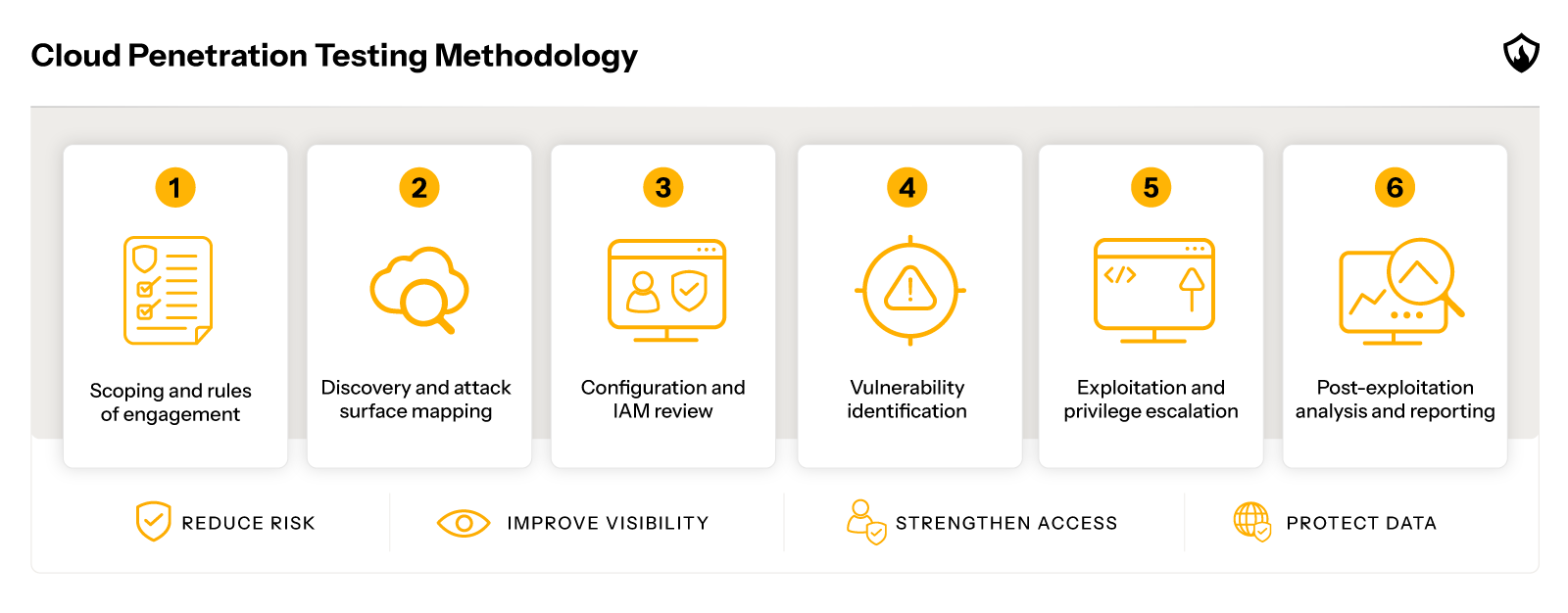
AWS penetration testing services should establish methodologies and frameworks, including the Penetration Testing Execution Standard (PTES), OSSTMM, NIST SP 800-115, the AWS Well-Architected Security Pillar, the CIS AWS Foundations Benchmark, and the MITRE ATT&CK Cloud matrix. For cloud environments, these testing methods are adapted to account for cloud architecture, identity and access management, provider rules, and dynamic cloud resources.
- Scoping and rules of engagement: Define the cloud providers, accounts, subscriptions, projects, regions, services, applications, workloads, testing windows, restricted actions, escalation contacts, and provider-specific rules.
- Discovery and attack surface mapping: Map the assets that could be targeted by an attacker, including exposed services, storage buckets, APIs, virtual machines, containers, Kubernetes clusters, serverless functions, databases, CI/CD systems, identity relationships, and internet-facing endpoints. Cloud pentests should include attack surface assessment, service architecture review, and analysis of services and configuration files.
- Configuration and IAM review: Review IAM roles, users, groups, policies, trust relationships, service accounts, managed identities, public access settings, encryption, logging, network rules, and cloud guardrails. This may include testing over-permissive policies, role chaining, IAM Access Analyzer gaps, condition-key bypasses, AssumeRole abuse, and attribute-based access control flaws.
- Vulnerability identification: Look for security gaps, potential vulnerabilities, and exploitable vulnerabilities across cloud systems. This phase includes testing the in-scope cloud services, such as EC2, S3, RDS, Lambda, EKS, ECS, ECR, Cognito, API Gateway, VPC networking, KMS, Secrets Manager, CloudTrail, GuardDuty, Config, and Security Hub.
- Exploitation and privilege escalation: Safely validate whether identified vulnerabilities can be exploited in real-world attack scenarios. This may involve testing IAM privilege escalation paths, instance metadata abuse, leaked credentials, insecure resource policies, exposed services, cross-account access, or lateral movement between cloud resources.
- Post-exploitation analysis and reporting: Document the scope, methodology, findings, evidence, affected cloud resources, attack scenarios, business impact, remediation steps, and retesting recommendations. Penetration testing deliverables typically include an executive summary, vulnerability descriptions, attack demonstrations, remediation guidance, a prioritization matrix, framework mapping, and free retesting within the defined period.
What a Real Cloud Penetration Test Should Validate
A real cloud penetration test should do more than list misconfigurations. It should validate whether weaknesses can be exploited, chained, and translated into business risk. In practice, this means answering questions such as:
- Can an exposed service lead to access to cloud credentials?
- Can a compromised IAM role, service account, or managed identity escalate privileges?
- Can one AWS account, Azure subscription, or GCP project be used to reach another?
- Can storage permissions expose sensitive data or critical business information?
- Can CI/CD secrets be abused to deploy code, access cloud resources, or modify infrastructure?
- Can Kubernetes, containers, or serverless workloads expose credentials or sensitive runtime data?
- Do logging and alerting systems detect the simulated attack path?
- Can multiple medium-severity issues be chained into a high-impact scenario?
This is the difference between reporting that a control is misconfigured and demonstrating what that misconfiguration enables. For buyers, it is also one of the clearest ways to separate expert-led cloud penetration testing from scanner-driven assessments.
Cloud Penetration Testing Tools and Techniques
Cloud pen testing tools can help penetration testers map cloud assets, detect misconfigurations, identify exposed services, and validate security weaknesses more efficiently. However, the value of cloud vulnerability testing lies in combining automated scanning with manual analysis, cloud expertise, and realistic attack scenarios.
Common tools and techniques include:
- Cloud posture and configuration review: Tools such as Prowler, ScoutSuite, AWS Security Hub, AWS Config, and cloud-native posture tools can help identify misconfigurations, weak security settings, exposed resources, and compliance gaps. These findings still require manual validation to determine exploitability and business impact.
- IAM and privilege escalation analysis: Cloud penetration testers review role chaining, AssumeRole abuse, IAM policy weaknesses, condition-key bypasses, service account permissions, managed identities, and cross-account or cross-project access. Blaze’s AWS testing scope also includes AWS-specific privilege escalation paths cataloged in Pacu, CloudGoat, and CloudFox.
- Compute, metadata, and workload testing: For EC2 and similar compute services, testing may include metadata service exposure, IMDSv1 or IMDSv2 abuse paths, instance role access, AMI and snapshot exposure, unsafe user-data scripts, and network exposure.
- Storage, database, and secrets testing: Testers review S3 or equivalent storage policies, ACLs, presigned URL exposure, KMS key policies, database access, unencrypted snapshots, secrets in environment variables, and cloud access tokens in code, containers, or pipelines.
- Container, Kubernetes, and secrets testing tools: When cloud workloads include containers, Kubernetes, CI/CD pipelines, or serverless functions, testers may use tools for container runtime security, image scanning, secrets detection, and infrastructure-as-code review.
- Exploitation and validation frameworks: Tools such as Pacu, CloudFox, CloudGoat, Metasploit, and custom scripts can help validate whether misconfigurations are actually exploitable. The key is safe, scoped validation within the approved rules of engagement.
Tooling can identify many potential issues, but Blaze Information Security’s 2025 data shows why manual validation matters: cloud findings often cluster around permissioning, data exposure, and control enforcement, where context determines real risk.
What Blaze’s 2025 Data Shows About Common Cloud Security Findings
Blaze’s 2025 Annual Penetration Testing Review found that cloud security assessments had the highest average number of vulnerabilities per project: 14.40, despite representing a smaller share of the overall dataset. This does not mean every cloud environment is more vulnerable than every web, API, or infrastructure environment. Still, it does show that cloud assessments can reveal a high density of security gaps when identity, configuration, and permissions are tested in depth.
The most common cloud findings in the dataset were closely tied to permissioning and data exposure, including incorrect permissions, improper access control, privilege management issues, hard-coded credentials, missing authorization, and protection mechanism failures. This aligns with the cloud security guidance from the Cloud Security Alliance’s 2024 cloud threats report, which highlights risks such as identity and access management, insecure interfaces and APIs, misconfiguration, accidental data disclosure, limited visibility, and unauthenticated resource sharing.
Common cloud pentest findings include:
- Misconfigured IAM and excessive permissions: Overly broad roles, weak trust relationships, excessive privileges, and misconfigured service accounts can create privilege escalation paths or expose sensitive cloud resources.
- Exposed storage and sensitive data: Public buckets, exposed snapshots, overly permissive object policies, logs containing secrets, or misconfigured databases can lead to sensitive data exposure.
- Security controls that exist but are not consistently enforced: Logging, encryption, MFA, network restrictions, and policy controls may be present in some areas but missing or misapplied across accounts, projects, regions, or workloads.
- Hard-coded credentials and exposed secrets: API keys, service account credentials, cloud access tokens, and CI/CD secrets may appear in repositories, configuration files, container images, or deployment scripts.
- Insecure APIs and internet-exposed services: Public APIs, dashboards, databases, serverless functions, or management interfaces may lack proper authentication, authorization, rate limiting, or input validation.
- Weak cloud visibility and monitoring: Incomplete logging or alerting can prevent the security team from detecting credential abuse, privilege escalation, data access, or suspicious changes to cloud resources.
Regular cloud penetration testing helps validate whether these weaknesses are exploitable and which fixes will most improve the organization’s overall security posture.
What’s the Duration and Cost of a Cloud Penetration Test?
The duration and cost of a cloud penetration test depend on the size and complexity of the cloud environment. A small assessment may focus on a single cloud account or project. At the same time, a larger engagement may involve multiple AWS accounts, Azure subscriptions, GCP projects, regions, workloads, Kubernetes clusters, serverless functions, and CI/CD pipelines.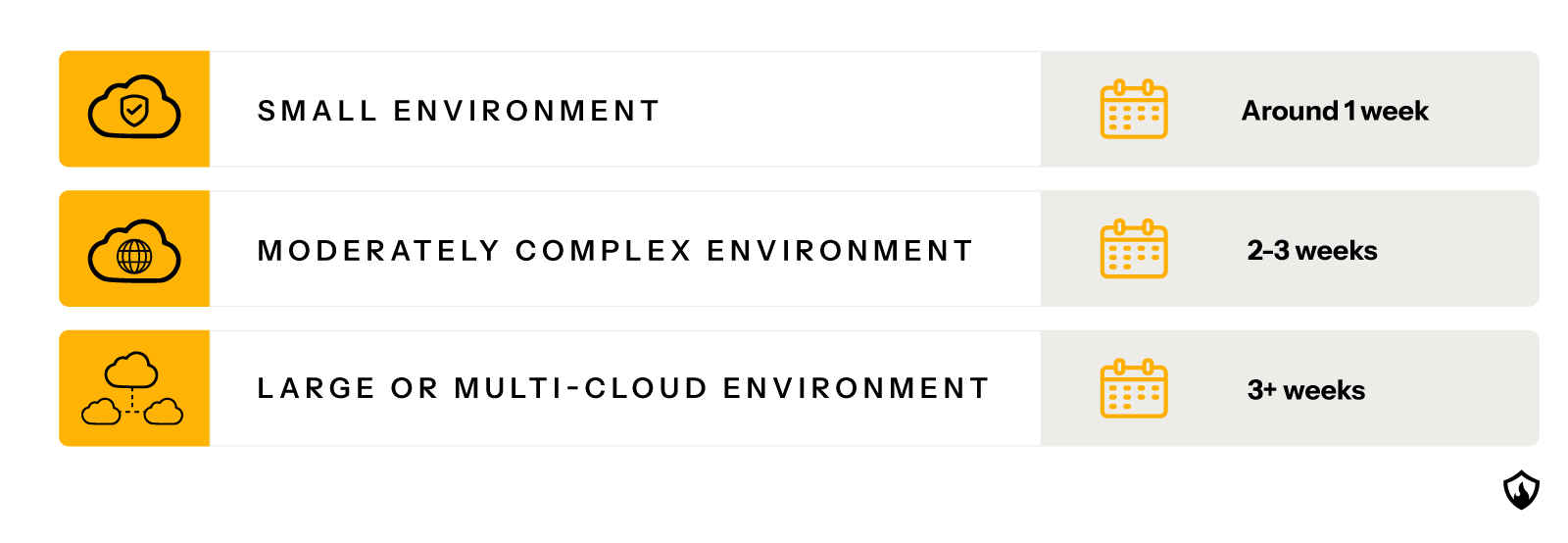
In Blaze’s AWS Marketplace listing, cloud engagements typically range from 7 to 25 person-days, depending on account count, region count, and service surface. For pricing, our penetration testing cost guide estimates cloud pentests at $10,000–$50,000, with larger or more complex cloud, internal network, product security, IoT, and red team engagements potentially ranging from $25,000 to $150,000+. These ranges are planning benchmarks, not fixed quotes, because final pricing depends on the exact scope and testing depth.
The main factors that influence duration and cost include:
- number of AWS accounts, Azure subscriptions, or GCP projects;
- number of regions and environments;
- IAM complexity;
- Kubernetes, serverless, CI/CD, and infrastructure-as-code scope;
- whether testing includes exploitation and privilege escalation;
- production testing constraints;
- compliance mapping, reporting depth, and retesting requirements.
For a deeper breakdown of pricing factors, see Blaze’s dedicated guide to Penetration Testing Cost.
What Can I Expect From a Cloud Penetration Test Assessment?
In a cloud assessment, you can typically expect:
- Initial consultation and scope definition: The team confirms the cloud providers, accounts, subscriptions, projects, regions, services, workloads, testing approach, and rules of engagement.
- Discovery and reconnaissance: Testers map cloud assets, exposed services, identities, storage, APIs, workloads, and trust relationships.
- Automated scanning and configuration checks: Cloud pen testing tools may identify potential misconfigurations, exposed services, weak settings, or known vulnerabilities, but results should be manually validated.
- Manual testing and exploitation: Penetration testers validate whether security weaknesses are exploitable in realistic attack scenarios, such as IAM abuse, privilege escalation, exposed data access, or lateral movement.
- Regular communication: The testing team provides updates, especially if they identify critical findings or encounter systems that require special handling.
- Comprehensive reporting: The final report documents scope, methodology, identified vulnerabilities, severity, affected cloud resources, evidence, business impact, and recommended fixes.
- Remediation guidance and retesting: The team explains the findings, helps prioritize remediation efforts, and validates fixes when retesting is included.
A good cloud penetration test helps the security team understand which weaknesses are exploitable, which cloud assets are most exposed, and which remediation steps will most improve the organization’s security posture.
How to Choose a Cloud Penetration Testing Provider
Choosing a cloud penetration testing provider requires more than checking whether a vendor offers AWS, Azure, or Google Cloud testing. Cloud environments are identity-driven, configuration-heavy, and highly dependent on provider-specific services, so the assessment should go beyond automated cloud posture checks or generic infrastructure testing. A qualified provider should be able to explain how they validate exploitability, not just how they identify misconfigurations.
Cloud-specific experience is especially important. Many meaningful cloud risks come from over-permissive roles, trust policies, service accounts, managed identities, cross-account access, Kubernetes configurations, serverless permissions, CI/CD secrets, and control-plane access. Relevant credentials and accreditations, such as CREST, can also help buyers distinguish experienced penetration testing providers from scanner-led services.
The rules of engagement also matter. A good provider should understand cloud service provider policies, production constraints, logging considerations, and how to test safely without disrupting critical workloads. They should provide clear deliverables, including evidence, exploit paths, business impact, remediation guidance, and retesting recommendations.
For buyers, the key question is simple: can the provider show how cloud weaknesses could be exploited in practice, or are they only reporting configuration issues? A real cloud penetration test should help your team prioritize the risks that create the most exposure, not just add another list of findings to the backlog.
FAQ
What is the difference between a cloud penetration test and a cloud security review?
A cloud security review checks whether cloud resources are configured securely against best practices, benchmarks, and governance requirements. A cloud penetration test goes further by validating whether weaknesses can be exploited, chained into attack paths, and translated into business impact.
Is cloud penetration testing allowed on AWS, Azure, and Google Cloud?
Yes, but only within each cloud service provider’s rules. AWS allows security assessments against permitted AWS services, Microsoft publishes security testing rules of engagement, and Google Cloud requires tests to affect only the customer’s own projects and comply with its policies.
Should cloud penetration testing be black-box, gray-box, or white-box?
Gray-box or white-box testing is usually best for cloud environments because IAM, resource policies, trust relationships, and logging configurations often require internal context.
Does cloud penetration testing include IAM privilege escalation?
Yes, when IAM is in scope. Testing should review roles, policies, service accounts, managed identities, trust relationships, and cross-account or cross-project permissions to identify excessive privileges and privilege escalation paths.
How often should cloud penetration testing be performed?
At least annually, and after major changes such as new cloud accounts, architecture changes, production launches, IAM redesigns, Kubernetes or serverless adoption, or compliance-driven changes.
Can automated cloud security tools replace cloud penetration testing?
Automated cloud security tools are improving quickly and are valuable for continuous monitoring, misconfiguration detection, IAM analysis, and cloud posture management. Some companies, such as OFFENSAI, are bringing interesting developments in this area, although they still cannot fully replace manual validation by experienced penetration testers.