


ISO 27001 environments produce more vulnerabilities per penetration test than any other compliance framework we assessed — and fewer critical ones. That combination sounds like a contradiction. It isn’t. It tells us where ISO 27001 scoping puts the test, and what kind of risk it is actually built to surface.
ISO 27001 penetration testing findings in this article are drawn from our annual report, which includes results from ISO 27001-related assessments conducted by Blaze Information Security in 2025. This article explains what those findings look like, why they cluster where they do, and what organizations preparing for an ISO 27001 pentest should expect.
What ISO 27001 Penetration Tests Usually Cover
In ISO 27001 programs, pentest scope follows the ISMS boundary – the systems and services that support the organization’s information security objectives and fall within documented risk treatment. In practice, the penetration testing process typically includes externally reachable applications, APIs, administrative portals, and production services that handle sensitive data, support critical assets or underpin critical business functions.
Because ISO 27001 scopes are risk-driven rather than prescriptive, what gets tested varies significantly between organizations. Many assessments concentrate on web applications and application-layer behavior. Some extend to internal testing: network segmentation, privilege boundaries, controls protecting supporting infrastructure. The specific scope depends on the risk assessment outputs, the controls selected during risk treatment, and the assets explicitly included.
The consequence of that scoping model is that ISO 27001 tests land disproportionately inside authenticated environments – inside workflows that the ISMS says are controlled. That is not a quirk, but the point of the framework, and it is why the findings look the way they do.
Not sure what should fall inside the scope? Read our guide to ISO 27001 pentest requirements to understand how testing scope, controls, and audit expectations fit together.
Severity and Finding Volume in ISO 27001 Pentests
ISO 27001 penetration tests identified an average of 11.67 vulnerabilities per project — the highest of any compliance-driven assessment group in our general 2025 pentest findings dataset, significantly above SOC 2 (7.0 per project) and nearly four times the PCI DSS average (3.1 per project). Only 4.3% of those findings were rated Critical or High — the lowest Critical/High rate of any compliance framework analyzed.
If you are used to evaluating pentest results by severity headlines, that profile looks reassuring. It shouldn’t, necessarily. High finding volume at low average severity means weaknesses are distributed differently. Many lower- and medium-severity issues are clustered around access control, information exposure, cryptographic implementation and session handling rather than concentrated in a small number of exploitable perimeter failures. These are not the findings that trigger an immediate incident response, but rather those that accumulate into realistic attack paths over time, particularly within trusted authenticated sessions.
ISO 27001 Pentest Findings: Severity Distribution
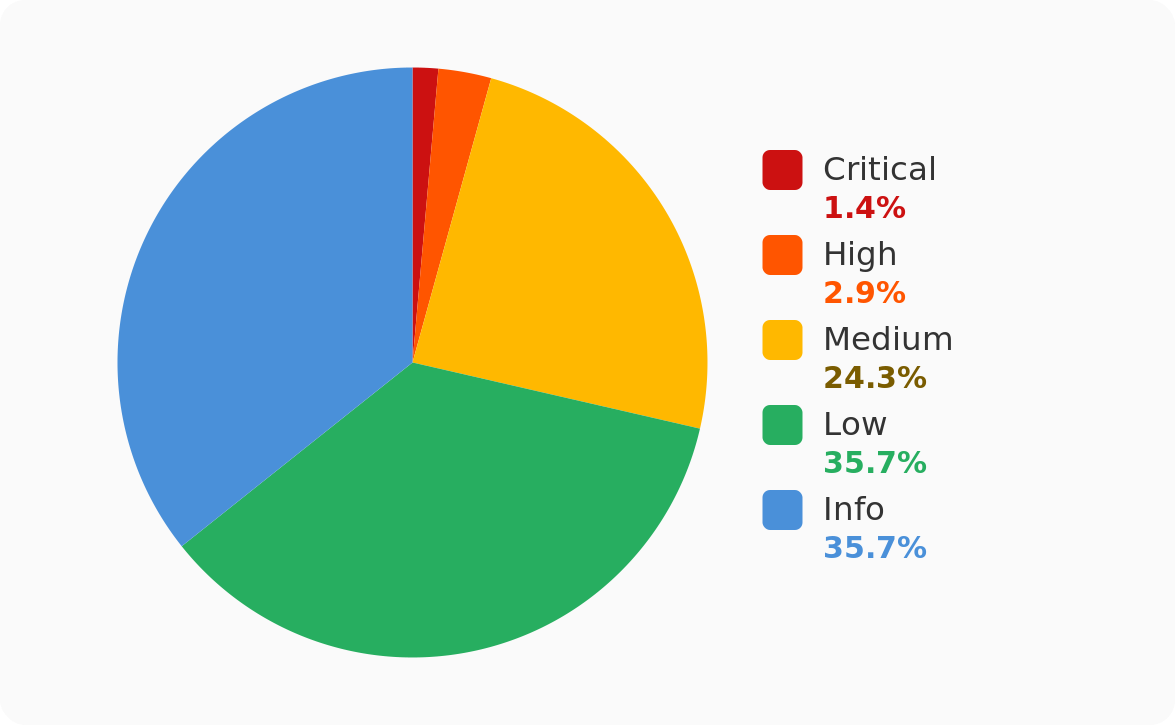
Low and Informational findings together account for 71.4% of ISO 27001 results — above SOC 2 (70%) and well above the overall dataset average (56.5%). However, when reviewing ISO 27001 penetration testing reports, the critical question is not which findings are rated Critical or High, but which findings combine into a realistic attack path. This requires reading the pentest report as a story about how an attacker moves through the environment, not as a list sorted by severity score.
The Most Common ISO 27001 Vulnerabilities
The most common ISO 27001 findings are concentrated in areas where applications must make repeated trust and access management decisions: who a user is, what that user may do, what information can be returned, and how control logic is enforced across components.
In 2025, we identified the following most common findings in ISO 27001-driven assessments:
Top 10 Vulnerabilities in ISO 27001 Penetration Tests (2025)
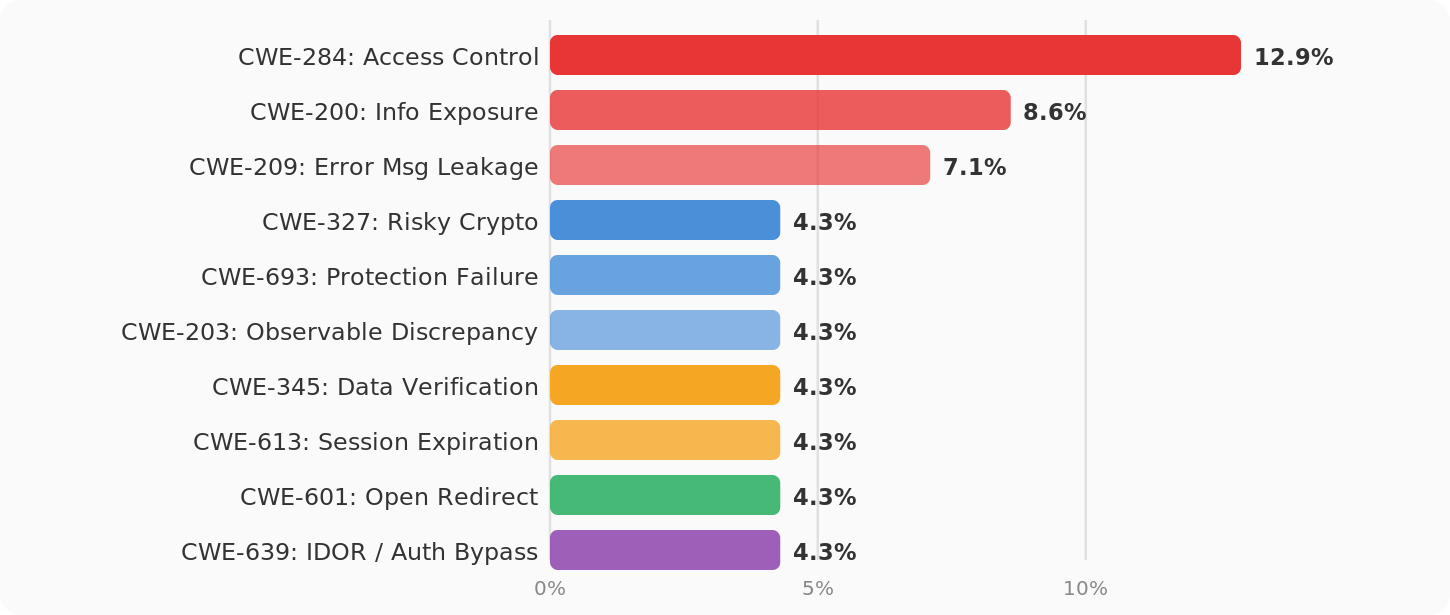
The top three categories of findings — CWE-284 (Improper Access Control), CWE-200 (Exposure of Sensitive Information), and CWE-209 (Error Message Information Leakage) — are identical to the top three found in SOC 2-driven assessments, at the same percentage shares. That consistency across two frameworks with fundamentally different scoping philosophies is not coincidental. They are systemic weaknesses in how applications handle identity, authorization, and data disclosure — and they appear regardless of what compliance lens is applied.
What ISO 27001 Pentest Findings Mean
ISO 27001’s risk-based model produces strong documentation of which controls should be in place. What penetration tests identify is the gap between that documentation and consistent enforcement in production. For organizations operating within an ISO 27001 framework, the central assurance question a penetration test answers is not whether a control is present in the ISMS, but whether it enforces the intended security outcome when real users interact with systems.
That makes these findings especially useful from an assurance perspective. They show where access restrictions, session controls, data handling rules, and other technical safeguards do not behave consistently once real users, real roles, and real service interactions are involved. The issue is often not that a control was never introduced, but that it was implemented unevenly, bypassed in certain paths, or allowed to drift over time as the environment changed.
Compared with general pentest results across all assessment types, ISO 27001 findings are less likely to center on unauthenticated external compromise and more likely to expose weaknesses in the effectiveness of controls within authenticated workflows. For organizations operating within an ISO 27001 framework, that distinction matters: the key question is not simply whether a control exists, but whether it continues to enforce the intended security outcome under normal production use.
Primary Attack Vectors in ISO 27001 Penetration Testing
42% of ISO 27001 findings involve authenticated users abusing permissions within an application. That is the highest authenticated-abuse rate of any compliance framework in the dataset, slightly above the 38% observed in SOC 2 assessments.
ISO 27001 Pentest Findings — Attack Vector Distribution
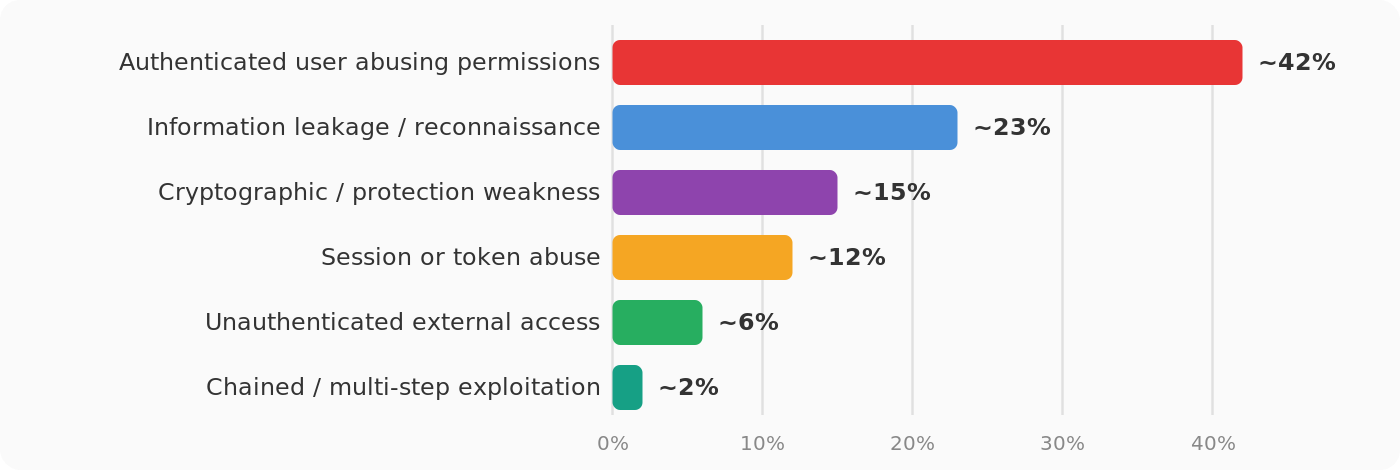
The dominant risk in ISO 27001 environments is not an anonymous attacker breaking through the perimeter. It is a user who has authenticated successfully and can now do things the application was never supposed to let them do. A legitimate login, followed by access control logic that fails, often results in unauthorized actions or privilege escalation within the application.
The next largest category, roughly 23%, is information leakage and reconnaissance. These findings rarely deliver immediate compromise, but they expose application logic, internal identifiers, and system behavior in ways that make other weaknesses significantly easier to exploit. Cryptographic and protection weaknesses account for about 15%, session and token abuse for another 12%. Together, those four categories cover 92% of all ISO 27001 findings — all of them occurring inside or adjacent to authenticated sessions, not at the perimeter.
Only about 6% of findings involve unauthenticated external access. ISO-scoped environments generally have adequate perimeter controls. Where they fail is inside trusted boundaries, in the authorization logic and session management that the ISMS risk register says are handled.
Conclusion
Even though ISO/IEC 27001 does not explicitly mandate pen testing by name, it requires organizations to run a risk-based ISMS, choose appropriate controls, and justify what they include or exclude in the Statement of Applicability. Performing penetration testing is one of the most practical ways to improve ISO 27001 audit readiness and demonstrate compliance, as it helps to verify whether technical controls actually operate as expected.
The most common findings in our ISO 27001-related assessments include access control failures, information exposure, verbose error handling, weak cryptographic implementations, session management weaknesses, and failures in the enforcement of protection mechanisms. Many of these issues emerge after authentication, inside workflows that appear trusted from a policy perspective but remain exploitable in practice.
That is the central lesson of penetration test results. They show where documented controls, access restrictions and security assumptions stop working under conditions resembling real-world attacks and help teams map findings back to control gaps that need remediation.
FAQ
Is penetration testing required for ISO 27001?
ISO/IEC 27001 does not explicitly require penetration testing by name. However, it requires organizations to operate a risk-based information security management system, select appropriate controls, and justify those controls in the Statement of Applicability. In practice, penetration testing is commonly used to validate whether technical controls are actually effective in production.
What does an ISO 27001 pentest usually cover?
The scope of an ISO 27001 pentest depends on the ISMS boundary and the organization’s risk treatment decisions. It often includes internet-facing applications, APIs, administrative portals, production services handling sensitive data, and sometimes internal systems such as segmented networks or supporting infrastructure.
What are the most common ISO 27001 pentest findings?
The most common findings are usually improper access control, exposure of sensitive information, information leakage through error messages, cryptographic weaknesses, protection mechanism failures, session management weaknesses, and authorization bypass through user-controlled identifiers. These findings typically appear in areas where systems must repeatedly enforce trust, identity, authorization, and data handling rules.
Why are authenticated users such a common attack vector?
Because many ISO 27001 environments already have perimeter protections and authentication controls in place, the most common weaknesses appear after login. In practice, many findings involve authenticated users abusing permissions, accessing data outside their scope, or interacting with workflows that do not enforce controls consistently.