


Last year, our security consultants conducted 660 penetration tests across 145 organizations, identifying 3,294 confirmed vulnerabilities belonging to 206 distinct CWE categories, highlighting the diversity of weaknesses that can emerge in modern software environments.
Our 2025 pentest data shows that certain vulnerability categories appear consistently across engagements. Understanding these recurring patterns helps explain where modern applications most frequently fail under adversarial testing and where organizations should focus defensive improvements to mitigate risks associated with modern cyber threats.
Common Cybersecurity Vulnerabilities Found During Penetration Testing
Because many organizations rely on similar architectures — including web applications, APIs, and cloud infrastructure — comparable vulnerability patterns frequently emerge during pen testing assessments. These common penetration testing findings reflect how modern applications manage identity, authorization, and sensitive data rather than isolated software defects.
The following graphic highlights the vulnerability categories most frequently identified during penetration testing engagements.
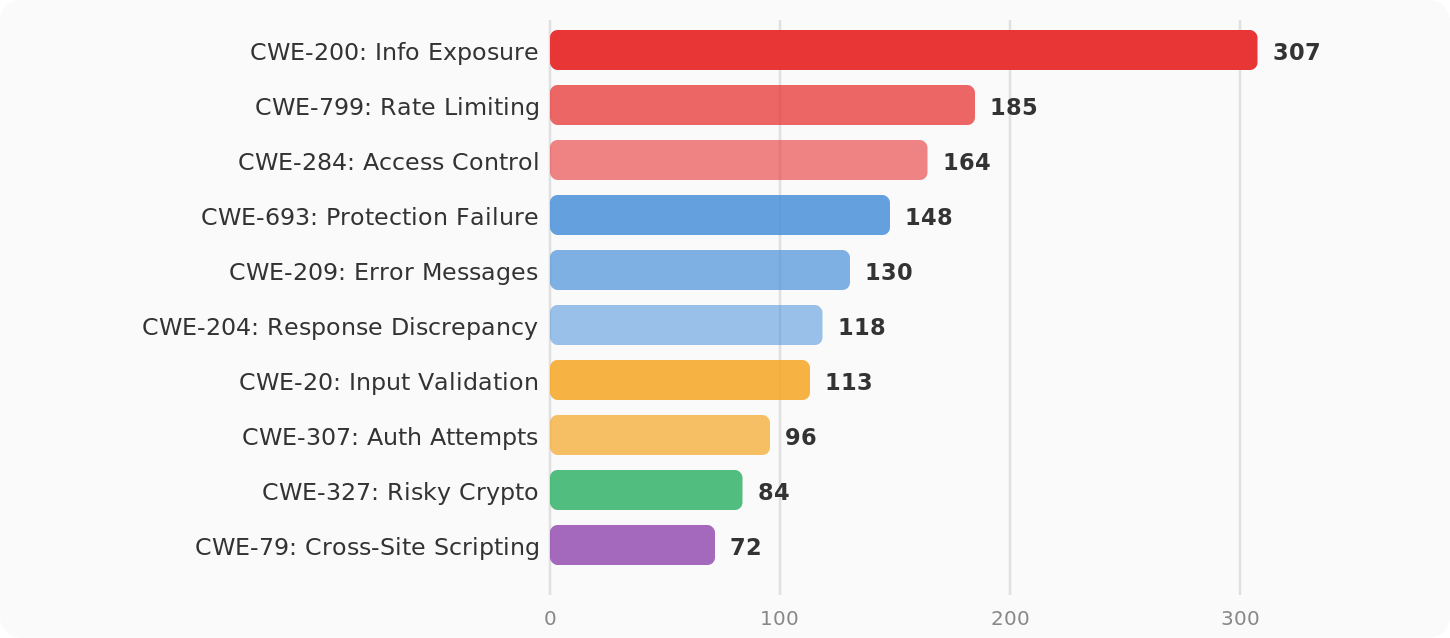
The chart shows that exposure of sensitive information (CWE-200), improper access control (CWE-284), and protection mechanism failures (CWE-693) are among the most frequently observed vulnerability categories. They occur in most organizations with complex application environments in which authorization logic and data-handling mechanisms are distributed across multiple services.
Other common vulnerability categories include improper input validation (CWE-20), rate-limiting issues (CWE-799), and error messages revealing internal information (CWE-209). Together, these categories illustrate how security issues often emerge at the intersection of application logic, data processing, and system configuration.
Sensitive Data Exposure (CWE-200)
Sensitive data exposure occurs when applications return more data than required for a given operation or fail to restrict access to sensitive fields.
Typical examples include API responses containing full object representations instead of filtered fields, exposure of internal identifiers, or leakage of sensitive values in logs or debugging output. In multi-step workflows, such data can be used to construct valid requests targeting other users’ resources.
Exploitation often begins with enumeration. Predictable identifiers combined with overly permissive responses allow attackers to retrieve data belonging to other users. Even when direct access is restricted, partial disclosures frequently provide enough context to support further attacks, including authorization bypass or credential targeting.
Attackers can use these weaknesses to gain unauthorized access to sensitive records, leading to large-scale data exfiltration and subsequent data breaches.
Improper Control of Interaction Frequency (CWE-799)
This category reflects the absence or weakness of rate-limiting controls on sensitive operations.
Endpoints handling authentication, password reset, or resource access are often exposed to repeated requests without sufficient restriction. Attackers can automate these interactions to test large credential sets, enumerate identifiers, or exhaust application logic.
In API-driven systems, a lack of rate limiting can also enable bulk data extraction by iterating over object identifiers. Where responses differ based on resource existence, this becomes an effective method for mapping valid accounts or assets.
Improper Access Control (CWE-284)
Improper access control represents a failure to enforce authorization decisions consistently.
In practice, this often manifests as IDOR (Insecure Direct Object Reference) or BOLA (Broken Object Level Authorization), where user-controlled parameters determine which resource is accessed, but the system does not verify ownership or permissions.
Exploitation is typically straightforward. An authenticated user modifies a request parameter — such as a user ID, account number, or resource identifier — and gains access to data belonging to another user. In more complex cases, access control logic differs between endpoints, allowing bypass through alternative request paths.
These issues frequently lead to direct exposure of sensitive data or unauthorized modification of application state, exploitation can also result in full administrative access.
Protection Mechanism Failure (CWE-693)
Protection mechanism failures occur when security controls are present but do not enforce the intended policy. Examples include missing authorization checks on specific endpoints, inconsistent application of security headers, or bypassable input validation layers. In distributed systems, controls implemented in one service may not be replicated in another, creating gaps in enforcement.
Attackers exploit these inconsistencies by identifying paths where controls are weaker or absent. The result is often equivalent to having no protection in place for specific operations.
Such gaps are particularly common in legacy systems or environments with complex initial setup processes, where controls are implemented inconsistently across components.
Information Exposure Through Error Messages (CWE-209)
Applications frequently return detailed error responses that expose internal implementation details.
Stack traces, exception messages, and verbose API responses may reveal database queries, internal endpoints, or validation logic. These details reduce uncertainty during exploitation by clarifying how the system processes input and where failures occur.
While not always directly exploitable, such information significantly improves the efficiency of attack development, particularly when combined with input validation or access control issues. These insights allow threat actors to better understand the affected system and refine exploitation strategies against vulnerable systems.
Observable Response Discrepancy (CWE-204)
Observable discrepancies arise when applications return different responses depending on internal state.
For example, a request for a non-existent resource may produce a different response than one for an existing resource that the user is not authorized to access. These differences can be measured through status codes, response bodies, or timing.
Attackers use these signals to enumerate valid users, resources, or identifiers. Once valid targets are identified, other vulnerabilities — such as access control flaws — can be applied more effectively.
Improper Input Validation (CWE-20)
Improper input validation allows untrusted data to influence application behavior in unintended ways.
This includes missing validation on parameters, insufficient type or range checks, or inconsistent validation across endpoints. In APIs, this often leads to injection of unexpected values or bypass of business logic constraints.
Exploitation may involve modifying request parameters to access unauthorized data, triggering logic paths that were not intended for a given user, or causing the application to process malformed input in a way that reveals internal behavior. Where unsafe backend processing is involved, the same weakness can escalate into a remote code execution vulnerability rather than remain limited to application logic abuse.
Improper Restriction of Excessive Authentication Attempts (CWE-307)
This vulnerability affects authentication endpoints that do not adequately limit repeated login attempts.
Attackers can use automated tools to test large volumes of credential pairs, leveraging known password reuse across services. Where account lockout or rate limiting is absent or ineffective, the likelihood of successful compromise increases significantly. Systems lacking proper authentication controls are particularly vulnerable when combined with weak passwords and reused credentials.
The impact is amplified in systems without additional controls, such as multi-factor authentication (MFA).
Use of Broken or Risky Cryptographic Algorithms (CWE-327)
Cryptographic weaknesses arise when outdated algorithms or insecure configurations are used.
Examples include deprecated TLS versions, weak cipher suites, or improper handling of encryption keys. In some cases, sensitive data may be encrypted using algorithms that are no longer considered secure, making it susceptible to decryption. In other scenarios, encryption is implemented but not enforced consistently, allowing fallback to insecure communication paths.
Cross-Site Scripting (CWE-79)
Cross-site scripting occurs when user-controlled input is included in a web page without proper sanitization.
An attacker can inject malicious scripts that execute in the context of another user’s session. This enables session hijacking, token theft, or manipulation of application behavior. Stolen session tokens can then provide immediate access to authenticated functionality without requiring the victim’s password.
Common Attack Vectors in Modern Pentesting
Another key pattern revealed by penetration testing data relates to how vulnerabilities are exploited. The graphic below illustrates how vulnerabilities discovered during penetration testing engagements are distributed according to their attack vectors.
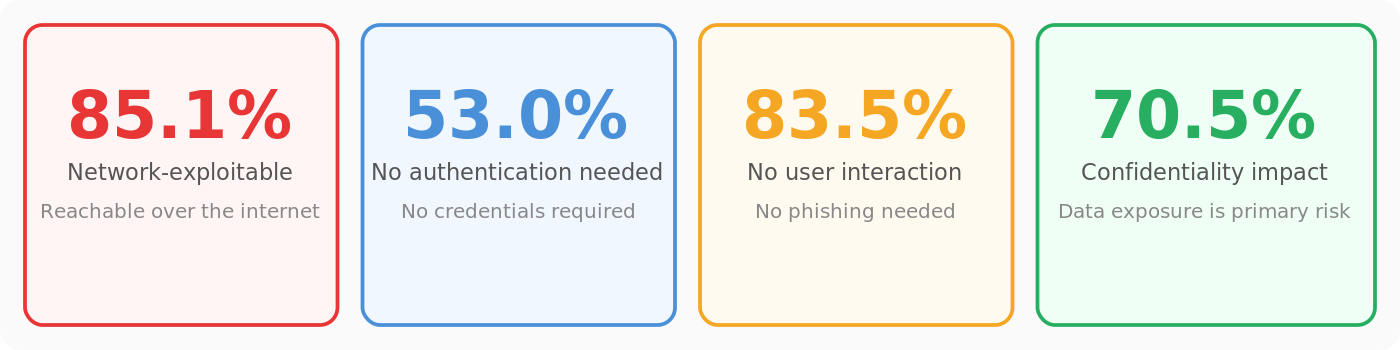
Our assessments from 2025 show that most exploitable vulnerabilities are reachable through network-accessible interfaces.
Approximately 85.1% of findings are exploitable over the network, meaning they can be reached through internet-facing services such as web applications and APIs. In addition, 53.0% require no authentication, and 83.5% can be exploited without user interaction, removing the need for credentials or user involvement.
From an impact perspective, these conditions are strongly associated with confidentiality risk. Around 70.5% of vulnerabilities affect data confidentiality, making exposure of sensitive information the most common outcome of successful exploitation.
This trend reflects the reality of how real-world attacks happen. Public-facing applications, APIs, and cloud services represent the most exposed components of modern digital infrastructure and therefore become the primary focus of both attackers and security assessments.
Industry Benchmarks: Common vulnerabilities by industry
Penetration testing findings are often influenced by industry regulations, system complexity, and the maturity of remediation efforts. In some sectors, elevated risk is linked to slower remediation cycles and the persistence of unpatched vulnerabilities in internet-facing or business-critical systems. Penetration tests conducted on companies from different sectors tend to show a different set of findings, as well as a different distribution of high and critical vulnerabilities.
Critical + High Findings by Industry
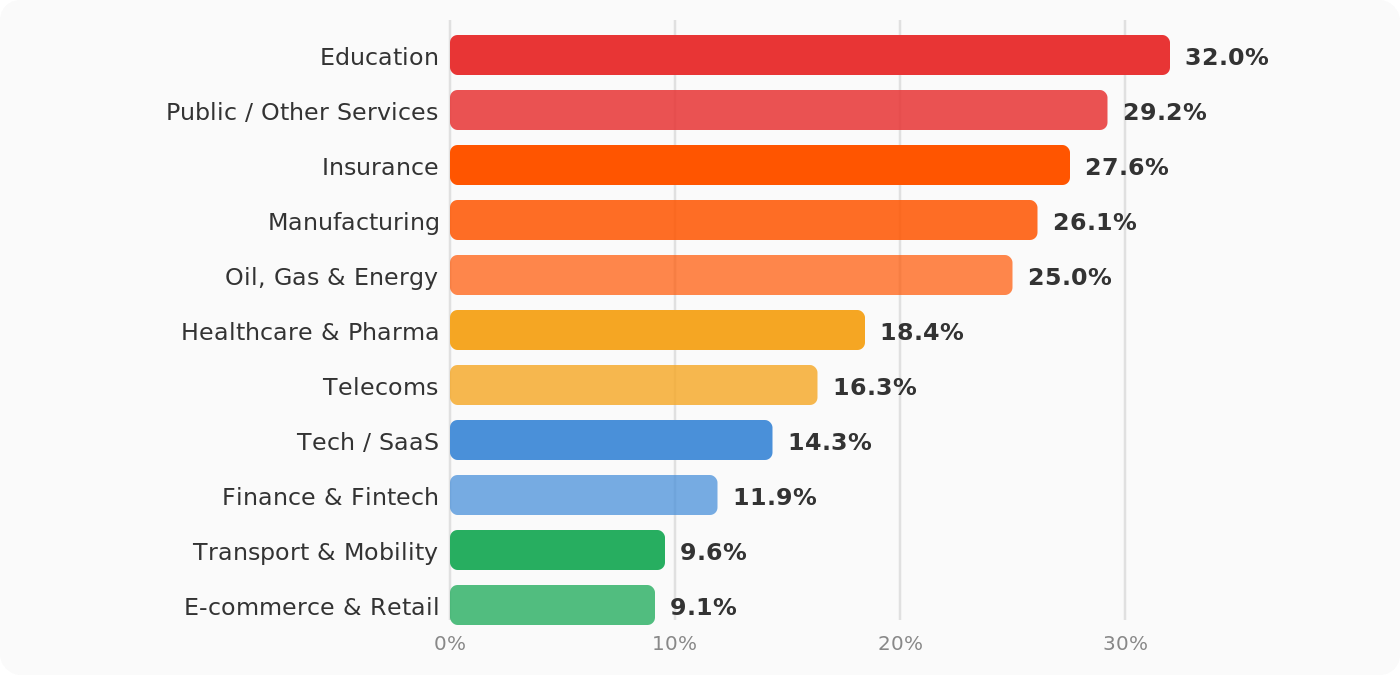
For an in-depth look at vulnerabilities affecting E-commerce & Retail, Healthcare, SaaS, Finance, and Energy, visit our separate blog posts on vulnerabilities discovered during pen tests conducted on organizations in those sectors.
How Compliance Scope Shapes What Gets Found
SOC 2, ISO 27001, and PCI DSS each approach penetration testing with different scope assumptions — and that shapes the finding profile significantly. If you’re commissioning a compliance-driven test or interpreting results from one, understanding what each framework tends to surface (and what it leaves out) changes how you read the report.
Typical Findings in Compliance Penetration Testing
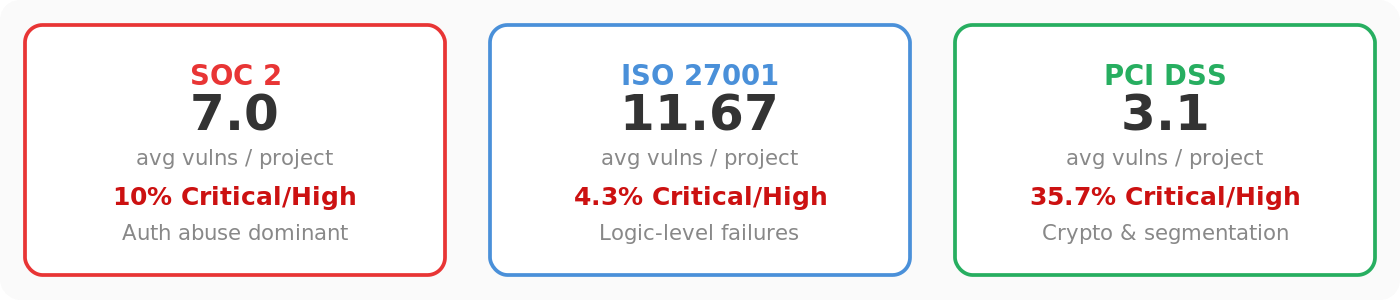
SOC 2 assessments (7.0 average findings per project) tend to surface a specific class of failure: authenticated users doing things they shouldn’t be able to do. The top three findings in SOC 2–driven tests are CWE-284 (Improper Access Control, 12.9% of findings), CWE-200 (Information Exposure, 8.6%), and CWE-209 (Error Message Leakage, 7.1%). Nearly two-thirds of findings require prior authentication to exploit.
ISO 27001 assessments average 11.67 findings per project — the highest of any compliance context — with a low Critical/High rate (4.3%). The framework’s risk-based model drives comprehensive control documentation, but 42% of findings come from authenticated users abusing permissions or roles in ways the risk register says are controlled. Only 6% of findings involve unauthenticated access.
PCI DSS penetration testing findings show the opposite pattern: 3.1 average findings per project, but 35.7% Critical or High — more than twice the overall dataset average of 13.5%. A narrow CDE scope means fewer findings, but the vulnerabilities that survive the scoping filter tend to have direct, serious consequences. CWE-327 (Use of Broken or Risky Cryptographic Algorithm) leads at 14.3% of PCI findings, followed by CWE-284. In practice, encryption is implemented, but TLS version, cipher suite selection, key management, and certificate handling create exploitable gaps.
Conclusion
Regular penetration testing helps identify security issues before malicious actors can exploit them and escalate them into security breaches, providing insights into security gaps and actionable guidance for remediation.
The analysis of penetration tests conducted by Blaze Information Security last year demonstrates that modern systems contain a diverse range of security weaknesses, including high-impact vulnerabilities that can expose sensitive data or enable privilege escalation.
The most common cybersecurity vulnerabilities — particularly authorization weaknesses, data exposure risks, and protection mechanism failures — reveal structural challenges in modern software systems. Distributed architectures, API integrations, and complex identity models all introduce opportunities for subtle but meaningful security failures.
By understanding these patterns, organizations can better anticipate the types of vulnerabilities penetration testing engagements may reveal and focus their defensive efforts on the areas where modern systems most frequently break down.