


PCI DSS penetration testing findings usually point to a narrow set of problems in a high-consequence environment. The number of identified vulnerabilities tends to be lower than in broader pentests, but the findings that remain tend to fall on top of controls that matter directly to payment security: segmentation, access control, authentication, credential protection, and cryptographic handling of cardholder data.
In our 2025 PCI pentest assessments, projects averaged 3.1 vulnerabilities, yet more than one-third of findings were classified as High or Critical, which is exactly the pattern a control-oriented PCI assessment would be expected to produce.
The following article analyzes security weaknesses identified during PCI DSS compliance-triggered penetration testing conducted by Blaze Information Security in 2025. Those findings form part of our 2025 Annual Penetration Testing Review and are grounded in weaknesses that our penetration testers validated during advanced manual engagements, rather than in inferences drawn from scanners or automated tools alone.
What PCI DSS Pentests Usually Validate
PCI DSS assessments are driven by the CDE scope. Our PCI-driven assessments consist primarily of application security testing, infrastructure and network penetration testing, PCI segmentation validation, and, in many cases, explicit network segmentation testing. Such scope reflects the practical purpose of the exercise: validating not only the security of payment-connected applications, but also the network boundaries, administrative paths, and technical separation that define the scope and protection of the entire cardholder data environment.
For auditors and compliance leads, this is the key distinction from a general pentest. PCI testing is not intended to give a broad picture of every application issue in the organization. It is intended to test whether the systems in scope for cardholder data are properly protected and whether the controls used to limit access to that environment are operating effectively. Findings in this context, therefore, have direct bearing on both security risk and compliance assurance. A general pentest may provide a wide picture of application and infrastructure risk, while a PCI engagement is designed to determine whether the systems in scope are protected under the relevant PCI security standards and related PCI DSS requirements.
Because of that narrower scope, PCI findings tend to say less about everything in the environment and more about whether critical systems inside or around the CDE are protected in the way the organization believes they are. That is why conducting PCI penetration testing is less about broad coverage and more about validating the controls that define scope, trust boundaries, and reachability.
Severity and Finding Volume
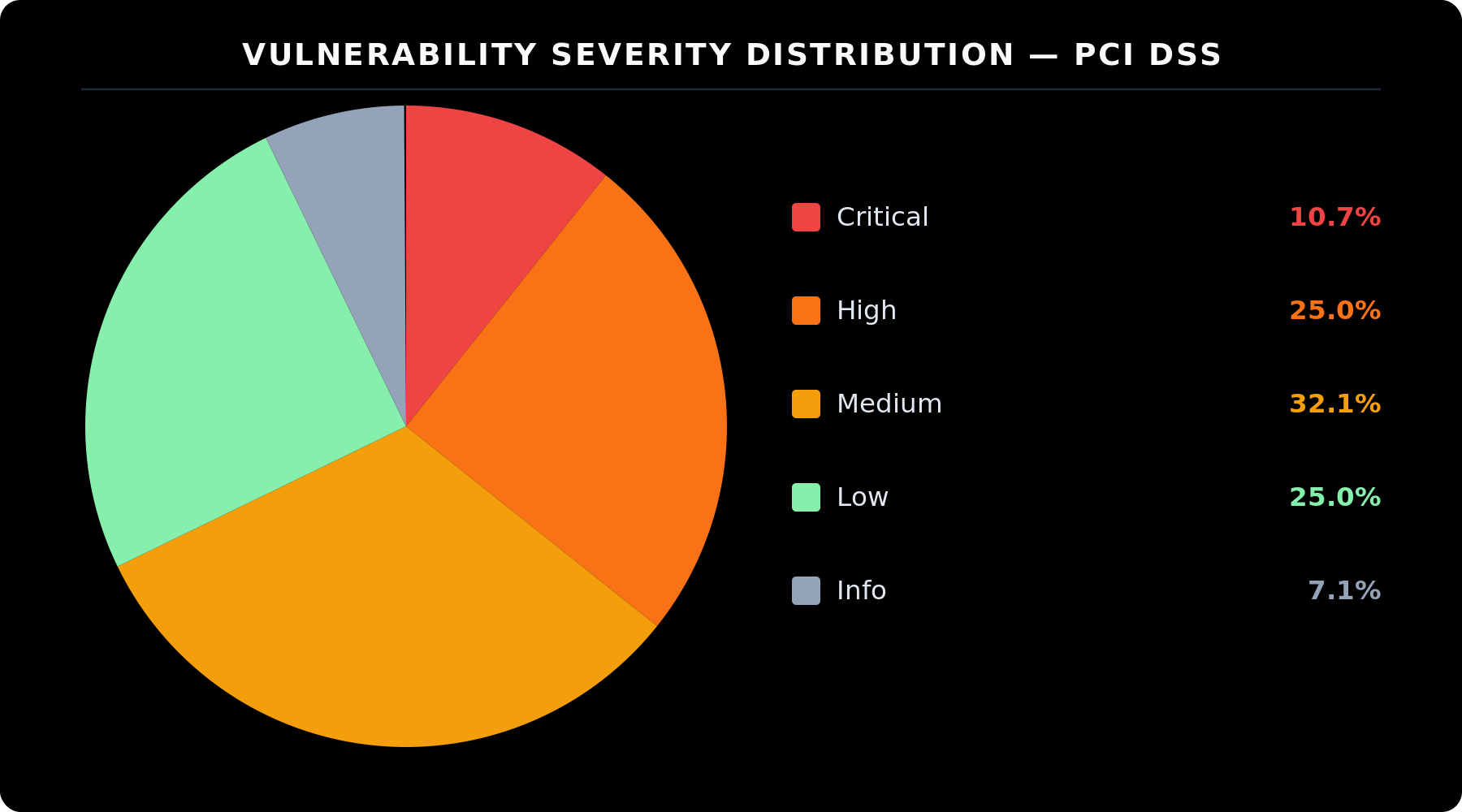
The PCI profile is best understood as lower volume, higher consequence. Broader pentest work in Blaze’s review averaged 4.99 vulnerabilities per project, with 13.5% of findings rated High or Critical. PCI assessments averaged 3.1 vulnerabilities per project, but 35.7% of findings were High or Critical.
That pattern is consistent with a tightly scoped compliance assessment. Once testing is limited to the CDE and the controls around it, lower-value findings fall away, and the remaining issues are more likely to directly affect the effectiveness of controls. For compliance teams, this means severity matters more than raw count. A few findings tied to segmentation, encryption, or privileged access can carry more audit significance than a longer list of lower-severity application issues outside a regulated boundary, especially when those weaknesses affect critical systems or expose material security gaps.
Compared with other compliance-driven work, PCI is also more concentrated. In the same review, SOC 2 pentest assessments averaged 7.0 vulnerabilities per project and ISO 27001 assessments averaged 11.67, with both profiles leaning more heavily toward authenticated misuse, session handling, and authorization consistency inside broader application environments. PCI is narrower, and the findings are correspondingly more concentrated around payment-environment controls.
The Most Common PCI DSS Findings
The leading PCI finding in Blaze’s review was CWE-327: Use of a Broken or Risky Cryptographic Algorithm, followed by CWE-284: Improper Access Control and CWE-200: Exposure of Sensitive Information to an Unauthorized Actor. Other recurring issues included improper restriction of authentication attempts, improper isolation or compartmentalization, missing encryption of sensitive data, cleartext transmission, insufficiently protected credentials, inadequate encryption strength, and hard-coded credentials.
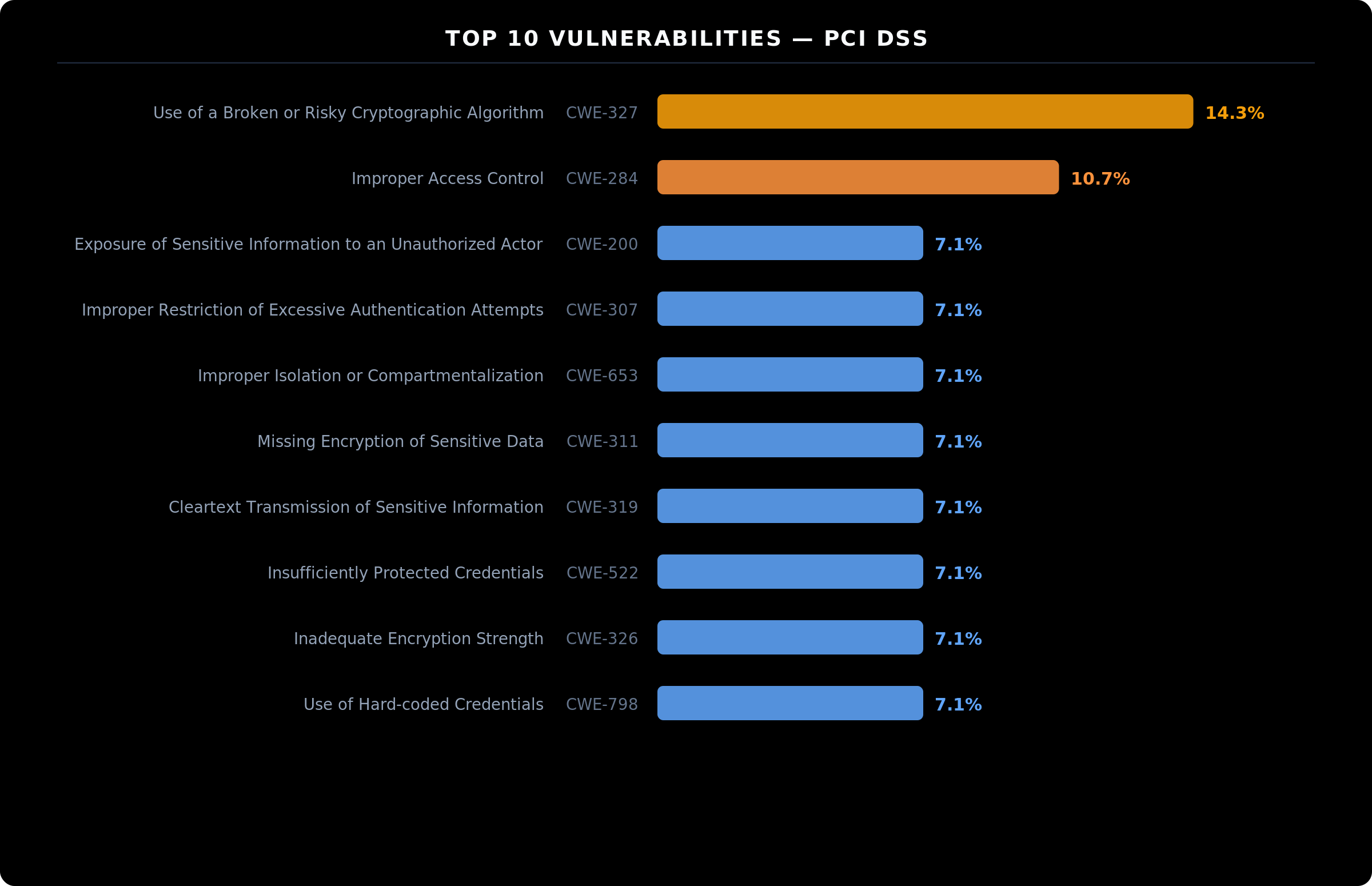
Those findings usually cluster into four control themes:
- cryptographic protection that exists, but is not consistently sound
- access restrictions that are defined, but not always enforced correctly
- sensitive data handling that remains looser than intended
- segmentation that appears stronger on paper than it is in operation
Cryptographic weaknesses indicate gaps in protocol selection, key management, certificate handling, or encryption strength. Access control weaknesses point to failures in determining who can access payment-connected systems and under what conditions. Sensitive information exposure points to leakage that can undermine confidentiality controls. Isolation and compartmentalization weakness points to segmentation failures or weak scope boundaries.
The prominence of cryptographic issues is especially important. Blaze’s PCI analysis notes that encryption is often present, but not always applied correctly or consistently, particularly in key management, protocol selection, and certificate handling. For compliance teams, that means the issue is not simply whether encryption exists as a stated control, but whether it is implemented in a way that actually supports PCI objectives in production.
Access-control weaknesses also take on a more specific meaning in PCI than they do in generic application testing. In broader testing, such findings often refer to inconsistent authorization inside an application; in PCI environments, the same issues frequently appear in payment-related services, administrative interfaces, support tooling, or trusted paths into the CDE, which makes the finding less about a narrow permission error and more about whether the environment is truly restricting access to sensitive systems.
Primary Attack Vectors
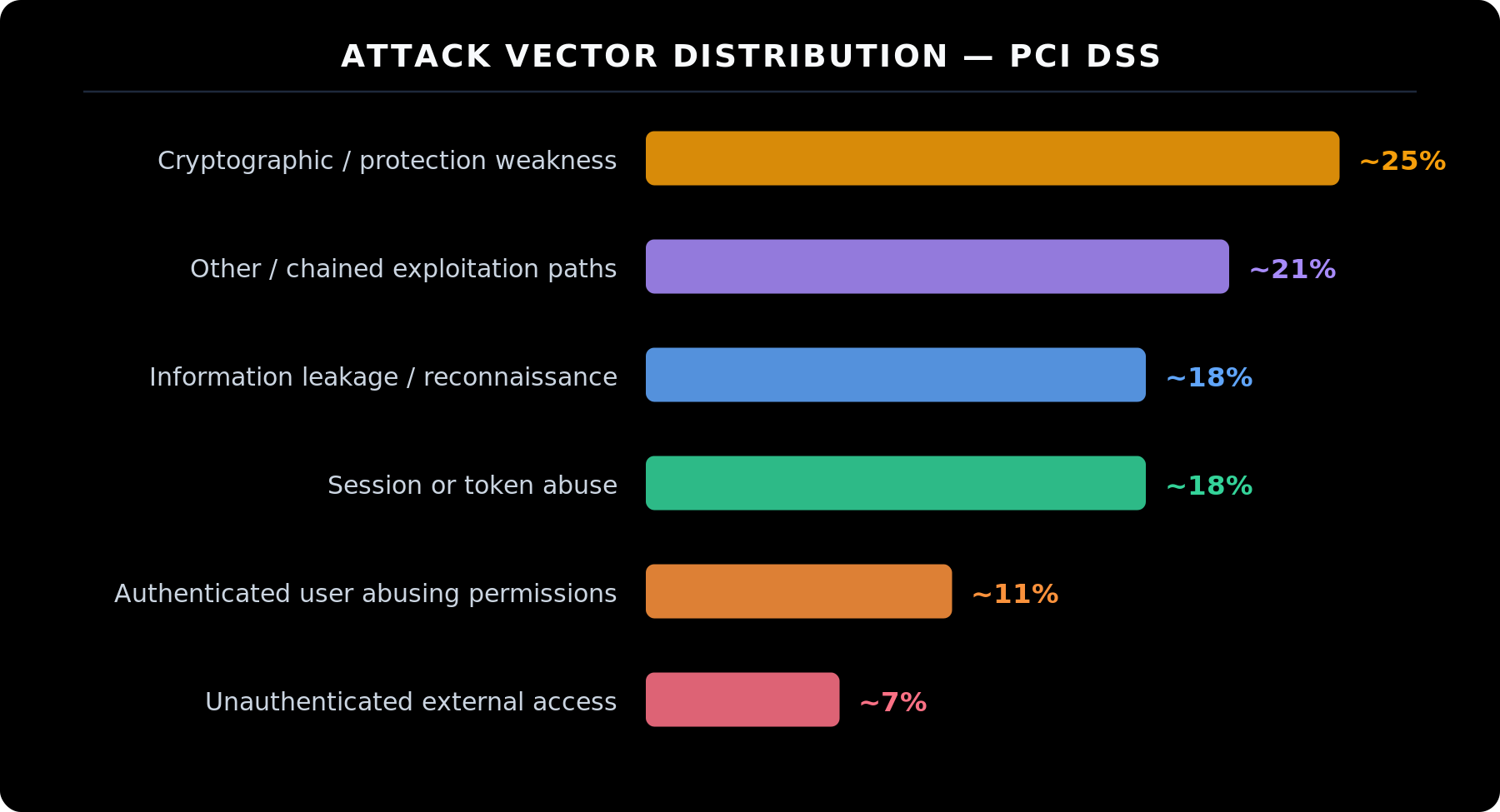
The PCI attack-vector distribution reinforces the same control-oriented picture. In our 2025 review, the largest category was cryptographic or protection weakness at 25%, followed by information leakage or reconnaissance at 18%, session or token abuse, authenticated user abuse of permissions at roughly 11%, and unauthenticated external access at 7%, with the remainder made up of chained or other exploitation paths. Such a distribution suggests that PCI environments are not dominated by obvious, fully unauthenticated “open door” failures; the more common pattern is degradation of controls inside or around trusted boundaries, where smaller weaknesses in protection, information handling, or session control can be combined into a more serious path to cardholder data.
From an assurance standpoint, chained exploitation is particularly important because it means apparently moderate findings may still have high control significance when considered together. A certificate-handling issue, an information leak, and an overly permissive administrative path may each appear manageable on their own, yet collectively they can indicate that the environment is not enforcing its trust boundaries as intended.
What These Findings Usually Mean
PCI findings usually reveal less about perimeter failure and more about whether the environment’s protective model is working as intended. In many cases, the problem is not that no control exists, but that the control is implemented inconsistently, enforced incorrectly, or applied unevenly across services and interfaces. That pattern appears across compliance-driven work more broadly, where scoped environments rarely fail because controls are absent and more often fail because control behavior breaks down in real workflows.
In practical terms, the recurring questions are straightforward: whether the CDE is narrower on paper than in operation, whether trusted or privileged paths are broader than intended, whether encryption-related controls are applied consistently across all relevant traffic, and whether a finding points to a local defect or to a broader implementation pattern. Those questions are usually more useful than a simple defect count because they determine whether teams can remediate security vulnerabilities locally or whether the issue reflects a larger weakness in configuration, standards, or architecture.
Conclusion
PCI security assessments help to demonstrate whether the controls protecting cardholder data work as intended when actively tested. The most common PCI findings our penetration testers identified last year clustered around cryptographic implementation, access control, sensitive data exposure, segmentation, and credential protection. Those are not peripheral issues. They sit directly on top of the controls that define whether a PCI-scoped environment is actually restricted, encrypted, and defensible.
The practical value of the PCI engagement lies not only in surfacing weaknesses but in helping organizations remediate security vulnerabilities, close material security gaps, and maintain PCI compliance over time. A useful PCI exercise, therefore, does more than satisfy a checkbox in a PCI DSS compliance journey. It helps identify security weaknesses in the systems and boundaries that matter most, and it gives organizations a stronger basis for deciding how to remediate security vulnerabilities, perform PCI penetration testing again where needed, and ensure compliance through validated corrective action rather than assumption alone.
FAQ
What are the most common PCI DSS penetration testing findings?
The most common PCI pen testing findings were CWE-327 (Use of a Broken or Risky Cryptographic Algorithm), CWE-284 (Improper Access Control), and CWE-200 (Exposure of Sensitive Information to an Unauthorized Actor). Other recurring findings included missing or weak encryption, cleartext transmission, insufficiently protected credentials, hard-coded credentials, and improper isolation or compartmentalization.
Why do PCI DSS pen tests usually find fewer issues than broader pentests?
PCI DSS testing is typically scoped around the cardholder data environment (CDE) and the systems connected to it, rather than a broader mix of applications and infrastructure. That narrower scope reduces the total number of findings and shifts attention toward payment-related systems, segmentation controls, and trust boundaries.
Does a short PCI findings list mean the environment is low risk?
No. PCI projects in this review averaged 3.1 vulnerabilities, but 35.7% of findings were High or Critical. In PCI environments, a small number of weaknesses can still be significant if they affect encryption, segmentation, credentials, or access into the CDE.
Why are cryptographic weaknesses so prominent in PCI DSS findings?
Because payment environments depend heavily on secure transport and strong protection of cardholder data. The PCI analysis notes that encryption is often present, but not always implemented correctly or consistently, especially in key management, protocol selection, and certificate handling.
Why do segmentation findings matter so much in PCI DSS pentests?
Segmentation is central to PCI because it determines whether the CDE is actually isolated. The PCI section notes that testing includes PCI segmentation validation specifically because segmentation failures can have immediate compliance impact and can make payment systems more reachable than intended.
What should teams review before conducting PCI penetration testing?
Before conducting PCI penetration testing, teams should confirm CDE scope, identify payment-connected applications and infrastructure, review boundary assumptions, and verify which administrative paths and trusted connections could affect cardholder data exposure. That preparation is important because PCI penetration testing requirements depend heavily on accurate scoping and on understanding where controls are supposed to separate the CDE from the rest of the environment.
What role do methodology and process play in PCI testing?
Penetration testing methodology and penetration testing process matter because PCI work is less about broad exploratory scanning and more about validating how scoped systems, trust boundaries, and access controls behave under active testing. Manual pen testing remains essential because some of the most important findings in these environments are difficult for automated tools to interpret correctly without context.
How should organizations choose a penetration testing provider for PCI work?
A penetration testing provider supporting PCI work should be able to test more than public-facing endpoints. The work needs to cover payment-connected applications, boundary controls, trusted administrative paths, and segmentation assumptions in a way that produces findings useful for remediation and assurance, not just a checklist of isolated flaws.