
LLM penetration testing is an authorized security assessment of applications that use Large Language Models (LLMs), generative AI, agents, RAG pipelines, plugins, or model-connected automation. It evaluates whether weaknesses in prompts, access controls, retrieved data, model outputs, or connected tools can expose sensitive data, trigger unauthorized actions, or manipulate AI behavior.
As organizations embed Artificial Intelligence into customer-facing products and internal operations, the attack surface expands beyond standard web and API security. AI penetration testing helps security teams identify vulnerabilities that traditional penetration testing may not fully address, including indirect prompt injection, data leakage, excessive agency, insecure output handling, data poisoning, and model theft.
This guide explains what LLM penetration testing covers, how it differs from web application testing and AI red teaming, when companies need an assessment, which common vulnerabilities to expect, and what buyers should look for in AI penetration testing services.
What Is AI Penetration Testing?
AI penetration testing is an authorized security assessment of applications, systems, and workflows that use artificial intelligence. It evaluates whether weaknesses in AI models, data pipelines, user inputs, access controls, APIs, automation tools, or downstream systems could be exploited to expose sensitive information, manipulate outputs, trigger unauthorized actions, or create unintended behavior.
LLM penetration testing, as defined above, is a specialized type of AI penetration testing. While AI penetration testing can include broader AI systems such as machine learning models, recommendation engines, computer vision systems, or AI-driven decision workflows, LLM pentesting focuses on the risks created when Large Language Models interact with users, proprietary data, system instructions, external data sources, and other systems.
Because these terms are often used interchangeably, it helps to clarify the scope before defining the rest of the assessment.
| Assessment type | Main focus | Best used for |
|---|---|---|
| Traditional penetration testing | Web apps, APIs, infrastructure, networks, cloud, and access controls | Finding exploitable security weaknesses in conventional systems |
| AI penetration testing | AI systems, AI-driven workflows, model behavior, data pipelines, automation, and downstream systems | Assessing whether AI capabilities introduce new security risks or expand existing ones |
| LLM penetration testing | Large language models, prompts, RAG, agents, tools, plugins, model outputs, and system instructions | Testing LLM vulnerabilities such as prompt injection, data leakage, insecure output handling, and excessive agency |
| AI red teaming | Broader adversarial testing, misuse scenarios, model resilience, safety boundaries, and operational controls | Evaluating how AI systems respond to adversarial attacks, real-world abuse scenarios, and policy bypass attempts |
For this guide, the focus is LLM penetration testing as a specialized form of AI penetration testing. However, many LLM assessments still include elements of traditional penetration testing, especially when the model connects to APIs, user accounts, cloud resources, internal tools, or other systems.
Why AI and LLM Applications Need Specialized Security Testing
AI systems introduce security risks that standard application testing may not fully capture. In a traditional application, user inputs usually follow predictable paths through code, APIs, databases, and access controls. In AI-driven systems, those inputs may also shape model behavior, influence model outputs, retrieve external data sources, trigger automation tools, or affect downstream systems.
This changes the attack surface. A chatbot, copilot, or agent may have access to sensitive data, internal documentation, proprietary data, customer records, source code, or operational workflows. If those permissions are not properly controlled, prompt injection, indirect prompt injection, weak authorization, or insecure tool use can lead to data leakage, unauthorized actions, or unintended behavior.
LLM security testing is also difficult because model behavior is probabilistic and context-dependent. The same application may respond differently depending on the prompt, conversation history, retrieved documents, system instructions, or connected tools. That is why automated tools and vulnerability scanners can support testing, but should not replace manual analysis and human oversight.
Specialized AI security testing helps security teams understand how AI systems fail in deployed environments. The goal is not only identifying vulnerabilities, but validating whether those weaknesses can expose sensitive information, manipulate outputs, bypass controls, or create business impact.
What a Real LLM Pentest Should Validate
A real LLM pentest should validate how the application behaves when prompts, data access, model outputs, tools, APIs, and user permissions are tested together. The goal is not just to prove that prompt injection is possible, but to determine whether an attacker could turn AI behavior into meaningful business impact.
A strong assessment should answer questions such as:
- Can a user override or bypass system instructions?
- Can direct or indirect prompt injection expose sensitive data, proprietary data, prompts, or internal context?
- Can malicious inputs manipulate outputs in ways that affect users, decisions, or downstream systems?
- Can one user or tenant access sensitive information belonging to another?
- Can the model call tools, plugins, APIs, or automation workflows outside the user’s authorization?
- Can unsafe model outputs lead to cross-site scripting, command injection, SQL injection, SSRF, or other code flaws when processed by the application?
- Can external data sources, retrieved documents, or user-generated content influence AI behavior in unintended ways?
- Can access controls prevent the model from retrieving or acting on data the user should not access?
- Can an attacker abuse the system to increase cost, degrade availability, or perform unauthorized actions at scale?
- Can safeguards, guardrails, and restriction mechanisms be bypassed through direct prompts, indirect prompts, retrieved content, or multi-turn interaction?
These validation questions align closely with the OWASP Top 10 for Large Language Model Applications. The OWASP list should not be treated as a checklist by itself, but it gives security teams a useful baseline for scoping LLM security testing and comparing findings against recognized LLM application risk categories.
When Do Companies Need an LLM Application Pentest?
While the ideal penetration testing frequency depends on the system's size, compliance requirements and type of assessment, some situations call for an AI-specific test. Companies should consider AI penetration testing before launching any application that uses Large Language Models, generative AI, AI agents, RAG, plugins, tools, APIs, or automated workflows. This is especially important when the system can access sensitive data, proprietary data, customer records, source code, internal documentation, or external systems.
An LLM pentest is also recommended when an AI feature moves from proof of concept to production. Early AI prototypes often rely on limited permissions, test data, or manual review, but production deployments may introduce real users, external data sources, system instructions, integrations, and downstream systems. That shift can expand the attack surface and create new data exposure risks.
Security teams should also test after major changes, such as adding RAG, connecting the model to APIs, enabling tool or function calling, changing model providers, modifying prompts, fine-tuning a model, or introducing automated workflows. Each change can affect model behavior, access controls, data leakage risk, and how the AI system responds to malicious inputs.
AI security testing is also useful before compliance audits, customer security reviews, vendor due diligence, M&A activity, or enterprise procurement.
Common Vulnerabilities in LLM Application Penetration Testing
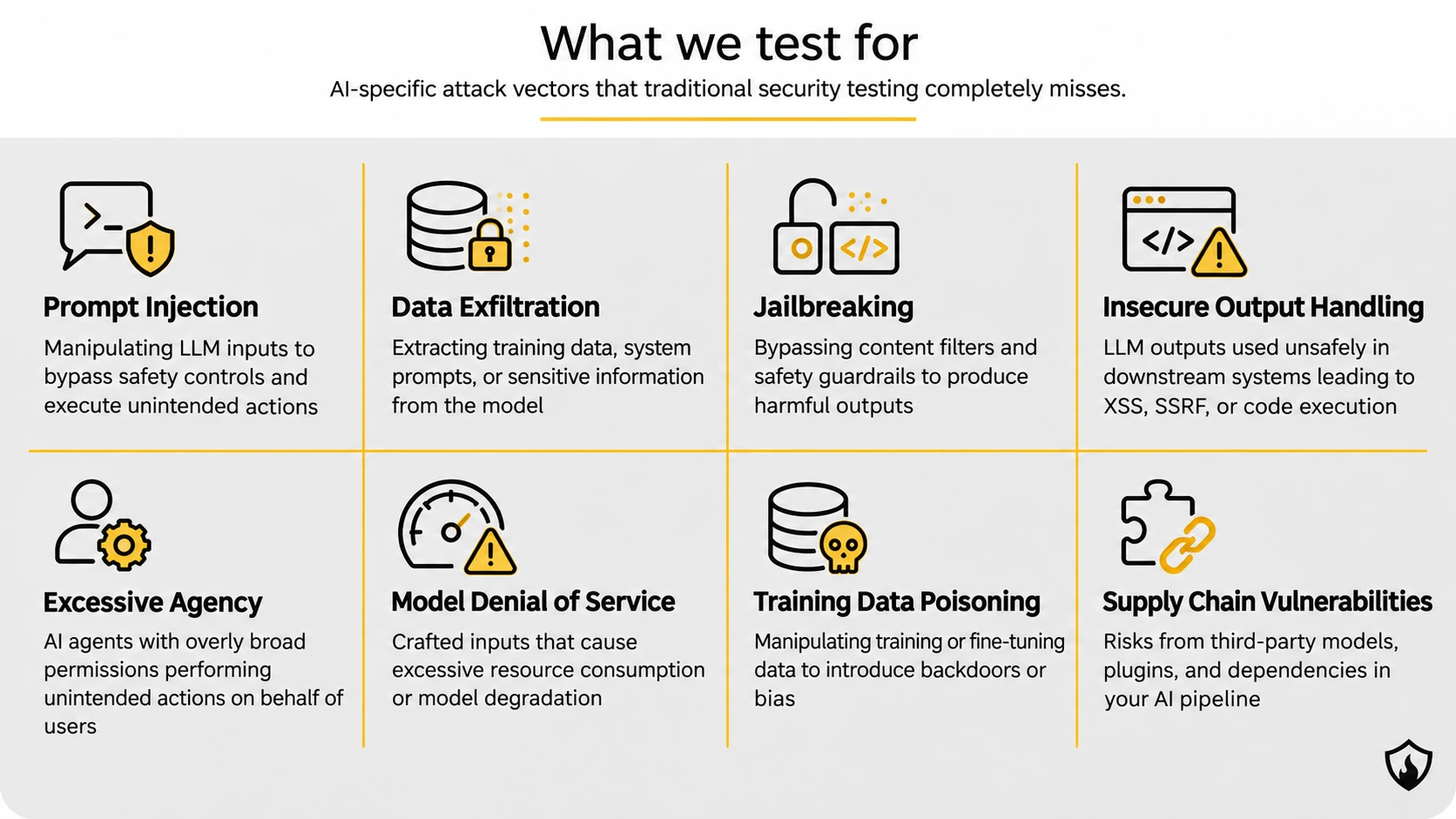
AI and LLM applications introduce risks that come from the way models, prompts, data, permissions, and external systems interact. Some issues look like familiar application security problems, such as weak access controls or insecure APIs. Others are more specific to large language models, including prompt injection, insecure output handling, excessive agency, system prompt leakage, and vector or embedding weaknesses.
Blaze’s 2025 Annual Penetration Testing Review reinforces why these issues matter in practice. Across 660 penetration testing and red team assessments, the most common findings included exposure of sensitive information, improper access control, protection mechanism failures, improper input validation, and cross-site scripting. These patterns are directly relevant to AI-driven systems, where model outputs, API integrations, retrieved data, user inputs, and authorization boundaries can all become part of the attack surface.
The OWASP Top 10 for Large Language Model Applications 2025 is one of the most widely used references for LLM security testing. The 2025 edition added System Prompt Leakage and Vector and Embedding Weaknesses as new categories, reflecting the growing role of system prompts, RAG systems and vector databases, and elevated Sensitive Information Disclosure to the second position.
| OWASP LLM Risk | Description |
|---|---|
| LLM01 Prompt Injection | Malicious inputs alter LLM behavior or override system instructions. |
| LLM02 Sensitive Information Disclosure | The model exposes confidential data from training, prompts, or retrieved context. |
| LLM03 Supply Chain | Compromised third-party components, datasets, or model weights affect integrity. |
| LLM04 Data and Model Poisoning | Pre-training, fine-tuning, or embedding data is manipulated to alter model behavior. |
| LLM05 Improper Output Handling | Model outputs are not validated before being rendered, executed, or passed downstream. |
| LLM06 Excessive Agency | The model takes unintended or unauthorized actions due to overly broad permissions. |
| LLM07 System Prompt Leakage | System-level instructions are exposed to unauthorized users or extracted via attack. |
| LLM08 Vector and Embedding Weaknesses | Vulnerabilities in RAG pipelines, vector databases, or embedding-based retrieval. |
| LLM09 Misinformation | The model generates false or misleading content that applications rely on without verification. |
| LLM10 Unbounded Consumption | Uncontrolled resource usage creates excessive cost or degrades availability. |
One of the most common LLM vulnerabilities is prompt injection. In a direct prompt injection attack, a user submits malicious inputs designed to override system instructions, manipulate outputs, or change AI behavior. In an indirect prompt injection attack, malicious instructions are hidden in external data sources such as documents, web pages, tickets, emails, or user-generated content that the model later processes.
Indirect prompt injection through RAG pipelines and agentic systems is often the higher-priority risk of the two, because the attack surface is anything the model reads, not just what the user types.
Sensitive data exposure is another major concern. An AI system may compromise data privacy by accessing proprietary data, customer records, internal documentation, source code, training data, prompts, logs, or retrieved content.
LLM pentesting should also evaluate insecure output handling. Model outputs may be rendered in browsers, passed to APIs, stored in databases, sent to downstream systems, or used to trigger automated workflows. If those outputs are trusted without validation, they can contribute to code flaws such as cross-site scripting, command injection, SQL injection, SSRF, or unsafe workflow execution.
Vector and embedding weaknesses are an emerging category that targets RAG systems and vector databases specifically. Testers evaluate whether document retrieval boundaries are enforced across tenants, whether embeddings can be poisoned or manipulated, and whether the retrieval layer can be abused to surface data a user should not be able to access.
Other common vulnerabilities include data poisoning, model theft, supply chain attacks, insecure plugins, weak API security, poor logging, and unbounded consumption that can increase cost or degrade availability. The exact risks depend on the application's architecture, the model's capabilities, the sensitivity of the data, and how much control the AI system has over downstream systems.
Preparing for an LLM Penetration Test
Before starting an LLM pen test, security teams should prepare the information testers need to evaluate the full application context:
- Define the AI features in scope
Identify the chatbots, copilots, agents, RAG pipelines, plugins, APIs, tools, or automated workflows that will be tested. - Share architecture and data flows
Document how user inputs, prompts, system instructions, external data sources, retrieved content, model outputs, logs, and downstream systems interact. - Provide model and provider details
List the large language models, AI providers, fine-tuning, embeddings, vector databases, guardrails, and safety controls used by the application. - Prepare test accounts and roles
Provide accounts for different users, roles, tenants, or permission levels so testers can validate access controls and tenant isolation. - Identify sensitive data and restricted actions
Clarify which data sources contain sensitive information and which actions should be restricted, simulated, or avoided during testing. - Agree on rules of engagement
Define allowed testing techniques, production constraints, logging requirements, communication channels, and escalation procedures.
AI and LLM Application Penetration Testing Methodology
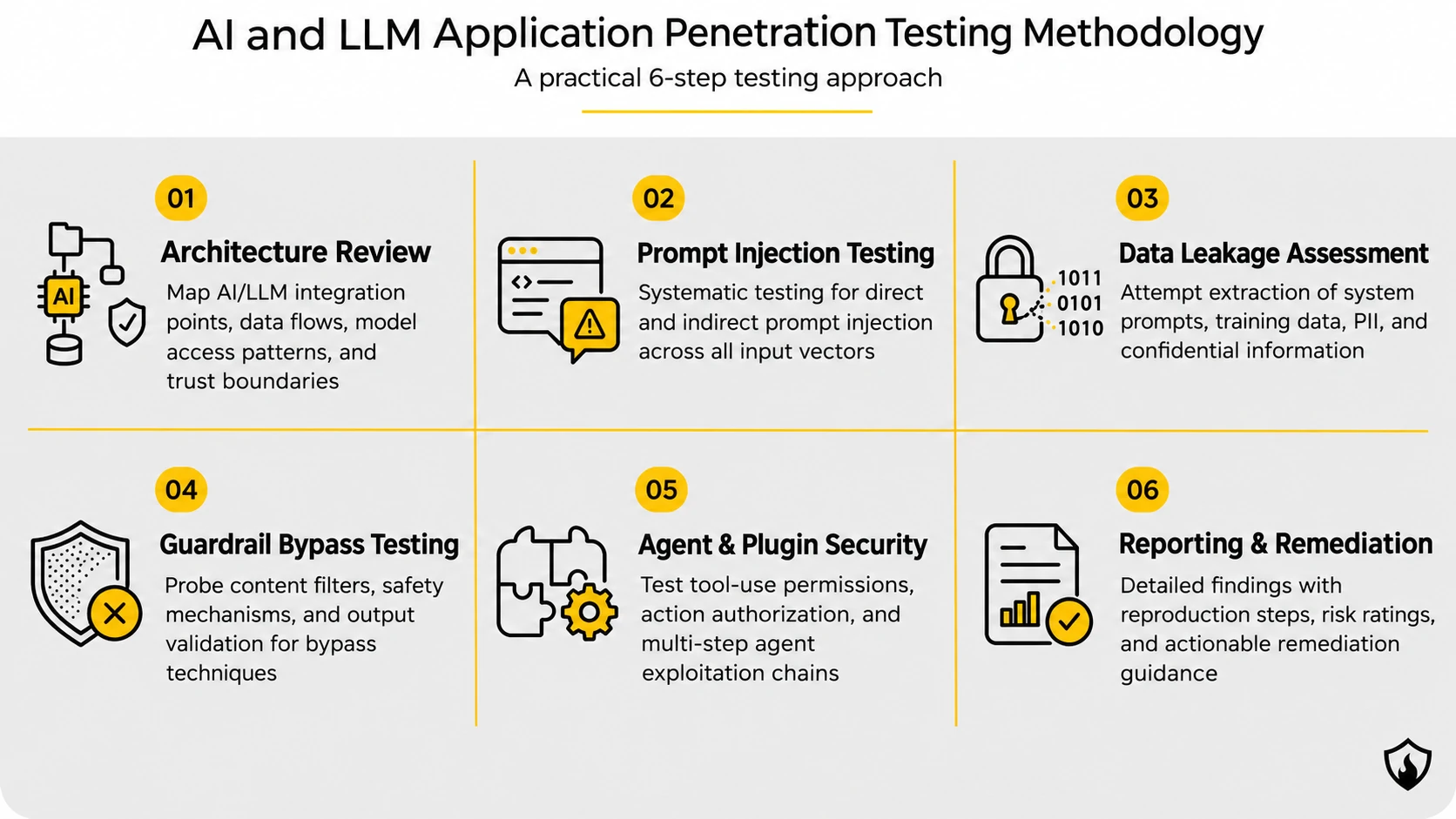
An AI or LLM pentest should follow a structured methodology that combines application security testing with AI-specific validation. The exact approach depends on the application architecture, the model’s capabilities, the data it can access, and whether the system uses RAG, agents, tools, plugins, APIs, or automated workflows.
1. Architecture Review: Map AI and LLM integration points, data flows, model access patterns, trust boundaries, user roles, connected systems, and downstream workflows.
2. Prompt Injection Testing: Test whether direct or indirect prompt injection can override system instructions, manipulate outputs, bypass restrictions, or influence the model through user inputs, retrieved content, or external data sources.
3. Data Leakage Assessment: Assess whether the application exposes system prompts, internal instructions, confidential information, proprietary data, customer records, retrieved content, or training-related data where applicable.
4. Guardrail Bypass Testing: Evaluate whether content filters, safety mechanisms, restriction controls, or output validation can be bypassed through jailbreak-style prompts, multi-turn interaction, obfuscation, or role manipulation.
5. Agent and Plugin Security: Test whether tools, plugins, APIs, or agentic workflows respect user permissions, action authorization, and business rules, especially in multi-step execution chains.
6. Reporting and Remediation: Document evidence-based findings with reproduction steps, affected workflows, risk ratings, business impact, and actionable remediation guidance. Where appropriate, retesting should confirm that fixes work in the full application workflow.
While every AI and LLM pentest should be scoped to the specific application, most mature assessments follow a similar flow: understand the system, map data and trust boundaries, test AI-specific abuse cases, validate access controls, and report exploitable impact.
AI and LLM Pentesting Tools and Techniques
LLM penetration testing uses a combination of open-source frameworks, commercial scanning platforms, and manual testing techniques. Automated tools support coverage at scale; manual analysis handles the context-dependent, architecture-specific vulnerabilities that scanners cannot reliably surface.
Open-source LLM security testing tools
Several open-source tools can support LLM security testing by automating probes, running repeatable test cases, and expanding coverage across known attack patterns. They are useful for triage and regression testing, but they should support manual analysis rather than replace it.
Garak is an open-source LLM vulnerability scanner associated with NVIDIA's garak project. It probes for issues such as data leakage, prompt injection, hallucination, misinformation, toxicity generation, jailbreaks, and other weaknesses, making it useful for early breadth testing across model behaviors and known failure modes.
PyRIT, Microsoft's Python Risk Identification Tool, is an open-source framework for automated and human-led AI red teaming. It supports single-turn and multi-turn attack strategies, which makes it useful for testing conversational systems, agent workflows, and scenarios where risk emerges over several interactions.
Promptfoo is an AI security and evaluation platform with an open-source testing library that supports prompt injection, jailbreak, PII leakage, and other security test cases. OpenAI announced in 2026 that it is acquiring Promptfoo to integrate its AI security capabilities into OpenAI Frontier, while continuing to develop the open-source project. Teams using Promptfoo should track the project's roadmap as that integration evolves.
Manual testing techniques
Automated tools are useful for breadth, but the most impactful LLM findings typically require manual analysis. Key manual techniques include:
- Adversarial prompting and jailbreak attempts: Testers craft inputs designed to override system instructions, bypass safety controls, or manipulate the model into producing restricted outputs.
- Indirect prompt injection via external content: Malicious instructions are embedded in documents, emails, tickets, web pages, or database records that the model processes. This technique is especially important for RAG-enabled applications and AI agents that read external data sources — a growing priority as agentic deployments become more common.
- Multi-turn conversation attacks: Attackers gradually shift model behavior across several exchanges, exploiting context accumulation and conversational memory to bypass guardrails that would catch single-turn attempts.
- Tool and agent abuse testing: Testers verify whether the model can be induced to call tools, invoke APIs, or perform actions outside the user's authorization scope.
- Tenant isolation testing: In multi-user or multi-tenant systems, testers check whether one user can access another's data, context, or conversation history through the model or retrieval layer.
- Tool-protocol testing: Emerging attack surfaces include tool poisoning and cross-server privilege escalation via protocols such as the Model Context Protocol (MCP), which is increasingly used in agentic AI deployments.
Why automated tools cannot fully replace manual testing
Because model behavior is probabilistic and context-dependent, automated scanners test defined scenarios but miss the vulnerabilities that appear in the boundaries between the model, the retrieval layer, the tool integrations, and the application logic.
Manual testers who understand the full architecture can explore those boundaries in ways that scanners cannot. Mature LLM pentests use automated tooling for initial coverage and breadth, then escalate to manual analysis for impact validation.
How Long Does an LLM Pentest Take and How Much Does It Cost?
The duration and cost of an LLM pentest depend mainly on scope and application complexity. In many cases, testing LLM or AI features is part of a broader Web, API or other type of security assessment, rather than a completely separate engagement.
For smaller scopes, such as a single chatbot with limited functionality and no external tools or data retrieval, an assessment may take around three to five business days. Applications with RAG, tool calling, agents, multiple integrations, several user roles, or multi-tenant data access typically require longer testing.
Pricing also varies by scope. As a rough planning benchmark, web or API security assessments that include AI or LLM features may fall in the $8,000 to $15,000 range, although there is no fixed price. For a single web application or API with AI features, Blaze's Assurance Package is $8,999 and covers up to 5 user roles. Our penetration testing cost guide explains what drives pricing in more detail.
The main cost drivers are the number of AI features being tested, the number of models or providers involved, the complexity of RAG pipelines, the number of tools or APIs connected to the model, the number of user roles and tenants, and whether other application components are included in the same assessment.
The most important question is not only how many prompts will be tested, but how much of the surrounding application needs to be validated. A simple LLM interface has a very different scope from an AI agent that can retrieve sensitive data, call internal APIs, trigger workflows, or act across multiple user permissions.
For mature AI security programs, ongoing testing is often more effective than a one-time assessment. An annual baseline pentest, combined with targeted testing after major releases, model changes, new RAG sources, or new tool integrations, helps teams validate security as the application evolves.
How to Choose an AI and LLM Penetration Testing Provider
Choosing a provider for AI penetration testing requires more than checking whether they understand prompt injection. A qualified team should combine traditional penetration testing expertise with AI-specific risks across large language models, RAG pipelines, agents, tools, and automated workflows.
A strong provider should be able to test the full application context, not only the model interface. Many LLM vulnerabilities appear at these boundaries, where model behavior meets application logic, permissions, or connected systems.
Framework knowledge can also indicate maturity. Providers should be familiar with the OWASP Top 10 for Large Language Model Applications, and, where relevant, broader AI risk references such as MITRE ATLAS and the NIST AI Risk Management Framework. Credentials and accreditations, such as CREST, can support trust, but they should not replace technical due diligence.
The key question is whether the provider can safely validate exploitable impact in your environment. Can the model expose sensitive information? Can it trigger unauthorized actions? Can outputs affect downstream systems? Can weaknesses be chained into realistic business risk? Clear deliverables should include evidence, reproduction steps, affected workflows, business impact, remediation guidance, and retesting recommendations.
Red flags to watch for
Be cautious of providers that focus on jailbreak demonstrations without connecting findings to data exposure, unauthorized actions, or downstream risk. A transcript of the model saying something unexpected is not enough; findings should explain what an attacker could actually do.
Another red flag is testing only the chat interface. Many impactful LLM vulnerabilities appear in the retrieval layer, tool integrations, access controls, and output handling. A provider that does not review architecture, data flows, and connected systems may miss the risks that matter most.
Finally, avoid automated-only assessments. Scanners can help cover known attack patterns, but they cannot reliably assess context-dependent issues in RAG pipelines, agent permissions, tenant isolation, or application-specific workflows. A real LLM pentest needs manual analysis and impact validation.