Red Team Services & Adversary Simulation
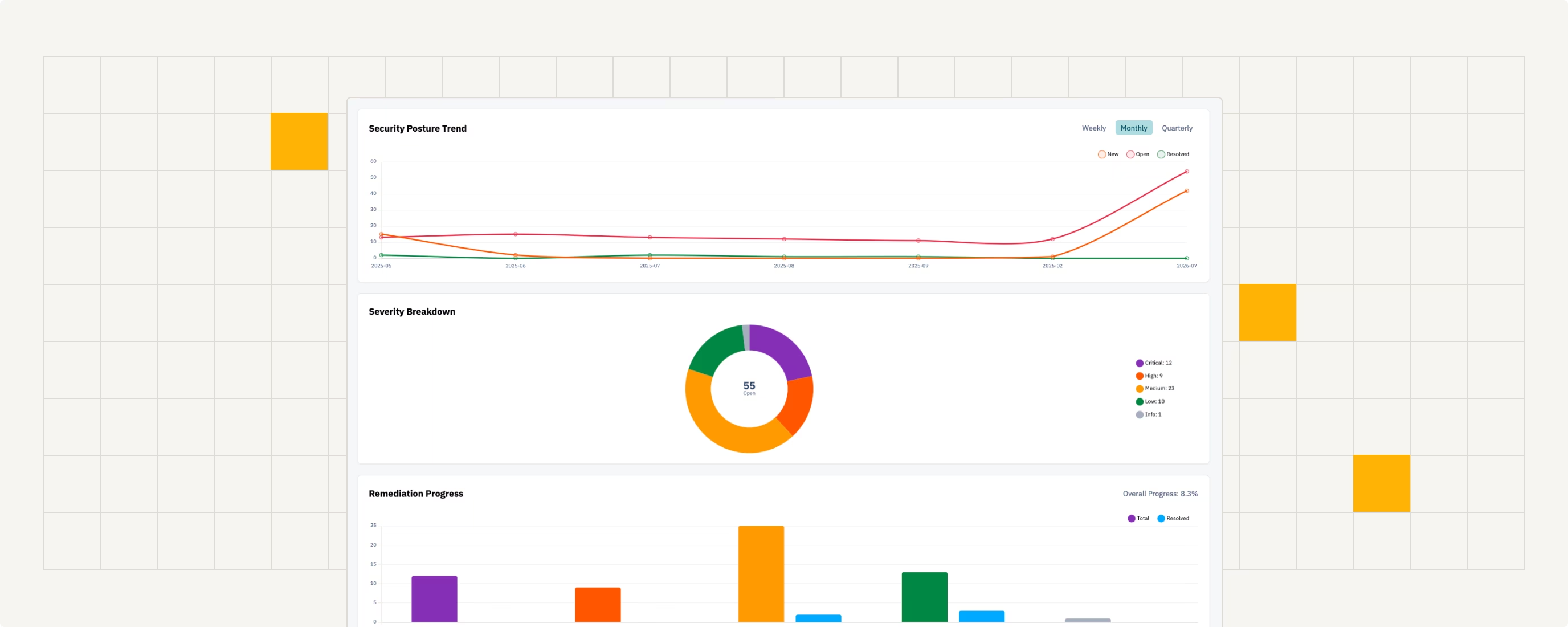
Goal-driven exercise
Agreed safety limits
MITRE ATT&CK coverage
Detection and response
Red team engagements test whether your organization can prevent, detect, and respond to a realistic attack. Blaze follows agreed objectives and rules of engagement, then shows how far an attacker could get and what your team would see.
Trusted by organizations around the world








Red team services test whether you would detect the attack
Red team operations are authorized, objective-led simulated attacks. Unlike penetration testing, a red team exercise follows realistic attack paths while staying covert, measuring detection and response against a targeted attack.

Red teaming
An objective-led adversary simulation that uses attack vectors relevant to your environment to test prevention, threat detection, and incident response.

What a red team engagement can cover

Adversary emulation
Multi-stage attack paths mapped to relevant MITRE ATT&CK techniques, from initial access and lateral movement to an agreed objective such as reaching sensitive data.
Social engineering
Phishing or pretexting when authorized, with targets, safeguards, and escalation paths agreed in advance.
Assumed breach and purple teaming
Start from a controlled foothold, or work alongside defenders to validate and tune detection in real time.
Detection and response evidence
See what was detected, where visibility failed, how the response unfolded, and which gaps to close first.
How a red team engagement works

Define the objective
Agree the target outcome, scope, safety limits, escalation paths, and stop conditions.

Prepare the scenario
Select realistic attack paths informed by your threat model, environment, and agreed security risks.
Execute and measure
Pursue the objective while recording how controls, people, threat detection, and incident response perform.

Debrief and improve
Review the attack narrative, missed signals, strengths, control gaps, and prioritized actions with stakeholders.
Penetration testing vs red team(ing)
Goal
Find vulnerabilities in scope
Achieve an objective (data, access)
Scope
Defined targets
Broad; people + process + tech
Stealth
Overt, cooperative
Covert; tests detection
Tests your SOC?
No
Yes, detection & response
Duration
1-3 weeks
3 weeks to months
Best for
Coverage, compliance evidence
Validating a mature security program
Named specialists from scoping through debrief
Named offensive security specialists stay with the engagement from planning through debrief, providing continuity, direct communication, and clear accountability.
 Named
NamedEngagement team
 Direct
Operator access
 Controlled
Rules of engagement
 Clear
ClearTechnical debrief
How Blaze keeps delivery accountable
Engagement roles, communication paths, and escalation contacts are confirmed before testing begins.
Frequently asked questions

Ready to test your defenses against a realistic attack?
Plan an objective-led exercise and see what your team detects, misses, and can improve.
