
Shopify requires an annual independent third-party security penetration test of the application for its Certified Technology Partner Program, following OWASP and NIST methodologies. This is a program-specific requirement, not a blanket annual pentest rule for every Shopify App Store app. A pentest report helps document technical testing; a separate security assessment and Shopify's decision determine program participation.
Who needs an annual independent test?
Applicants to and participants in the Certified Technology Partner Program should plan for an annual independent third-party application pentest. Shopify's qualification guidance names the annual test and OWASP and NIST methodologies. Its program terms also describe annual review and an assessment selected or approved by Shopify. Check the current instructions supplied for your application or renewal before commissioning work.
Do not confuse this program with a standard Shopify App Store listing or the separate Built for Shopify designation. Each has its own criteria. An internal code review, continuous scanning, and secure development practices are valuable, but they do not by themselves fulfill a requirement that explicitly calls for an independent third party. A storefront-only report also may miss the partner application that Shopify asks to have tested.
Shopify does not specify a particular OWASP checklist release, NIST publication, minimum number of testing days, or universal report template in the qualification language. The OWASP Web Security Testing Guide and NIST SP 800-115 are useful methodology references, not additional versions mandated by Shopify. An extra test after a major authentication, architecture, or data-flow change is a sensible risk decision; it is distinct from the stated annual cadence and from validating a specific fix.
What should the application pentest cover?
The test should follow the application and its sensitive data flows: merchant-facing web interfaces, backend APIs, OAuth and session handling, webhook receivers, administrative functions, storage, and supporting services that the partner controls. Define the authorized environment and exclusions in writing. An assessor needs to understand where the application obtains a shop identity, how it authorizes a user or service, and whether that context survives every asynchronous step. Shopify-managed infrastructure is outside a partner's engagement unless separately authorized.
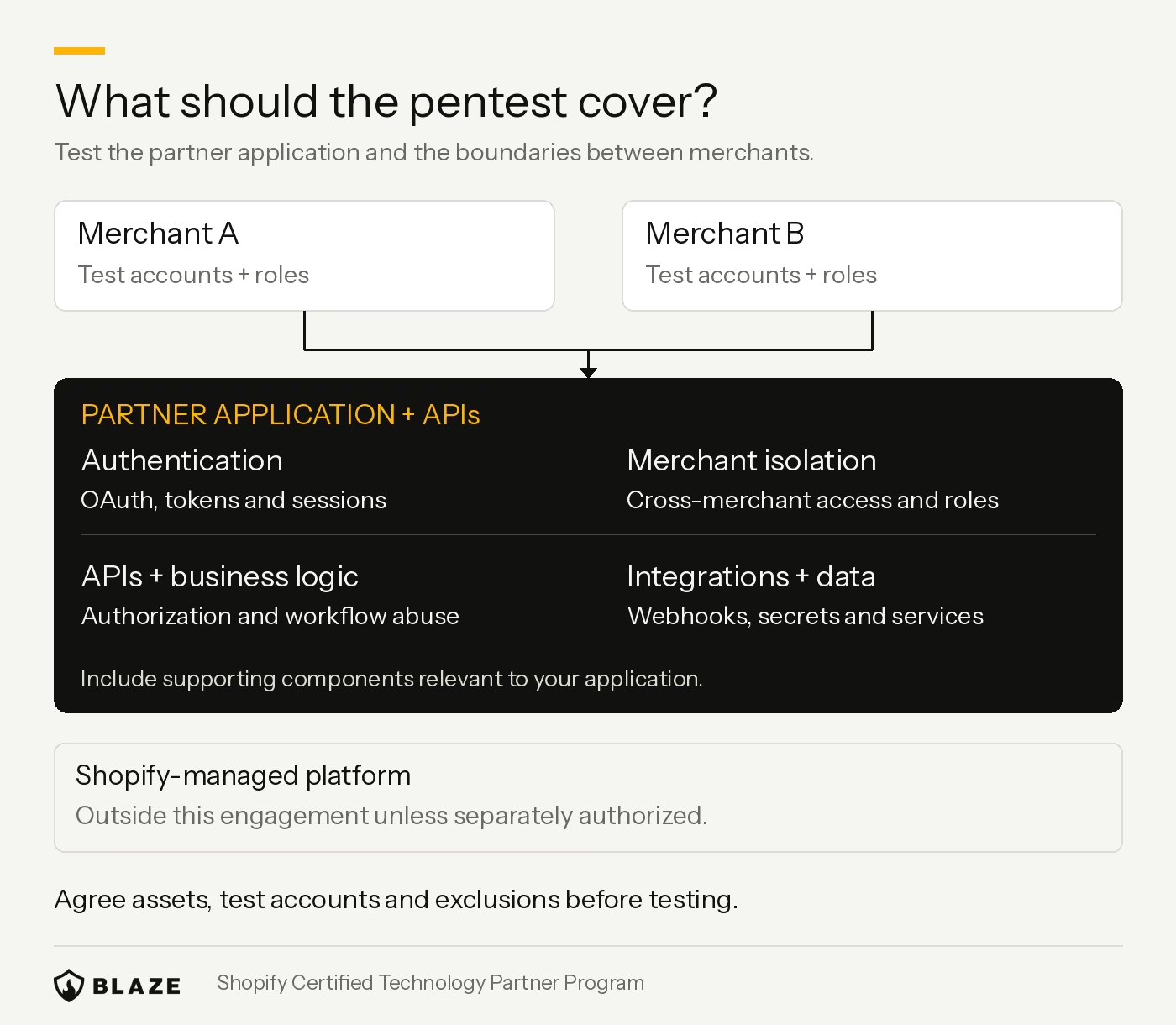
A useful scope includes these questions:
- Merchant isolation and access controls: Can one shop or a lower-privilege user read another merchant's customer records, change configuration, trigger an export, or act as an administrator? Test object, property, and function-level authorization across UI and API paths. OWASP's API guidance frames common authorization risks.
- Authentication and OAuth: Are shop and user identities bound to the correct session and backend operations? Are tokens protected, rotated when appropriate, and limited to the scopes the integration needs? Can a stale or misbound token cross a merchant boundary?
- Webhooks and background jobs: Does the receiver verify deliveries, associate events with the correct shop, and safely process duplicate or delayed events? Shopify describes webhook verification for HTTPS deliveries. Check the queue and worker path as carefully as the initial request.
- Business logic and data handling: Can an invalid sequence bypass approvals or billing rules? Can exports, logs, backups, or connected storage reveal sensitive customer data or secrets? Encryption, retention, and deletion controls deserve review according to the architecture.
For example, imagine an export endpoint that accepts a record identifier from Shop A while the request is authenticated for Shop B. A missing shop ownership check could disclose customer data even when the interface never presents the other shop's records. In another illustrative case, a valid webhook is queued under the wrong shop context; a worker could update the wrong merchant's data. A background job that picks up a cached token belonging to another shop creates a similar boundary failure. These examples are test ideas, not claims about findings in a particular Shopify app.
Automated scanning helps identify known weaknesses, but it cannot establish the intended merchant boundary or whether a business transaction is valid. Ask a provider to explain the manual role and merchant comparisons it will perform, the workflows it will exercise, and how it will substantiate findings. Our broader guide to SaaS penetration testing discusses the same multi-tenant concern beyond Shopify apps.
How do you turn the scope into a meaningful test?
List the application's distinct trust boundaries before choosing a package. An embedded admin page and its API may serve the same workflow, while a separate analytics portal or public ingestion API may add another application or API group. Count the merchant contexts and roles the tester needs to compare, including staff permissions, support access, and service credentials where applicable. Document any feature flags or restricted workflows that make behavior different between shops. These details determine whether a published package reflects the real effort or a custom engagement is warranted.
For each important workflow, define a legitimate action and a nearby misuse case. An export should be available only to the appropriate merchant and role; its download URL, queued job, and completed file should keep that boundary. A webhook should be tied to the shop whose event it represents all the way through a retry or downstream sync. An OAuth installation and reauthorization flow should not allow one shop's access token to be reused under another shop's session. The tester can then trace a complete path instead of testing isolated endpoints without business context.
Agree on safe execution rules before the test. Use synthetic customer records and two or more controlled shops when feasible. Identify workflows that send email, move funds, change live inventory, or call third-party systems, and provide a safe way to exercise them. Clarify any rate limits, logging, alerting, and emergency contacts. If production is the only representative environment, specify how evidence can be gathered without exposing real customer data unnecessarily. Record exclusions in the report so a reviewer can see what the test actually covered.
What evidence supports the partner security review?
A clear pentest report records the target and dates, methodology, credentials and roles used, coverage and exclusions, reproducible evidence for each finding, impact, severity reasoning, and specific remediation guidance. A severity score such as CVSS can help prioritize work alongside business context; Shopify's cited requirement does not prescribe it. Track an owner and fix for each issue, and keep a record of any agreed validation round. The report should distinguish a tested fix from an untested design change.
The security review reaches beyond the pentest. Use this planning checklist to connect each control to the evidence a reviewer may request and the narrower contribution of a test. Confirm the current requirements and submission instructions for your program review.
| Security area | Evidence to prepare | Pentest contribution |
|---|---|---|
| Tokens, encryption, and access | Token rotation and storage design; encryption in transit and at rest; least-privilege OAuth scopes and production access records. | Probe exposed token, session, and access-control paths; identify observed configuration or authorization failures. |
| Merchant separation and data lifecycle | Shop-context design, customer-data inventory, retention and deletion rules, and tenant isolation controls. | Compare controlled merchants and roles across APIs, exports, webhooks, storage paths, and jobs. |
| Environment and recovery | Test and production separation, backup procedures, and evidence of annual restore testing. | Assess reachable paths and misconfigurations in the agreed environment; the report does not prove an annual restore occurred. |
| Disclosure, response, and fixes | Vulnerability disclosure channel, response process, remediation tickets, relevant code reviews, and fix records. | Provide reproducible findings and, when included, validate specified fixes; operational processes need separate evidence. |
Blaze’s package deliverables include a technical report with evidence, impact, and remediation guidance, an attestation letter documenting the assessment, and access to findings through VulnKeep. The engagement also includes a 30-day findings Q&A period. The buyer assurance page offers a report preview so buyers can inspect the reporting style. Where included in the package, a validation round verifies agreed fixes and produces separate fix-validation documentation. The Blaze attestation and any fix-validation record are distinct from the program’s Letter of Validation.
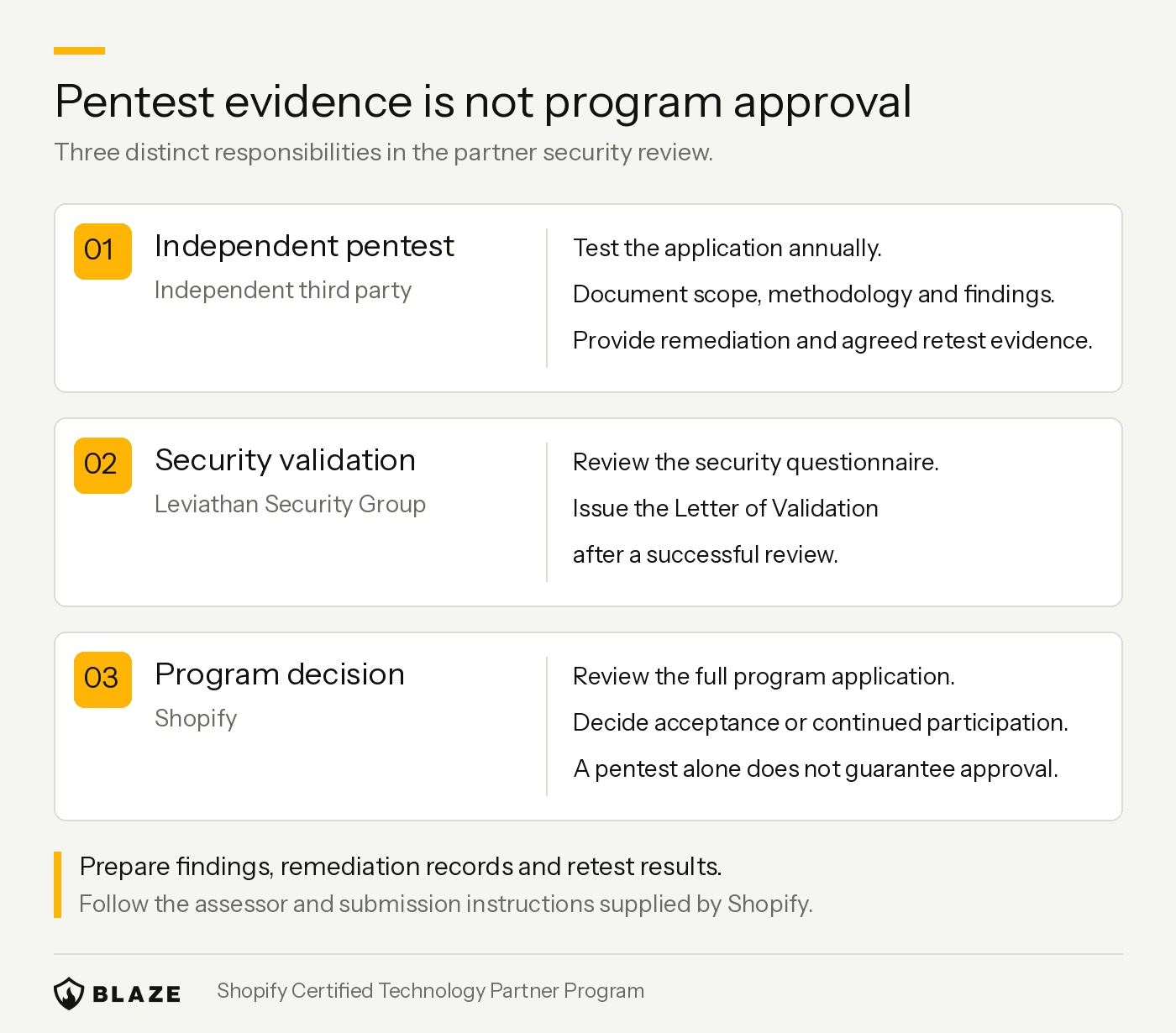
Leviathan Security Group's published process describes a separate security questionnaire assessment and a Letter of Validation after a successful review. Shopify then makes the final program decision. The independent pentest provider supplies technical testing evidence; the program assessor evaluates its broader requirements. Shopify's pentest wording does not name Leviathan as the required pentest provider. Confirm the reviewer, submission format, and any separate assessment costs in your own onboarding instructions.
What should happen after findings are reported?
Prioritize findings by demonstrated impact on merchant and customer data, the privileges needed to exploit them, and the reach of the affected workflow. A cross-shop read can be more consequential than a flaw limited to a test-only function, even when a generic score looks similar. Fix the cause at the authorization or context-binding boundary, then check related paths such as exports, batch operations, and worker queues. Keep evidence of the patch and deployment version with the finding.
For a validation round, give the tester access to the fixed build and the same roles and shop contexts used in the original proof. The tester should attempt the reported path again and record the result and limitations. Plan additional coverage if the fix redesigns a workflow or substantial new functionality has arrived.
Shopify partner penetration testing cost: Blaze packages
The published prices below are Blaze service prices, not fees set by Shopify. They describe bounded web application or API group scopes. Confirm the application boundary, roles, workflows, integrations, and report needs before selecting a package; additional components may require a custom scope. Taxes are additional.
| Package | Package price (USD) | Published scope and fix validation |
|---|---|---|
| Lite | $4,999 | One web application or API group with up to two roles. Fix validation is an add-on. |
| Essentials | $7,499 | One web application or API group with up to three roles, business logic testing, and one validation round within 90 days. |
| Assurance | $8,999 | One web application or API group with up to five roles, advanced and business logic testing, and one validation round within 90 days. |
Essentials is a practical starting point when business logic coverage and a round of retesting are needed. Lite may fit a smaller, clearly bounded target; Assurance may fit a wider role model. Multiple applications, separate API groups, infrastructure reviews, or complex workflows require a tailored scope and quote. The security questionnaire assessment and any associated assessment fee are separate from Blaze's pentest price.
How should a partner prepare and schedule the test?
Give the tester a current architecture diagram, data-flow overview, target URLs and API documentation, sample authenticated requests, and a list of integrations and exclusions. Provide production-like staging and synthetic data where practical, with accounts for at least two merchants and all in-scope roles. Name an engineering contact who can explain exceptional workflows and safely reset test state. Our guide to preparing for an API penetration test covers the access and documentation that save time during kickoff.
Plan backward from the partner review: scope and access agreement, test start, active testing, report review, engineering fixes, and any validation round. Blaze's shop describes a typical start in two to three weeks and a fast-track start at approximately one week, subject to availability. Those are start estimates, not promises for active testing duration, report delivery, or remediation completion. Confirm milestones for your actual scope and leave room for your team to fix findings. If a significant new feature ships after the test, assess whether it needs added testing; a fix-validation round does not automatically cover newly introduced workflows.
Map your app, API groups, role model, and review date to a scope before booking. If your assurance program includes other frameworks, our SOC 2 penetration testing guide explains that separate context.