AI Penetration Testing Services for LLMs and Agents
Expert-led AI penetration testing for LLM applications, RAG pipelines, and agents. Assess prompt injection, data leakage, unsafe output handling, excessive agency, tool use, and chained attacks across the surrounding application.

What every AI and LLM pentest includes
- OWASP LLM risk coverage
- Prompt injection and jailbreak testing
- System prompt and sensitive data exposure
- Agent permission and tool use abuse
- RAG retrieval and poisoning risks
- Direct access to the researchers on your engagement
- Fix validation when included in scope
What is AI penetration testing?
AI penetration testing is a controlled assessment of AI systems and the applications around them. Blaze tests prompt handling, retrieval pipelines, data exposure, agents, tool permissions, output handling, APIs, and identity controls to find exploitable paths and explain how to reduce the risk.
organizations trust Blaze worldwide
AI security guidance used where relevant
Test the AI system and the application around it
Researchers assess prompts, model behavior, RAG, agents, tools, APIs, identities, and data flows. Every finding is reproduced and tied to a practical remediation path.
Why choose Blaze for AI penetration testing services?
Combine offensive-security depth with practical testing of AI systems, LLMs, RAG, agents, tool use, and the applications around them.


AI-native expertise
Test prompt handling, RAG, model behavior, and agent workflows with adversarial techniques—not generic scanners.

Full-stack coverage
Assess the AI layer and surrounding web, API, identity, and data flows.

Actionable remediation
Receive practical guidance for guardrails, permissions, output handling, and safer AI architecture.
AI security guidance
Testing can reference OWASP guidance, MITRE ATLAS, and NIST AI RMF where relevant to the system and scope.
OWASP Top 10
Common LLM application risks
AI testing
OWASP guidance for AI-system testing

MITRE ATLAS
Adversarial tactics and techniques for AI systems

NIST AI RMF
AI risk-management context
PTES
Penetration Testing Execution Standard
OWASP ASVS
Controls in the surrounding application
Compliance support
Relevant findings mapped to applicable requirements
Expert-led AI penetration testing services
Named security researchers run the engagement and stay available throughout testing and remediation.
 Named
Namedexpert team for each engagement
 Direct
access throughout testing
 Manual
validation of every finding
 Clear
Clearremediation guidance for engineers
Our Team Holds Industry-Leading Certifications
Research contributions: Our testers have spoken at BlackHat, DEF CON, and BSides conferences worldwide.
What AI penetration testing services cover
AI-specific attack paths that conventional application testing may not cover.
Prompt injection
Direct and indirect prompt injection in user and retrieved content.
Data leakage
Exposure of system prompts, confidential data, or retrieved content.
Guardrail bypass
Bypassing safety controls, context handling, or output validation.
Unsafe output handling
Untrusted model output reaching browsers, APIs, tools, or interpreters.
Excessive agency
Over-privileged agents taking unintended or unauthorized actions.
Model denial of service
Inputs causing excessive resource use or service degradation.
Retrieval manipulation
Manipulating retrieved content to influence model behavior.
Supply chain
Risks in models, tools, plugins, and dependencies.
Our testing methodology
A systematic approach combining adversarial ML techniques with traditional offensive security.


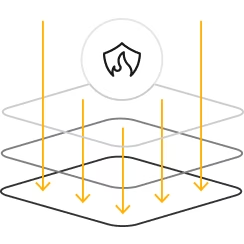


We know your AI stack
Test models, RAG pipelines, copilots, and agents in the application’s security model—not as a generic benchmark.








Illustrative risk
Indirect prompt injection in retrieved content can expose system instructions or trigger unsafe tool use.
Illustrative risk
An over-privileged agent can be manipulated into taking unintended actions when authorization controls are weak.
Related services


Frequently asked questions
Answers about AI application scope, models, RAG, agents, tools, safety limits, pricing, and remediation.
Ready to test your AI application?
Talk to an expert about your models, RAG, agents, tools, data flows, timeline, and required coverage.
