


Choosing a penetration testing service is not just a procurement decision. For many organizations, it is part of a broader effort to identify vulnerabilities, strengthen data protection, support compliance, and improve overall risk mitigation. The challenge is that many penetration testing companies describe their services in similar terms, which can make it difficult to evaluate differences in scope, testing methodologies, reporting quality, and the experience of the penetration testing team.
This article is for security-literate readers who are evaluating providers, especially security leaders, technical stakeholders, and internal teams that need to compare services. This piece focuses on the key questions to ask pentest providers when assessing whether a service is appropriate for your environment, business requirements, and security objectives. If your goal is to write a pentest Request for Proposal, we have a comprehensive article on that.
The right questions can help clarify how a provider approaches automated and manual testing, sensitive data, access controls, reporting, and the provision of actionable guidance. The goal is not to identify a universally “best” provider, but to make it easier to evaluate which service is a good fit for your organization.
What questions to ask pentest providers
These questions can be included in a Request for Proposal (RFP) or asked directly during vendor discussions. They help organizations gather consistent information about each provider’s methodology, experience, and reporting practices.
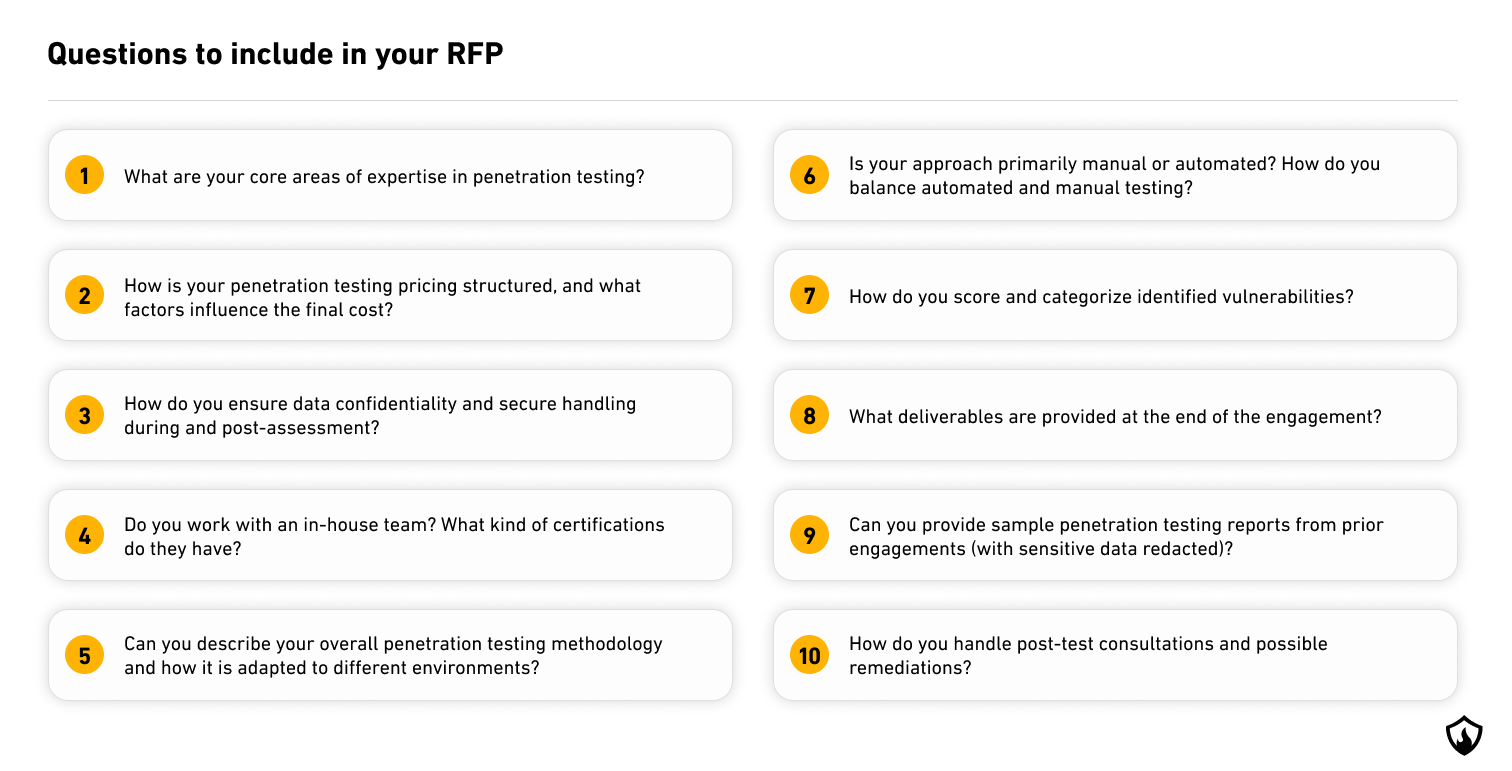
1. What are your core areas of expertise in penetration testing?
This question helps determine whether the provider’s experience matches the technologies and environments in scope, such as web applications, networks, cloud infrastructure, mobile applications, or APIs. A provider may be strong in one area but less experienced in another. It is also useful to know whether they have worked with organizations similar to yours in size, complexity, or sector.
2. How is your penetration testing pricing structured, and what factors influence the final cost?
This helps clarify whether pricing is based on scope complexity, time and effort, risk level, or predefined packages. A transparent pricing model makes providers easier to compare and helps show whether the estimate reflects realistic testing depth. Providers that quote a flat fee before understanding the environment should be assessed carefully.
3. How do you ensure data confidentiality and secure handling during and after the assessment?
A penetration test may involve access to sensitive systems, credentials, or business data, so secure handling practices matter. This question helps assess how the provider stores, transfers, limits, and disposes of sensitive information. It can also show how they handle accidental exposure or other security incidents during the engagement.
4. Do you work with an in-house team? What kind of certifications do they have?
This question clarifies who will actually perform the assessment and whether the work is handled internally or outsourced. In-house professionals are preferred over contractors for consistency and accountability in penetration testing projects. You can request information about the certifications held by the penetration testing team, as well as by the company itself, such as CREST, ISO 9001:2015, and other industry-relevant certifications.
5. Can you describe your overall penetration testing methodology and how it is adapted to different environments?
Ensure the provider’s testing methods and security tools are tailored to your organization’s specific technology stack and environment. A clear methodology indicates that the provider follows a structured, repeatable process rather than an ad hoc approach. This question helps assess how the testing is planned, executed, and adapted to different systems or business contexts. It can also show whether the provider accounts for industry-specific requirements and regulatory requirements.
6. Is your approach primarily manual or automated? How do you balance automated and manual testing?
This question is important because automated scanning alone does not provide the same depth as a full penetration test. Understanding the balance between automated tools and manual testing helps clarify the level of analysis involved. A strong vulnerability assessment should rely heavily on manual testing, with automation supporting efficiency and coverage rather than replacing expert judgment.
7. How do you score and categorize identified vulnerabilities?
The answer to this question shows how the provider determines severity and prioritizes findings in the final report. That matters because scoring affects how internal teams interpret risk and decide what to remediate first. A solid penetration testing report should include detailed documentation on how vulnerabilities were accessed and specific steps to fix each issue.
8. What deliverables are provided at the end of the engagement?
This sets expectations for what the provider will deliver once the test is complete. It helps clarify whether the output includes only technical findings or also an executive summary, supporting evidence, and actionable remediation guidance. Clear expectations at this stage make it easier to assess the value of the engagement.
9. Can you provide sample penetration testing reports from prior engagements (with sensitive data redacted)?
A sample report gives a practical view of the provider’s reporting style, level of detail, and clarity. It helps assess whether findings are presented in a way that supports remediation planning and internal communication. Reviewing a redacted sample can also show whether the report includes an executive summary, technical depth, and useful remediation guidance.
10. How do you handle post-test consultations and possible remediations?
This question helps clarify whether the provider’s role ends with the report or includes follow-up support or retesting. Post-test consultation can help internal teams validate findings, understand technical details, and prioritize remediation. Retesting is essential to verify that vulnerabilities have been effectively resolved and no new issues have been introduced.
What strong answers from pen test providers tend to include
The value of these questions depends not only on whether a provider responds, but on how specific and transparent those responses are. They should make it clear how the penetration testing team plans to identify vulnerabilities, validate findings, and communicate potential risks in a way that supports decision-making.
In most cases, stronger providers also describe how they balance automated and manual testing, how they prioritize critical vulnerabilities, how they adapt to the evolving threats and what kind of actionable recommendations are included in the penetration testing report. Clear explanations of pricing, deliverables, follow-up support, and technical qualifications can make it easier to compare penetration testing companies beyond cost alone.
The goal is not to look for identical answers, but to assess whether a provider demonstrates a structured process, relevant expertise, and a realistic understanding of your environment. If you’re still unsure how to choose the best pentest company for your business, our articles on penetration testing companies to consider and on choosing the right pentest provider might help.