Vulnerability scanning and penetration testing are both used to identify security weaknesses, but they serve different purposes. Vulnerability scans are designed to quickly detect known vulnerabilities, misconfigurations, and exposed services across an organization's systems, while penetration testing goes further by investigating whether weaknesses can actually be exploited and what impact they could have.
The terms are sometimes used interchangeably, which can make it hard for security teams to decide which type of assessment they need. Vulnerability assessments add another layer of confusion, as they often include vulnerability scanning but typically involve additional analysis and prioritization of the findings.
Understanding the difference is important because choosing the wrong approach can leave security gaps, lead to unnecessary spending, or create a false sense of assurance. This article is intended for IT teams, procurement teams, and other decision-makers evaluating different types of security testing. We compare penetration testing, vulnerability scanning, and vulnerability assessment, explain their main strengths and limitations, and show how each can contribute to an organization's security posture and more comprehensive security coverage.
What is vulnerability scanning?
Vulnerability scanning is an automated process that identifies security weaknesses across networks, applications, systems, and infrastructure. Vulnerability scanning tools typically look for issues such as outdated software, known software vulnerabilities, exposed services, weak configurations, and other common security gaps.
Because scans are automated, they can cover large environments quickly and be repeated on a regular schedule. This makes vulnerability scanning particularly useful for continuous monitoring and vulnerability management, helping security teams identify weaknesses as systems change and new software vulnerabilities are disclosed.
However, a vulnerability scan does not necessarily determine whether every identified issue is exploitable in a real-world attack. Automated scanners can also produce false positives or miss vulnerabilities that depend on business logic, unusual system behavior, or context that predefined checks alone can't identify.
Vulnerability scanning vs vulnerability assessment
Although the terms are sometimes used interchangeably, vulnerability scanning and vulnerability assessment are not exactly the same.
A vulnerability scan is primarily the technical process of detecting potential vulnerabilities. A vulnerability assessment is broader: the vulnerability assessment process typically combines scanning with vulnerability analysis, validation, prioritization, and remediation guidance to help security teams understand which weaknesses pose the greatest risk to the organization.
In other words, vulnerability scanning identifies potential security weaknesses, while a vulnerability assessment adds context to help determine what should be addressed.
What is penetration testing?
Penetration testing is a security assessment that goes beyond identifying potential vulnerabilities to determine whether attackers could exploit vulnerabilities in practice and what impact they might have. Pen testers combine automated tools with manual techniques to investigate systems, applications, networks, and other parts of an organization's security architecture. NIST includes penetration testing among the technical security testing and assessment methods used to identify and validate weaknesses in information systems.
A pen testing engagement can include steps like validating vulnerabilities, testing authentication and authorization controls, chaining multiple weaknesses together, and simulating real-world attack scenarios. Skilled security professionals can also adapt their approach as new information emerges, allowing them to investigate security gaps that automated scanners may not recognize.
The goal is not simply to produce a list of vulnerabilities, but to understand which weaknesses are genuinely exploitable, whether any critical vulnerabilities can be chained into broader attacks, and what the consequences could be for network security, data security, or business operations.
Penetration testing is typically scoped around specific assets, applications, or objectives and results in a detailed report that includes evidence, risk context, and remediation recommendations. Depending on the engagement, it can also assess whether existing security controls and defense mechanisms are effective against realistic attacks.
Penetration testing vs vulnerability scanning: key differences
The main difference between penetration testing and vulnerability scanning is depth. Vulnerability scanning is designed to identify potential weaknesses quickly and at scale, while penetration testing investigates whether those weaknesses can actually be exploited and what an attacker could achieve.
Vulnerability assessments sit between the two in some respects: they go beyond raw scan results by adding analysis, validation, prioritization, and remediation guidance, but they do not necessarily include the same level of exploitation or attack simulation as a penetration test.
| Vulnerability scanning | Vulnerability assessment | Penetration testing | |
|---|---|---|---|
| Main objective | Identify potential security weaknesses | Identify, analyze, and prioritize vulnerabilities | Determine how weaknesses can be exploited and what impact they could have |
| Approach | Primarily automated | Automated scanning combined with analysis | Combination of automated tools and manual testing |
| Depth | Broad, usually surface-level | Broader analysis of identified vulnerabilities | Deeper investigation of selected systems and attack paths |
| Human involvement | Limited | Moderate | High |
| Validation of findings | Limited or tool-dependent | Findings may be reviewed and validated | Vulnerabilities are actively investigated and validated where appropriate |
| Business logic testing | Limited | Limited | Common |
| False positives | More likely without manual validation | Reduced through analysis and review | Lower because findings are typically manually validated |
| Typical output | List of detected vulnerabilities and technical findings | Prioritized findings with analysis and remediation guidance | Detailed report with evidence, exploitability, impact, and remediation recommendations |
The frequency of testing depends on the organization's profile and security program rather than the assessment type alone. Vulnerability scans are often automated and run continuously or on a frequent schedule, but vulnerability assessments and penetration tests can also be performed regularly, after major changes, or as part of an ongoing security testing program.
Coverage and testing depth
Vulnerability scanning is particularly effective when security teams need broad coverage across many assets. Automated scanners can repeatedly check an organization's systems for known vulnerabilities, misconfigurations, and other common weaknesses without requiring extensive manual effort.
Penetration testing focuses more on depth. Rather than checking as many systems as possible, penetration testers investigate how weaknesses interact, whether existing security controls can be bypassed, and whether a malicious attacker could use them to compromise sensitive data or other critical assets.
Detection vs validation
A vulnerability scanner may indicate that a system appears to be affected by a known weakness, but that does not always mean the vulnerability is exploitable in that specific environment.
Pen testers can investigate further, test the conditions required for exploitation, and determine the real-world impact of the issue. This helps security teams distinguish between potential vulnerabilities and weaknesses that represent a more immediate cyber risk.
Automation and human expertise
Vulnerability scanning relies heavily on automated tools and predefined checks. That makes it fast and repeatable, but it also limits how well scanners can understand context, unusual system behavior, or business logic.
Penetration testing combines automation with human expertise. Testers can change their approach based on what they discover, investigate unexpected behavior, and develop attack paths that automated scanners may not identify on their own.
How penetration testing and vulnerability scanning work together
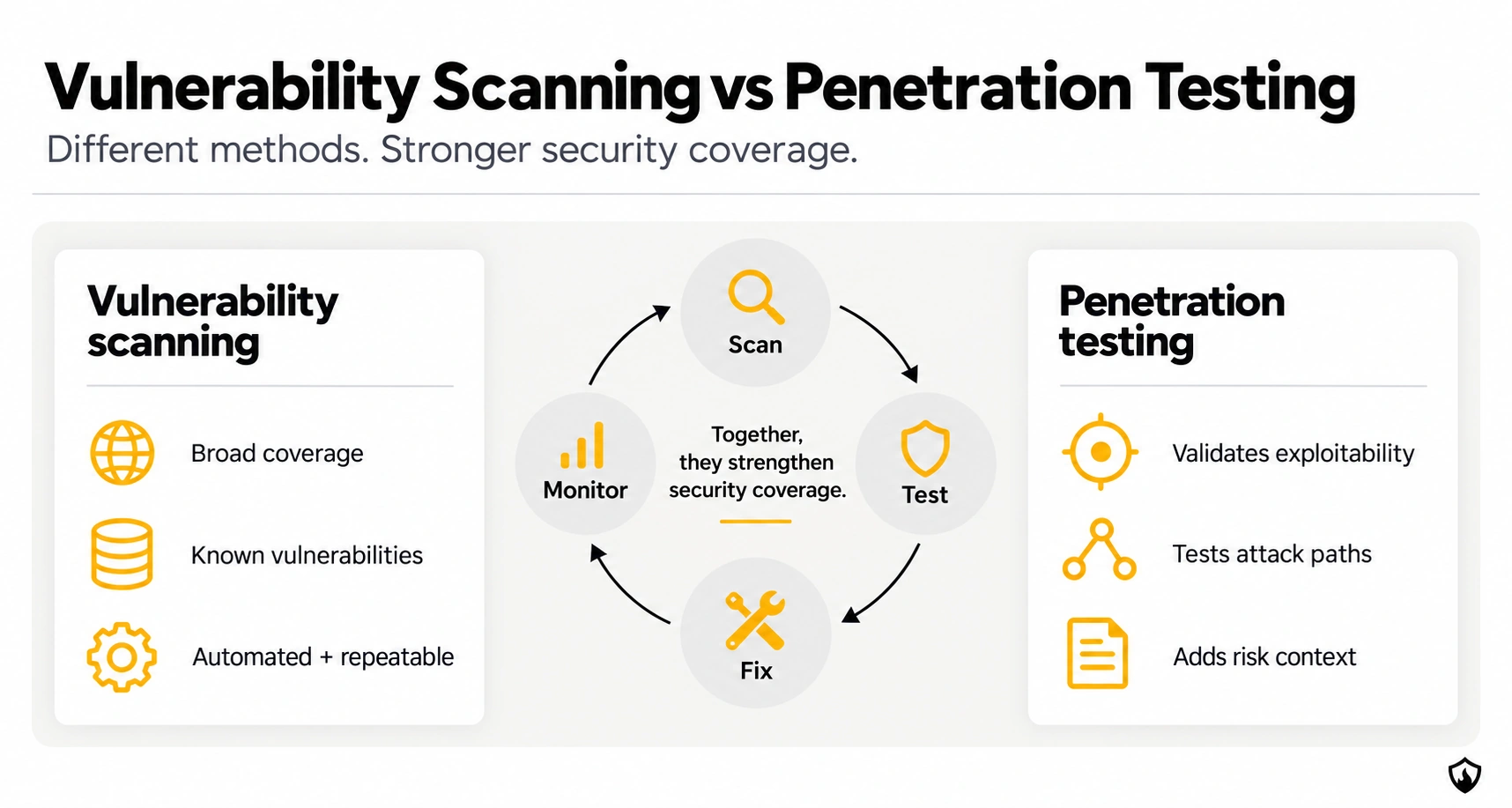
Penetration testing and vulnerability scanning are most effective when they are treated as complementary parts of a broader security testing program rather than as alternatives.
Vulnerability scanning provides broad, repeatable coverage across an organization's systems. It can help security teams identify known vulnerabilities, misconfigurations, outdated software, and other common weaknesses as environments change. Because scans are automated, they can be performed routinely and across large environments.
Penetration testing adds depth. Rather than only identifying potential weaknesses, pentesters investigate whether vulnerabilities can actually be exploited, whether multiple issues can be chained together, and what impact a successful attack could have. This can also help validate whether existing security controls are effective against realistic attack scenarios.
The two approaches can reinforce each other. Scan results may help security teams identify areas that deserve deeper investigation, while penetration testing findings can reveal attack paths or recurring weaknesses that organizations can monitor more systematically afterward.
There are also compliance-driven reasons to use both approaches. PCI DSS or DORA, for example, include requirements for vulnerability scanning and penetration testing, while other frameworks and regulations may require broader risk assessment and security testing activities.
In other situations, one approach may make more sense on its own. Vulnerability scanning is particularly useful for ongoing visibility and vulnerability management across large or frequently changing environments. Penetration testing is more appropriate when organizations need to understand exploitability and real-world impact, such as before a major launch, after significant infrastructure changes, or when regulatory, customer, or risk requirements call for deeper validation.
In many security programs, the strongest approach is to use vulnerability scanning for continuous coverage and penetration testing for periodic, in-depth validation. Vulnerability assessments can sit between the two by adding analysis and prioritization to scan results, but the core distinction remains the same: scanning helps identify potential weaknesses, while pentesting tests how those weaknesses could be used in practice.
Conclusion
The key difference between penetration testing and vulnerability scanning is not that one is better than the other, but that they answer different security questions. Vulnerability scanning helps organizations identify potential weaknesses quickly and at scale, while penetration testing provides deeper validation of how those weaknesses could be exploited and what impact they might have.
If you are choosing your next pentest provider, this is one of the things you should clarify, along with these 10 questions to ask your pentest provider.
Used together, they give security teams both broad visibility and deeper assurance. The right balance will depend on the organization's risk profile, systems, regulatory requirements, and security objectives, but relying on only one approach can leave important gaps in coverage.