


Loading the Elevenlabs Text to Speech AudioNative Player...
How security assessments help meet compliance and secure connected devices
From smart home devices and wearable health monitors to industrial sensors and medical equipment, billions of Internet of Things (IoT) devices are now woven into our daily lives and critical infrastructure. Ensuring these systems are not only functional but demonstrably secure has become an essential part of bringing them to market.
IoT penetration testing delivers that assurance. It’s a thorough, manual security assessment that examines every layer of a device’s ecosystem — from hardware and firmware to communication, applications, and cloud components — to confirm that products meet both technical and compliance expectations.
This article explains how a professional IoT pentest is conducted, what’s typically in scope, and how the results help organizations meet the regulatory, legal, and vendor security requirements shaping the IoT market in 2025 and beyond.
What is IoT penetration testing?
IoT penetration testing is a manual security assessment designed to evaluate how resilient a connected device and its supporting ecosystem are against real-world attacks. Unlike traditional network or web application pentests, IoT pentesting spans multiple domains — hardware, firmware, connectivity, cloud infrastructure, and companion applications — each introducing its own unique attack surface.
The goal is not simply to catalogue vulnerabilities, but to understand how they interact across layers. A firmware vulnerability might allow access to network credentials, which in turn could expose cloud APIs or backend systems. By following the same paths a real attacker would take, a pentest reveals how one weakness can cascade through the entire device environment.
A well-scoped IoT pentest provides organizations with a detailed understanding of technical risks, evidence to support compliance with frameworks such as the EU Cyber Resilience Act and the U.S. Cyber Trust Mark, and clear guidance for remediation. The result is a verified security posture that satisfies both engineering and regulatory expectations.
How IoT penetration testing is conducted
A professional IoT penetration testing involves examining the entire IoT ecosystem: from physical hardware to cloud infrastructure. The following sections outline the main areas of assessment and the methods used to identify vulnerabilities at each layer.
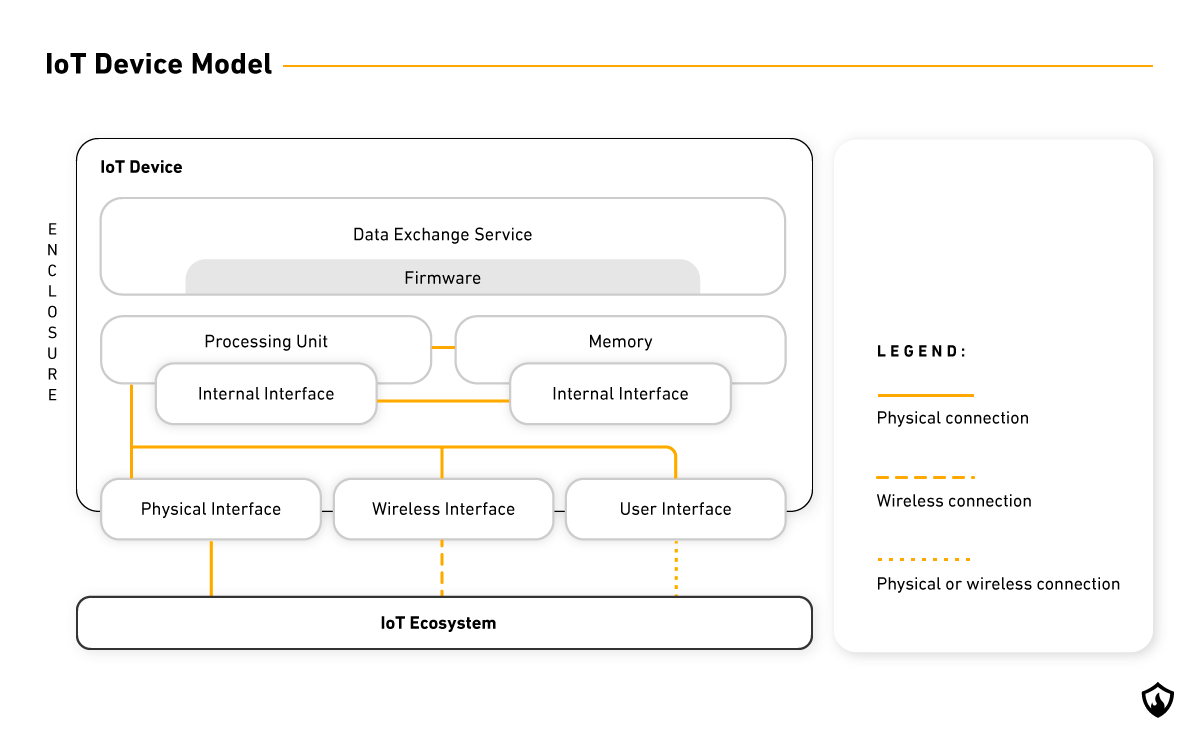
The diagram below shows a simplified model of an IoT ecosystem and the layers typically examined during a penetration test, from physical interfaces to firmware and connected services.
Hardware security assessment
Hardware is the first and often most overlooked layer of IoT security. Attackers who gain physical access to a device can exploit exposed interfaces, manipulate components, or extract firmware to uncover sensitive data and cryptographic material. Hardware testing during an IoT pentest focuses on identifying these hardware vulnerabilities before they can be abused in the field.
The process begins with examining debug and communication interfaces, such as UART, JTAG, SPI, or USB. While these are essential during development, if left exposed in production, they can serve as direct entry points. Malicious actors can exploit these interfaces to gain unauthorized access to the device’s memory, bypass security controls, obtain a shell (sometimes with root privileges), or dump sensitive data, such as encryption keys or firmware. Tools such as Bus Pirate, JTAGulator, oscilloscopes and logic analyzers are used to probe and access these interfaces.
Another key activity is firmware extraction. Penetration testers attempt to obtain the device’s firmware from flash memory, eMMC, or SPI interfaces, or from publicly available update files.
In some cases, advanced techniques such as side-channel attacks and fault injection (also known as glitching) are employed. By manipulating the power supply, clock frequency, or electromagnetic fields, pentesters assess whether the device’s security controls, such as secure boot or cryptographic operations, can be disrupted. These tests help determine the device’s resilience against more sophisticated, resourceful adversaries.
Firmware and software security testing
Firmware is the foundation of every IoT device, controlling how hardware, applications, and communications function. Vulnerabilities in firmware or embedded software can compromise the entire ecosystem – attackers can use them to gain persistence, extract credentials, or take control of multiple devices.
IoT penetration testing, therefore, examines firmware and software with a combination of static and dynamic analysis. Once firmware is obtained, pentesters review it for vulnerable or outdated libraries, hardcoded secrets, and insecure coding patterns that could expose the device to remote exploitation. Reverse engineering tools are used not only to identify vulnerabilities but also to understand how security mechanisms, such as secure boot or encryption, are implemented and whether they can be bypassed.
A key part of this process involves authentication and access control testing. Pentesters attempt to bypass login mechanisms, manipulate inputs, and exploit weaknesses in password handling. For example, poorly implemented hashing (such as MD5 or SHA1) or insecure session management can allow unauthorized access. In some cases, timing attacks or replaying authentication tokens can be used to test whether the system properly validates credentials, as presented in this talk at DEFCON 22.
The goal of this stage is to determine whether an attacker could extract sensitive data, escalate privileges, or inject malicious code into the device’s firmware. Beyond identifying vulnerabilities, the assessment also validates how well update and patch management processes protect against tampering — an important consideration for maintaining long-term product security.
Communication protocol security assessment
IoT devices rely on multiple communication protocols, such as Wi-Fi, Bluetooth, Zigbee, Z-Wave, and MQTT, to connect with cloud servers, mobile apps, and other devices. These channels are essential for functionality but also represent a major attack surface. Misconfigurations or weak implementations can allow attackers to intercept, manipulate or replay data.
During penetration testing, communication layers are examined for confidentiality, integrity, and authentication flaws. Pentesters analyze how the device establishes and maintains its network connections, verifying whether encryption protocols, such as TLS, are correctly implemented and whether data is transmitted securely between endpoints. They capture and replay traffic to simulate real-world attacks, testing how the device responds to malformed or spoofed packets.
A key focus is man-in-the-middle (MitM) testing. By inserting themselves between the IoT device and its server or gateway, attackers can intercept and manipulate traffic. Security professionals simulate this attack using tools like Wireshark or Bettercap, checking for encrypted communication and the robustness of mutual authentication mechanisms. A great tool called certmitm can be used to find TLS/SSL certificate validation vulnerabilities in IoT pentesting.
Pentesters also perform encryption and protocol fuzzing assessments, which evaluate whether cryptographic keys are properly managed and whether the device safely handles unexpected inputs or protocol errors. These assessments reveal vulnerabilities that could lead to data theft, device malfunction, or denial-of-service conditions.
By evaluating communication protocols at this level of depth, IoT penetration testing helps ensure that data in transit remains protected against interception and manipulation.
Web interface and API security assessment
Many IoT devices interact with cloud services or companion apps via APIs. Using tools like Burp Suite or Postman, ethical hackers evaluate the APIs for improper input validation, authorization bypasses, and broken authentication mechanisms. For example, they test whether an unauthenticated user can gain access to sensitive API endpoints or manipulate API calls to escalate privileges.
Pentesters check for common security issues from the OWASP Top 10 Web Vulnerabilities, such as SQL injection, Cross-Site Scripting (XSS), and Cross-Site Request Forgery (CSRF). This part involves injecting malicious scripts or payloads to manipulate the web interface or API.
Mobile application security testing
Mobile apps are often the main interface for interacting with IoT devices, making them a prime target for attacks. Penetration testing examines both the source code and runtime behavior of these applications to uncover vulnerabilities such as hardcoded credentials, insecure API calls and weak certificate validation.
Pentesters also analyze how the app stores sensitive information, like access tokens or configuration data, ensuring it uses secure storage mechanisms rather than plaintext files or shared preferences. Finally, they verify that communication between the app, the device, and backend services is properly encrypted and protected against interception.
By identifying these issues early, mobile application testing prevents attackers from exploiting companion apps to gain control over IoT devices or access sensitive data in associated cloud systems.
Cloud interface security testing
Quite often, IoT devices rely on cloud services for data storage and management. Penetration testers evaluate whether proper OAuth or token-based authentication and password-based mechanisms are used and whether session management is robust. They may also attempt privilege escalation by accessing resources or functionality not authorized for their user role.
The assessment also examines data protection in transit and at rest. Using tools and techniques for SSL/TLS analysis, pentesters confirm that data between the IoT device and the cloud service is encrypted using modern protocols and that certificates are validated correctly. Weak encryption or expired certificates could allow attackers to intercept or alter communications.
Insecure configurations, poorly segmented cloud environments, and exposed API endpoints are also common findings. By identifying these security gaps, cloud interface testing helps ensure that IoT backends are resilient against credential theft, unauthorized access, and large-scale data breaches that can compromise an entire product ecosystem.
IoT network security testing
Pentesters begin by scanning for open ports and exposed services, identifying any network interfaces or protocols that shouldn’t be accessible. Services like Telnet, FTP, or outdated web servers can provide attackers with easy entry points. Once the network map is established, pentesters analyze traffic flows to see how data moves between the device, its companion apps, and the cloud.
Another important step is evaluating network segmentation and isolation. Penetration testers verify whether IoT devices are properly segregated from critical internal systems or administrative networks. Weak segmentation can allow attackers to pivot laterally — using a compromised device to reach other sensitive parts of the environment.
Through this analysis, network security testing reveals how effectively the device and its surrounding infrastructure are protected from remote compromise, lateral movement and large-scale exploitation across connected systems.
Data storage security testing
IoT devices often store configuration files or user data locally. Penetration testers check whether this data is encrypted using secure algorithms (e.g., AES-256). They also analyze storage mechanisms to ensure that sensitive data, such as credentials, is not stored in plaintext or easily accessible locations.
Security professionals also perform memory dump analysis to verify that sensitive information, such as encryption keys or passwords, is not left in volatile memory after use. Residual data in memory can be extracted by attackers with physical access, exposing the device or its users to further compromise.
Volatility is a popular memory forensics tool, but it may not work out of the box for IoT pen testing.
User Interfaces (UI) security assessments
User interfaces in IoT devices, such as web dashboards, touchscreens, or local configuration portals, are often the first point of contact between users and systems. They are also a frequent entry point for attackers if not properly secured.
During testing, penetration testers check for default or weak credentials, ensuring that devices do not ship with easily guessable logins and that users are required to set strong passwords on first use. They also evaluate access controls and configuration options, verifying that critical features like encryption, logging, or firmware updates cannot be disabled without proper authorization.
IoT security testing methodologies and guidelines
The most widely used methodologies during IoT pentesting are the OWASP IoT Top Ten and the OWASP IoT Security Testing Guide. The former lists the most common risks affecting IoT devices, and the latter provides a detailed reference to the IoT testing framework and specific test cases. (For an overview of the OWASP IoT Top Ten and more insights on IoT cyber threats, be sure to check out our dedicated blog post on the common cybersecurity risks in IoT devices.)
Another important industry standard is established by the ioXt Alliance, an industry-led organization that sets security standards and certifications for IoT devices. The ioXt certification program allows manufacturers to test their IoT devices against ioXt security standards, and devices that pass the test can carry the ioXt certification mark. The testing covers multiple aspects of device security, such as encryption, software updates, authentication, and network security.
How long does an IoT pentest take?
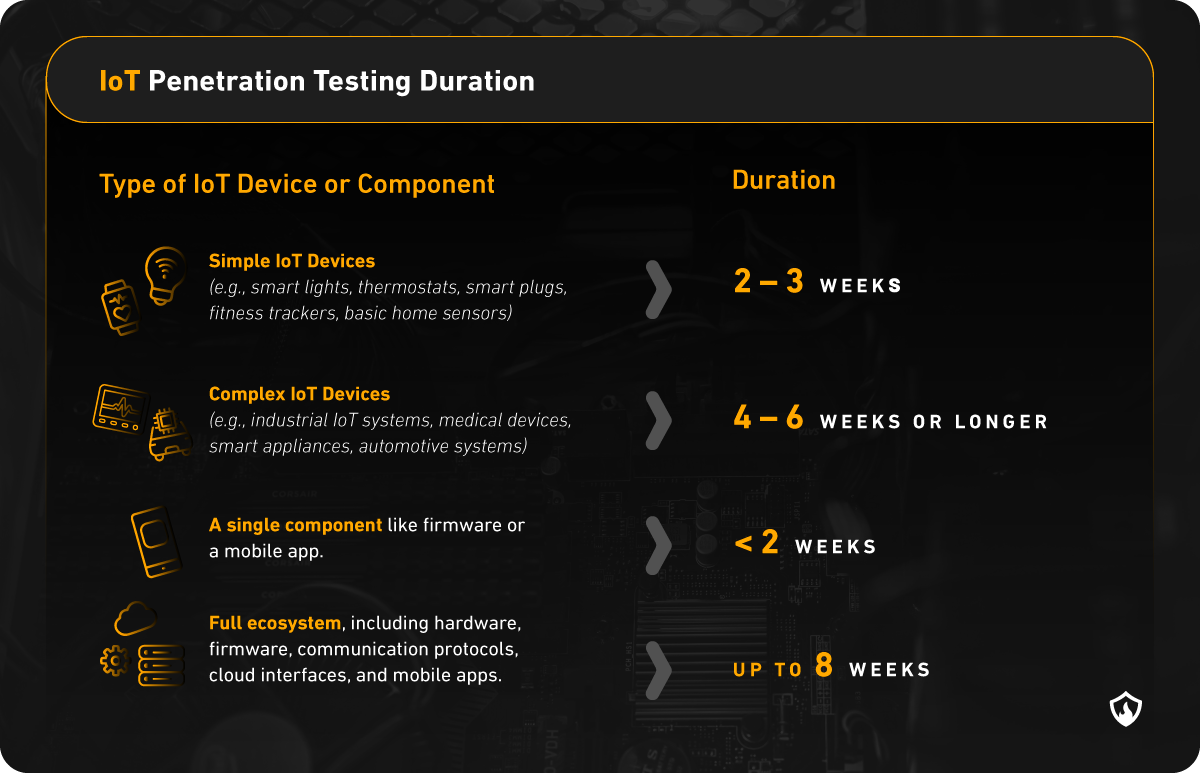
An IoT penetration test engagement typically ranges from 2 to 10 weeks, depending on the device’s complexity and the testing scope. Simpler IoT devices, such as consumer products like smart lights or smart thermostats, can be tested in about 2 to 3 weeks. However, more complex devices, such as industrial IoT systems or medical devices, may take 4 to 6 weeks or even longer due to their multi-component nature, including sensors, cloud integration and mobile applications.
The scope of the testing also significantly influences the timeline. A limited scope focusing on a specific component, like firmware or a mobile app, can usually be completed in under two weeks. In contrast, comprehensive testing that covers the entire system involving hardware, firmware extraction, communication protocols, cloud interfaces, web, API and mobile apps requires more time, often up to eight weeks.
Testing network interfaces and communication protocols can also extend the timeline, depending on their complexity and variety. Testing cloud services and connectivity typically adds another one to two weeks.
Overall, in our experience, most IoT penetration tests for simple consumer devices typically take around 3 to 4 weeks for a full assessment, but larger or more complex devices may require additional time.
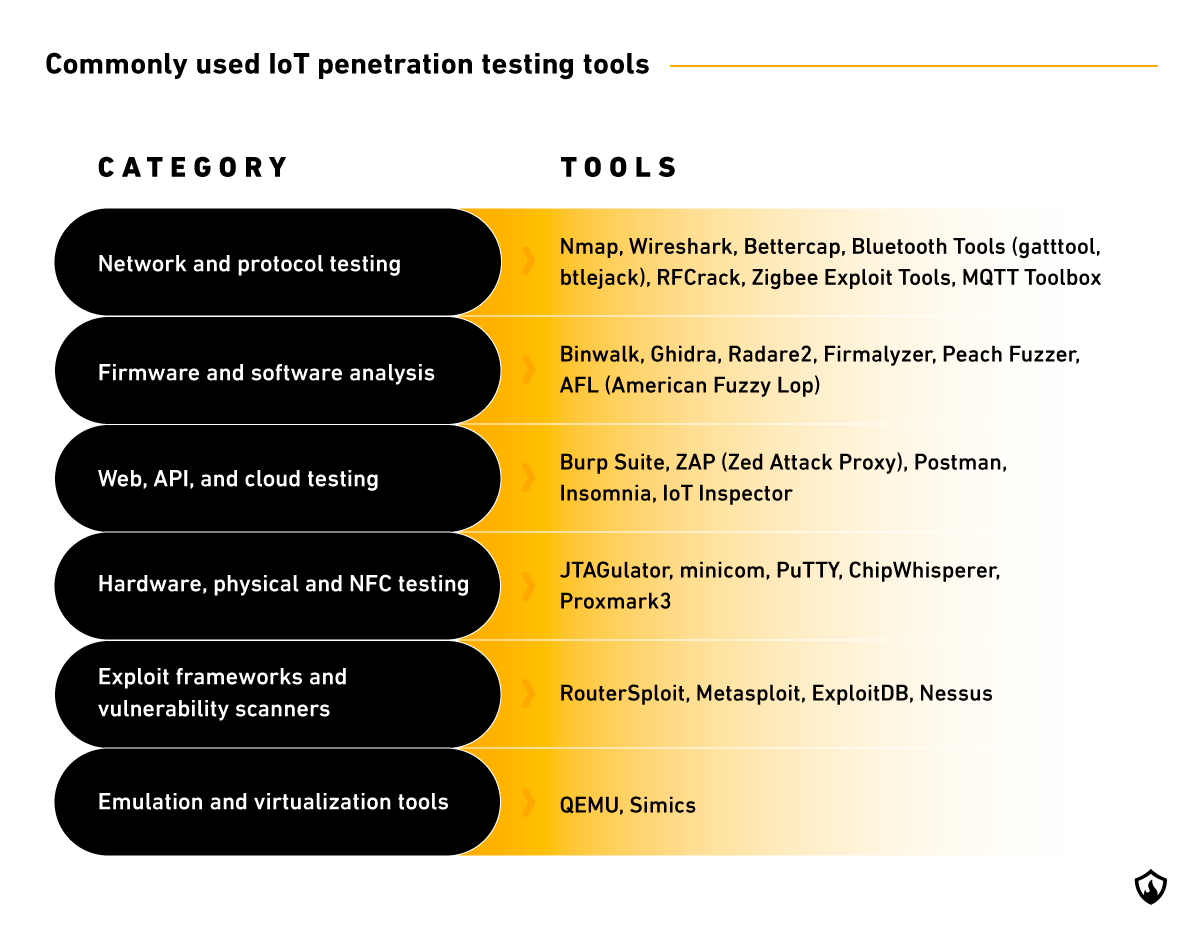
Common IoT penetration testing tools
Benefits of IoT penetration testing
For most IoT devices, penetration testing is an essential part of demonstrating compliance and regulatory readiness. As frameworks such as the EU Cyber Resilience Act, the Radio Equipment Directive (EU) 2022/30, the U.S. Cyber Trust Mark, and sector-specific rules like HIPAA, Germany’s DiGA and DiPA, ISO/IEC 62443, and the FDA’s medical-device cybersecurity guidance take effect, manufacturers are expected to provide evidence that connected products have been independently assessed for security.
A professional IoT pentest generates that evidence. It verifies that devices meet the technical expectations these frameworks impose:
- Secure design and encryption requirements under the Cyber Resilience Act and Radio Equipment Directive are validated through hardware, firmware and communication pentesting.
- Data protection obligations under HIPAA and GDPR are supported through assessments of local data storage, transmission security and access controls.
- Patch management and update verification, required by the FDA and ISO/IEC 62443, are reviewed during firmware analysis and update-mechanism pentesting.
- Authentication and access control measures, a focus of nearly every regulatory scheme, are rigorously evaluated across device interfaces, APIs, and cloud components.
A pentest provides enduring value to engineering and product teams. It ensures that devices are not only secure today but designed to remain resilient as cyber threats and regulations evolve. The result is a stronger security posture, smoother certification processes, and credible assurance for customers, partners, and regulators alike.
Conclusion
The security of connected devices now determines whether they can operate safely – or even reach the market. With regulatory frameworks tightening across the EU and the U.S., manufacturers must show not only that their products function as intended but that their security controls have been verified and vulnerabilities addressed.
A professional IoT penetration test provides this assurance. It exposes flaws that automated tools and vulnerability scanning overlook, validates the strength of encryption, authentication and update mechanisms, and documents every finding in a format that satisfies regulators and enterprise buyers alike.
In a landscape where smart devices underpin everything from healthcare to manufacturing, IoT penetration testing is the proof of trustworthiness that determines whether your technology is ready for the world.
FAQ
How long does an IoT penetration test take?
Most IoT pentests take between 3 and 4 weeks, depending on the device’s complexity and testing scope. Simple consumer devices can usually be assessed in two to three weeks, while complex industrial or medical systems may require several phases spanning up to ten weeks. Each engagement includes scoping, execution, and reporting, and often concludes with a retest to validate fixes — producing results suitable for both engineering improvement and regulatory documentation.
What are the benefits of IoT penetration testing?
A professional IoT pentest provides the independent verification that modern compliance frameworks now expect. It validates secure design, data protection, and update mechanisms required by regulations such as the EU Cyber Resilience Act, Radio Equipment Directive, HIPAA, ISO/IEC 62443, and the U.S. Cyber Trust Mark.