


E-commerce platforms and retail environments sit at an unusual intersection: they combine the complexity of large-scale software systems with the urgency of high-volume online transactions, consumer-facing interfaces, and sensitive payment and identity data. That combination makes them one of the most consistently targeted sectors in the threat landscape, and one of the most rigorously tested.
In our 2025 Annual Penetration Testing Review, we analyzed 3,294 confirmed vulnerabilities identified across 660 penetration tests conducted between January and mid-November 2025. E-commerce and retail accounted for the largest share of our testing volume: 9 clients commissioned 242 separate penetration testing engagements, generating 1,025 confirmed security findings — more projects than any other sector in our dataset.
This article draws on that data to examine the most common ecommerce vulnerabilities, the types of assessments driving such vulnerabilities, and what the pattern of security issues tells us about where the sector’s risk is actually concentrated.
Why E-commerce Attracts the Highest Testing Volume
The gap between client count and project count in this sector is striking. Nine organizations generated 242 projects (an average of nearly 27 separate engagements per client). That figure reflects a structural reality of large ecommerce businesses: they rarely have a single, unified attack surface. Instead, they operate across multiple brands, regional platforms, mobile apps, payment APIs, third-party integrations, and backend systems — each requiring its own recurring security validation.
High release cadences compound this. Retail teams typically ship frequently, which means the window between a new feature and a security assessment must stay short. This testing density has security implications beyond just volume. Organizations that test frequently tend to find and remediate vulnerabilities before they mature into more critical issues, as shown in the severity data below.
The Assessment Mix: API Pentesting Is the Differentiator
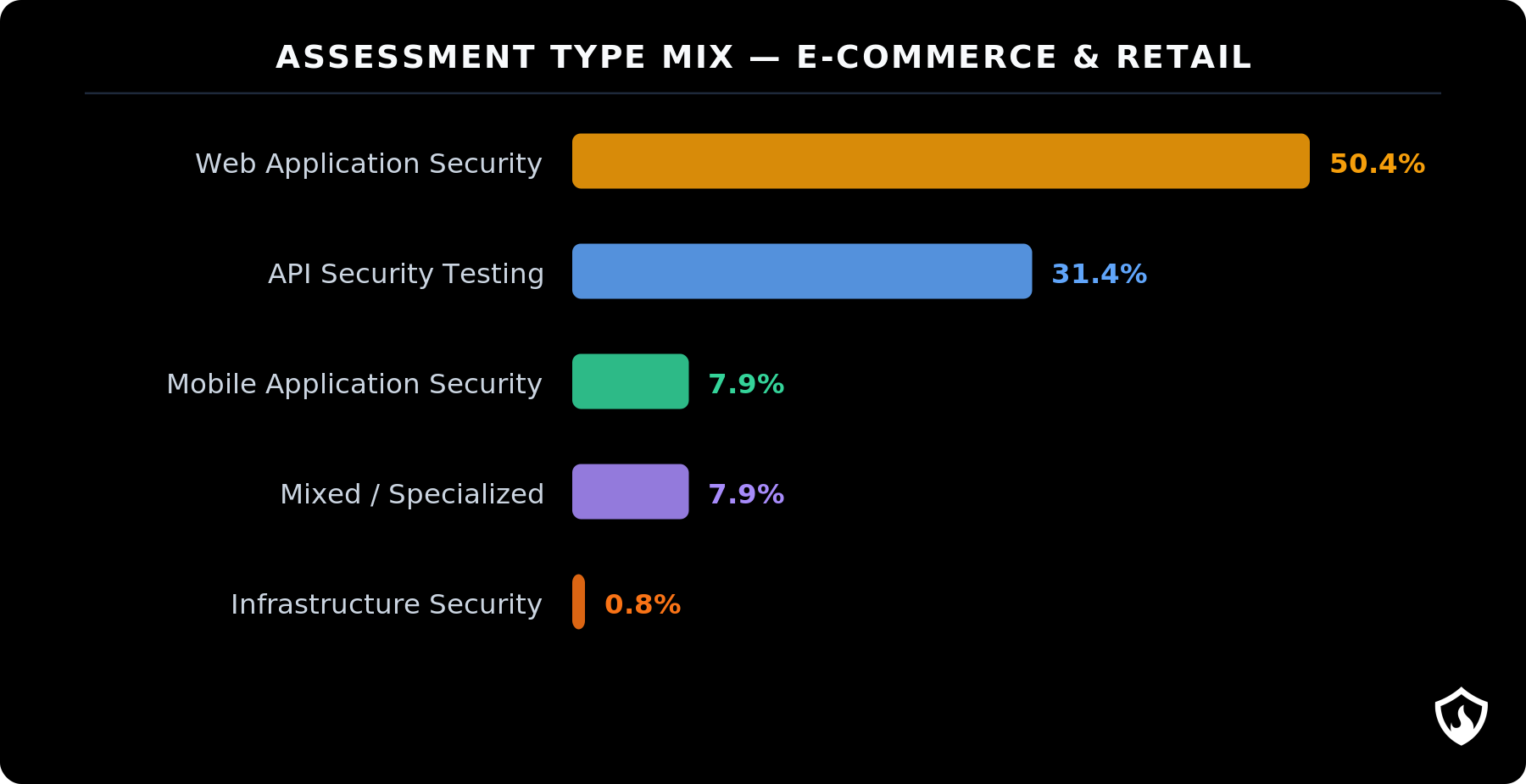
E-commerce has the most diversified assessment portfolio of any sector we assessed. Web application testing accounts for the largest share at 50.4%, but the more telling figure is API security testing at 31.4%, which is the highest API proportion of any industry in our dataset. For comparison, Finance & Fintech, the next biggest sector we tested, conducts API penetration testing on 11.5% of projects.
The reason is structural. Modern e-commerce platforms are deeply API-dependent. Product catalogs, inventory systems, payment gateways, loyalty programs, partner integrations, and mobile clients all communicate via APIs, often with different authentication models, rate controls, and data access patterns. This integration complexity creates a correspondingly broad API attack surface, which the assessment mix reflects.
The remaining 15.7% of engagements are split between mobile application testing (7.9%) and mixed or specialized assessments (7.9%), with infrastructure security testing at just 0.8%, numbers consistent with the sector’s predominant cloud-native, application-layer focus. This architecture also creates fertile ground for business logic flaws — weaknesses that emerge from how services interact rather than from any single component in isolation.
Severity Profile: High Volume, Lower Severity Rate
Across 242 projects and 1,025 findings, the average number of vulnerabilities per project was 4.24, which is below the cross-sector average of 4.99. The severity distribution reflects a broadly mature testing program: 50.1% of findings were Low severity, 22.7% Medium, 18.1% Informational, 8.1% High, and approximately 1% Critical.
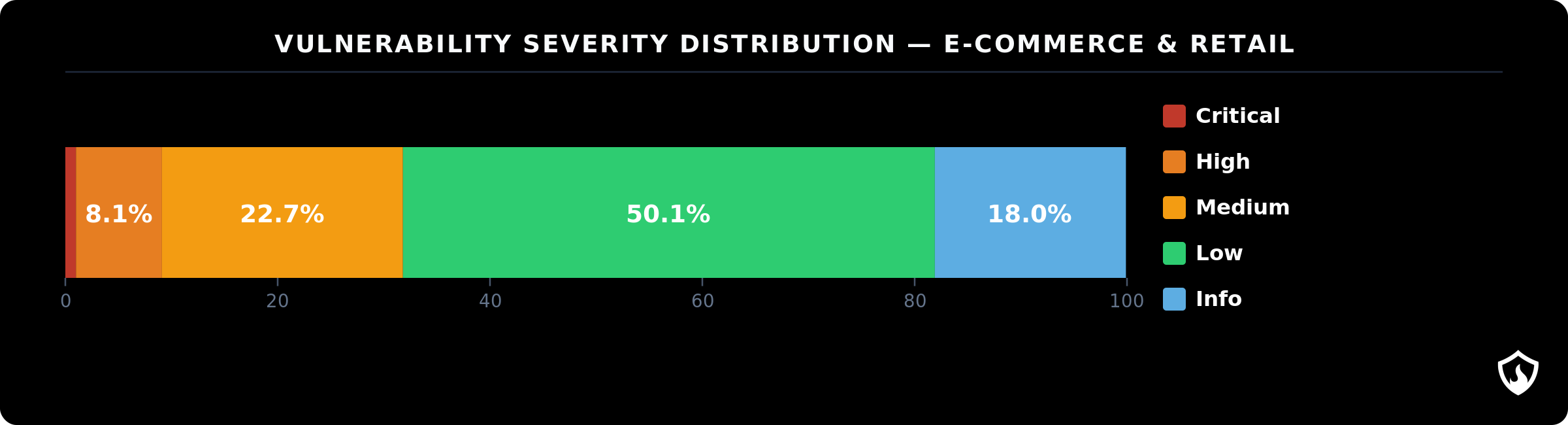
The combined High and Critical rate of 9.1% is the lowest of any industry in our dataset. The sectors with the highest severe finding rates — Education (32.0%), Public Services (29.2%), and Insurance (27.6%) — tend to test far less frequently, which means critical issues have longer to accumulate before they are identified.
That context matters when interpreting the e-commerce figures. A lower severe finding rate is not simply a reflection of a safer environment; it is at least partly a function of a testing cadence that catches and surfaces issues early. It also does not imply that risk is negligible. In absolute terms, roughly 93 of the 1,025 findings in our e-commerce dataset were High or Critical severity, each representing a confirmed, exploitable security issue in a customer-facing or business-critical system.
The dominant severity band (Low and Medium combined at over 72%) covers a category of findings that, individually, may seem manageable but collectively represent real exposure when aggregated across complex, integrated environments.
The Top 10 Common Ecommerce Vulnerabilities: Three Patterns
The top ten vulnerabilities identified across e-commerce and retail security engagements fall into three functional clusters, each pointing to a distinct class of systemic weakness.

Protection and enforcement failures
CWE-693 (Protection Mechanism Failure), the single most common finding at 7.6%, covers a broad category: security controls — output encoding, session management, access checks, rate limiting — that either fail to function or are applied inconsistently across the application. In e-commerce environments with complex, multi-component architectures, it is common for these controls to work correctly in one part of the platform and be absent in another.
CWE-799 (Improper Control of Interaction Frequency, 4.3%) captures a specific enforcement gap: the absence of effective rate limiting on API endpoints and resource-intensive functions beyond authentication flows. Left unchecked, these gaps allow automated abuse at scale while degrading service for legitimate customers. Effective controls in these contexts often depend on behavioral analysis to distinguish legitimate usage patterns from automated abuse.
CWE-284 (Improper Access Control, 3.6%) — which frequently manifests as business logic vulnerabilities where trust boundaries are incorrectly defined or enforced — is the most consistently dangerous vulnerability class across all the industries we assessed. In our full dataset, 64 of the 164 CWE-284 instances were High or Critical severity. In e-commerce, access control failures typically manifest at the object level: a user accessing another user’s order history, a guest session querying authenticated resources, or triggering unauthorized transactions through exposed payment endpoints — each a pathway to privilege escalation or broader data exposure.
CWE-307 (Improper Restriction of Excessive Authentication Attempts, 2.2%) reflects missing or insufficient controls on login and account recovery flows — systems that fail to prohibit multiple failed logins leave themselves exposed to brute-force attacks and credential stuffing via automated tools against customer accounts. Account takeover across multiple accounts is a direct consequence in high-traffic retail environments processing millions of authentication events.
Together, these four account for approximately 17.7% of sector findings — a consistent pattern of controls that exist in principle but break down in practice across the attack surface.
Information disclosure
The second cluster captures how applications reveal information about their internal state, structure, or data to unauthenticated or low-privilege actors. CWE-200 (Exposure of Sensitive Information to an Unauthorized Actor) is the second most common finding at 7.4%, covering the broader category of unintended customer data disclosure through application logic — response bodies returning more than a user should see, API endpoints exposing excessive field content, or error conditions surfacing internal details.
CWE-209 (Generation of Error Message Containing Sensitive Information, 4.9%) captures a more specific manifestation: verbose error handling that leaks stack traces, database queries, or internal path structures — disclosures that give malicious actors a roadmap for follow-on exploitation.
CWE-204 (Observable Response Discrepancy, 3.1%) occurs when an application returns meaningfully different responses to valid versus invalid inputs — a pattern that attackers can exploit for account enumeration, access probing, or content discovery.
These weaknesses are particularly consequential in multi-tenant retail environments, where a customer’s ability to see or infer customers’ personal data — or about internal system behavior — can enable targeted attacks, data breaches, identity theft, or constitute a regulatory data exposure event.
Input handling and cryptographic weaknesses
CWE-20 (Improper Input Validation) appears at position three with 5.7% — unusually prominent for what is often treated as baseline hygiene. In e-commerce environments, insufficient input validation frequently manifests as missing constraints on API request parameters, unsafe defaults passing user-controlled values into sensitive functions, or inconsistent validation across endpoints handling the same data. It is also the underlying weakness behind injection-class attacks such as SQL injection and cross-site scripting, where malicious code reaches application data layers or users’ browsers through unvalidated input.
CWE-327 (Use of a Broken or Risky Cryptographic Algorithm, 2.7%) captures systems that encrypt data but do so using deprecated algorithms — MD5, SHA-1, or older cipher suites — that no longer provide meaningful protection against modern attacks.
CWE-319 (Cleartext Transmission of Sensitive Information, 2.6%) indicates that data — including credentials, session tokens, API keys, or payment-adjacent information — is being transmitted without adequate encryption in at least some component. This often surfaces in internal API calls, partner integrations, checkout workflows, or legacy endpoints that predate the main application’s TLS enforcement — even on systems where SSL certificates are correctly deployed at the perimeter.
Together, these three account for approximately 11% of sector findings, and they are particularly consequential in transaction-heavy environments where the integrity of data in transit directly affects payment security and online payment fraud exposure.
E-commerce-Specific Threat Patterns
Not all risks in e-commerce environments surface through standard vulnerability categories. Several threat patterns are specific to the sector’s architecture and operational model, and are worth understanding alongside the technical findings above.
Bot-driven abuse and credential stuffing
Malicious bots increasingly mimic legitimate users and operate at scale, enabling account abuse, inventory manipulation, price scraping, and checkout disruption. In technical terms, CWE-693 (Protection Mechanism Failure, the single most common finding in our e-commerce dataset at 7.6%) and CWE-799 (Improper Control of Interaction Frequency, 4.3%) are the weaknesses that most directly shape an environment’s resistance to these patterns — with CWE-307 (Improper Restriction of Excessive Authentication Attempts) providing a further foothold specifically on login and account recovery flows.
Credential stuffing is a common form of bot-driven account abuse: automated tools use leaked username and password pairs to systematically test access across platforms where credentials have been reused. The resulting account takeover can lead to unauthorized purchases, drained loyalty balances, and customer trust damage that extends well beyond the compromised accounts themselves.
E-skimming
E-skimming is a threat specific to checkout and payment pages, where attackers inject malicious JavaScript code to capture card data as customers enter it. It commonly enters environments through compromised third-party scripts, misconfigured integrations, or vulnerable frontend components. Unlike many of the findings in this report, e-skimming does not require access to backend systems as it targets what executes in the customer’s browser. Effective defense requires visibility and control over all third-party code loaded at the point of payment, not just internal application logic.
Business logic abuse
Business logic vulnerabilities — where application rules governing pricing, discounting, promotions, or fulfillment can be manipulated — represent a category of risk that automated scanning tools consistently miss. These weaknesses require human-driven, context-aware testing to surface. In e-commerce environments, where complex promotional logic, multi-tier pricing, and third-party integrations interact across customer journeys, business logic flaws can enable significant financial exposure without triggering conventional security alerts.
How These Vulnerabilities Are Reached
The attack vector profile for common security vulnerabilities in e-commerce reinforces the application-layer focus. Nearly four out of five vulnerabilities in this sector are exploitable remotely over a network, typically requiring no authentication and no user interaction, lowering the bar considerably for malicious actors. This is consistent with an attack surface dominated by public-facing applications, APIs, and integrations rather than internal-only systems.
A secondary share of vulnerabilities surfaces through adjacent and local vectors such as internal admin panels, partner-facing endpoints, and backend systems supporting commerce operations — paths through which attackers gain access to sensitive resources without ever touching the public perimeter.
The impact distribution skews toward confidentiality and integrity rather than availability — the expected profile for an application-heavy environment. The most damaging outcomes are data exposure, online payment fraud, and the compromise of transaction or account integrity, rather than service disruption.
What This Means for Security and Engineering Teams
- API coverage is not optional. At 31.4% of testing volume, APIs represent a significant fraction of the attack surface of e-commerce sites, and they carry distinct risk characteristics compared to web applications. API environments often lack the rate limiting, input validation, and access control enforcement that are more commonly implemented on web front-ends. If your API estate is not being tested with the same rigor as your web applications, your security coverage has a meaningful gap.
- Control coverage must be consistent, not just correct. The top finding — CWE-693 (Protection Mechanism Failure) at 7.6% — reflects a pattern more systemic than any single bug: security controls that function correctly in one part of the platform and are entirely absent in another. Rate limiting, access enforcement, input validation, and output filtering all require uniform application across every endpoint, integration, and workflow. A control correctly implemented in the main application but missing from an API endpoint or a less-visited admin path is the gap that attackers find first.
- Low severity rates at the portfolio level do not eliminate risk at the asset level. The 9.1% High+Critical rate is the lowest of any sector in our dataset, but it describes an aggregate across 242 projects. Individual systems within the estate — older integrations, recently acquired platforms, less-tested internal tools — may carry a very different profile. Segmented, asset-level testing provides a more accurate picture than portfolio averages.
- Testing cadence is a security control. The correlation between frequent testing and lower severe finding rates is not incidental. It reflects the compound effect of shorter cycles between deployment and security validation, earlier detection before issues are more difficult to remediate, and security teams developing familiarity with the platform’s evolving risk profile.
About This Data
All pentest findings were collected through VulnKeep, Blaze’s Penetration Testing as a Service (PTaaS) platform, and represent confirmed, validated vulnerabilities identified during live security assessments — not theoretical risks or automated scan results.
Want to benchmark your e-commerce environment against these findings? Our team runs web application & API, and mobile security assessments tailored to retail architectures, with findings delivered in real time through VulnKeep. Get in touch to discuss a testing program that fits your release cadence and attack surface.
Preparing for an ISO 27001 certification audit or pentest? Explore our ISO 27001 penetration testing services or talk to an expert about defining the right scope for your environment.
FAQ
What are the most common e-commerce vulnerabilities found during penetration tests?
Blaze’s 2025 retail findings point to recurring issues in protection mechanism failures, sensitive data exposure, input validation, verbose error handling, access control, anti-automation weaknesses, authentication-attempt restrictions, and crypto or transport protection. In practical terms, those findings usually cluster around customer-facing workflows, APIs, account actions, and integrations rather than around a single isolated defect class.
Are retail pentest findings usually high severity?
Not necessarily. In Blaze’s 2025 data, e-commerce and retail had a relatively low High + Critical share compared with some other industries, but it still generated the highest project volume and a very large total number of vulnerabilities. In this sector, medium-severity flaws can still be highly important when they affect public transaction paths, account workflows, or sensitive data exposure.
Why is penetration testing especially useful for e-commerce and retail?
Retail risk often lives in real business logic, object access, transaction flows, and integration behavior that automated scanning does not interpret well. Pentesting is valuable because it exercises the system the way an attacker would, across the exact workflows that matter most to customer trust, fraud exposure, and operational integrity.