


A penetration testing quote is a detailed proposal outlining the services, scope of work, and associated costs. It serves as a roadmap for the service provider and client during testing. However, it is not uncommon for quotes to vary greatly between providers, leading to confusion and making apples-to-apples comparisons difficult.
Understanding the nuances of these quotes can help you make an informed decision when selecting a provider and ensure the testing meets your specific needs. This blog post aims to demystify the penetration testing quote process, explaining why quotes may differ among providers and how to compare them effectively.
If you need a short answer, a penetration testing quote should not be compared on price alone. A good quote should clearly explain the scope, testing methodology, number of days, tester experience, deliverables, reporting format, retesting terms, communication process, and any compliance evidence included. Two providers can quote the same environment at very different prices because one may include manual business-logic testing, authenticated testing, remediation validation, and audit-ready reporting, while another may include only automated scanning and a generic report.
Penetration test quote
On average, a penetration test quote can range from $5,000 to $15,000 for a basic web application security assessment or a mobile application pentest. For scopes such as more intricate applications, product security testing, or pentests of large networks, the price can go above $100,000.
Penetration test quotes vary significantly based on several factors, resulting in a broad price range for penetration testing services. In the upcoming sections, we’ll discuss why it’s crucial to obtain multiple quotes, understand the structure of a quote, and explain why quotes can vary, sometimes radically, among different pentest providers.
Typical penetration testing quote ranges in 2026
The exact cost of a penetration test depends on the scope, complexity, testing depth, methodology, reporting requirements and post-test support. Still, most commercial quotes fall into recognizable ranges. The table below gives a practical benchmark for comparing proposals in 2026.
| Test type | Typical 2026 quote range | What can increase the quote |
|---|
| Web application pentest | $5,000–$30,000 | Multiple user roles, complex authentication, business logic, payments, SSO, integrations |
| API pentest | $5,000–$20,000 | Number of endpoints, REST/GraphQL/gRPC, authorization model and documentation quality |
| Mobile application pentest | $5,000–$30,000 | iOS and Android coverage, backend API, local storage, certificate pinning, biometrics, payments |
| External network pentest | $5,000–$20,000 | Number of IPs, exposed services, segmentation and compliance requirements |
| Internal network pentest | $8,000–$35,000 | Active Directory complexity, number of sites, VPN/on-site access, privilege escalation depth |
| Cloud pentest | $10,000–$50,000 | AWS/Azure/GCP accounts, IAM complexity, Kubernetes, serverless, multi-cloud environments |
| Red team exercise | $30,000–$150,000+ | Duration, objectives, attack paths, phishing, physical or social engineering components |
These figures are only a benchmark. A narrow, well-documented API can cost less than a small but highly complex SaaS application with multiple roles, payment flows, admin functions and sensitive data. For a deeper breakdown of current pricing factors, see our dedicated guide on penetration testing costs.
Understanding the basics of a penetration testing quote
Understanding a penetration testing quote involves evaluating key factors, including the scope of testing, the testing methodology, the team’s experience, the provider’s reputation and more. Each element contributes to the final quote, influencing the price and the value you receive.
What are the key components of a pentest quote?
An average penetration testing quote typically consists of three fundamental components:
- Scope of Work: This section outlines the testing scope, including web applications, APIs, and IP addresses for target networks. It also outlines the type of testing to be performed (e.g., black box, white box, gray box), the testing methodologies to be used, the compliance requirements to be met (e.g., SOC 2, ISO 27001 or PCI DSS), and any specific vulnerabilities or risks to be focused on.
- Timeframes: The quote should accurately estimate the time required for the test. This will depend on the scope size, the complexity of your environment, and the depth of testing. Note that a thorough penetration test can’t be rushed. It’s essential to consider that a quicker, less expensive pentest may not provide the depth of insight you need, leaving your organization’s security risks poorly assessed.
- Pricing: This part outlines the cost of the service. Some providers may offer a fixed price, while others may bill based on the time and resources used (time and materials). Remember that a higher penetration testing cost doesn’t necessarily mean better quality, and vice versa.
Common misconceptions about penetration testing quotes
A common misconception is that all penetration testing quotes are created equal, and this couldn’t be further from the truth. Each penetration testing provider has its own methodologies, tools, expertise in a particular set of technologies, company accreditation, and staff certifications, all of which will be reflected in their quotes.
Additionally, a penetration testing quote is not just a price tag but a comprehensive proposal that should provide a detailed overview of the provider’s offerings, test approach, and deliverables, as we briefly touched on in the last section.
Understanding these elements can help you estimate the real value behind the numbers.
What should a good penetration testing quote include?
A useful quote should make the proposed work easy to understand, easy to compare and easy to defend internally. If you are comparing several pentest providers, look for the following items before you focus on the final price.
| Quote component | What to check | Why it matters |
| Scope | Applications, APIs, IP ranges, user roles, environments and exclusions | Prevents thin coverage, misunderstandings and surprise exclusions |
| Testing approach | Black box, gray box, white box, authenticated testing and role-based testing | Shows how much context the testers will have and how deep the assessment can go |
| Methodology | OWASP, PTES, NIST, cloud-specific or mobile-specific guidance | Shows whether the provider follows a structured process |
| Manual testing depth | Business logic, access control, authentication, authorization and chained exploitation | Separates real penetration testing from basic vulnerability scanning |
| Team experience | Named tester profiles, seniority, certifications and relevant industry experience | Helps you assess whether the team has the right technical caliber |
| Deliverables | Executive summary, technical findings, proof of concept, reproduction steps and remediation guidance | Determines whether the report will be useful for engineering, leadership and auditors |
| Retesting | Included or paid, number of rounds, time window and validation process | Affects your total cost after remediation |
| Communication | Kickoff, critical finding escalation, testing windows, and debrief format | Reduces operational risk and improves collaboration |
| Compliance evidence | Attestation letter, auditor-ready report and framework mapping where relevant | Supports SOC 2, ISO 27001, PCI DSS, HIPAA and vendor security assessments |
| Legal and operational terms | Authorization, rules of engagement, emergency contacts, liability and insurance | Protects both the buyer and the provider during testing |
Common misconceptions about pentest quotes
A common misconception is that all penetration testing quotes are created equal, and this couldn’t be further from the truth. Each penetration testing provider has its own methodologies, tools, expertise in particular technologies, company accreditation, and staff certifications, all of which will be reflected in their quotes.
Additionally, a penetration testing quote is not just a price tag but a comprehensive proposal that should provide a detailed overview of the provider’s offerings, test approach, and deliverables, as we briefly touched on in the last section.
Understanding these elements can help you estimate the real value behind the numbers.
Factors that influence the price of a penetration testing quote
Understanding the factors that influence the cost of a penetration testing quote is crucial for making an informed decision when choosing a provider. We have written a comprehensive blog post on pentest costs and factors that influence pricing. Still, below, we explore the essential details that can influence the cost of a penetration test.
Size and complexity of the scope and IT environment
The size and complexity of your IT environment are significant factors in determining a penetration testing quote. Large networks, complex environments or intricate scopes often require more time and resources than smaller, less complex ones. For instance, a multinational corporation with several interconnected networks will likely receive a higher quote than a small business with a single website to test.
Specific testing methods to be used
The chosen testing methods can also influence the quote. Penetration testing can be conducted as black-box testing (from an outsider’s perspective with no prior knowledge), white-box testing (with full knowledge of the system), or gray-box testing (a blend of the two). Each approach requires different levels of effort and expertise, which will be reflected in the quote. Additionally, specialized testing types, such as physical security or social engineering tests, can increase the cost.
Experience and technical caliber of the penetration testing team
The testing team’s expertise and know-how are another key factor. A team with a strong track record and deep expertise may command higher prices, perhaps in testing specific industry systems. It’s essential to weigh this against the potential quality of the results.
Relevant industry accreditations and certifications
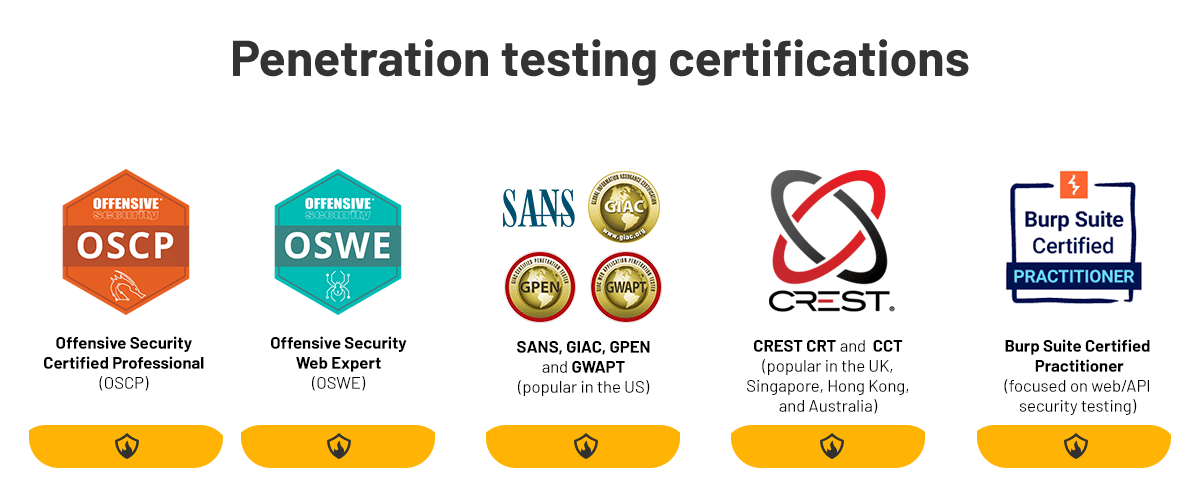
Industry accreditations and certifications can serve as a testament to a team’s proficiency and commitment to maintaining high standards in their work. Teams composed of pentesters holding qualifications such as the Offensive Security Certified Professional (OSCP), CREST CRT and CCT, or SANS GIAC Penetration Tester (GPEN) are likely to be well-trained for the job, which can be reflected in the price.
The use of automated tools vs. manual testing
While automated tools can quickly scan for known vulnerabilities, manual penetration testing identifies complex security issues that automated tools might miss. A good penetration test often combines both. If a provider relies more heavily on manual testing, which requires greater expertise and is more time-consuming, the quote will likely reflect that.
Post-testing services – custom reporting, retesting and consultation
Post-testing services can significantly enhance the value of a penetration test. Comprehensive audit-ready reports that list vulnerabilities and provide a detailed analysis, accurate risk rating, and recommended mitigation strategies are incredibly useful. Further consultation or assistance in addressing the identified vulnerabilities may also be offered. The depth and quality of these services often influence the overall price of the penetration testing quote.
In the next section, we’ll discuss why penetration test quotes vary across providers.
Why it’s important to get multiple penetration test quotes
Just as any organization would require multiple quotes for evaluation when hiring services or products, the same principle applies when seeking penetration testing services. This process helps businesses ensure they receive the best value for their money and identify the most suitable supplier for their unique needs.
In our experience, organizations that procure penetration testing services typically aim to acquire at least three quotes. This number offers a good balance, providing a range of options to compare without becoming overwhelming. Gathering multiple quotes enables effective comparison of several crucial aspects, including the scope of services, testing methodologies, the depth of reports and deliverables, retesting options, and pricing structure.
Running a Request for Proposal (RFP) can be more effective for larger projects or multi-year contracts. An RFP invites providers to submit a proposal for a specific service, providing the organization running the tender with comprehensive details on what each provider can offer. This approach clarifies project-specific needs and requirements, aligns expectations, and enables deeper comparisons of offerings.
Why penetration testing quotes can differ among providers
Penetration testing quotes can vary significantly among providers, which can be confusing for potential clients. Here are some reasons for this variance:
Differences in methodologies
Each provider employs unique methodologies and processes for conducting penetration tests, which can influence the quote you receive. Some providers may use a more comprehensive, tailored and in-depth approach, resulting in a higher quote. On the other hand, a provider using a more streamlined and one-size-fits-all approach might offer a lower quote. Understanding each provider’s methodology can help you evaluate whether the quote offers value for money.
Variances in expertise and experience
The penetration testing team’s experience and expertise significantly influence the quote. A team of seasoned, certified security experts with a proven track record might command a higher quote than a team of less experienced pentesters.
Different focuses in the test type
Different penetration tests focus on different areas. For instance, some might focus on web applications, others on network security, and others on social engineering attacks or a holistic view of your organization’s security, such as a full-scale red team exercise. Depending on your specific requirements, the test’s focus can affect the quote.
Specific test requirements
Pricing for penetration tests can also vary based on specific test requirements. For example, tests conducted outside regular business hours or requiring on-site services often command higher costs due to the additional resources and logistical considerations involved.
Therefore, the test’s complexity and specific conditions are important factors to consider when comparing quotes.
You were quoted a vulnerability scan, not a manual pentest
It’s essential to note that a manual penetration test can significantly differ from an automated vulnerability scan, even though both are key components of a comprehensive security strategy.
A vulnerability scan is an automated process that identifies potential points of exploitation in a system, while a penetration test is a more in-depth, lengthy manual process that not only identifies vulnerabilities but also attempts to exploit them to understand the potential impact of a breach.
Therefore, if the quote you’ve received seems lower than expected or too good to be true, you may want to verify if you’ve been quoted for a vulnerability assessment rather than a more comprehensive penetration test.
Discrepancies in post-testing services and deliverables
What happens after the test can also affect the quote. Some providers offer comprehensive audit-ready reports, free retesting, presentation of results and follow-up consultations as part of their service, while others might simply provide a list of vulnerabilities identified. The depth and quality of these post-testing services and deliverables can significantly impact the quote.
Red flags in a pentest quote
A low quote is not automatically a bad quote, and an expensive quote is not automatically a good one. However, some warning signs should make you pause before selecting a provider.
Watch out for these red flags:
- The quote does not list the exact applications, APIs, IP ranges, environments, user roles or exclusions.
- The provider promises to test a complex application, cloud environment or internal network in an unrealistically short timeframe.
- The methodology only mentions automated tools, vulnerability scanning or generic security checks.
- There is no clear explanation of authenticated testing, access control testing, business logic testing or manual exploitation.
- The quote does not explain who will perform the work or what experience the testers have.
- The provider cannot share a sample report or explain what the final deliverable will contain.
- Retesting, remediation, validation or post-test support is missing or hidden as an extra cost.
- The quote does not mention how critical vulnerabilities will be escalated during testing.
- The report is vaguely described as a “security report,” with no mention of evidence, reproduction steps, impact, risk rating or remediation guidance.
- The price is dramatically lower than every other quote, but the provider does not explain what is different about the scope or delivery model.
If a quote has several of these warning signs, ask follow-up questions before moving forward. In many cases, the issue is not the price itself but the lack of detail behind the price.
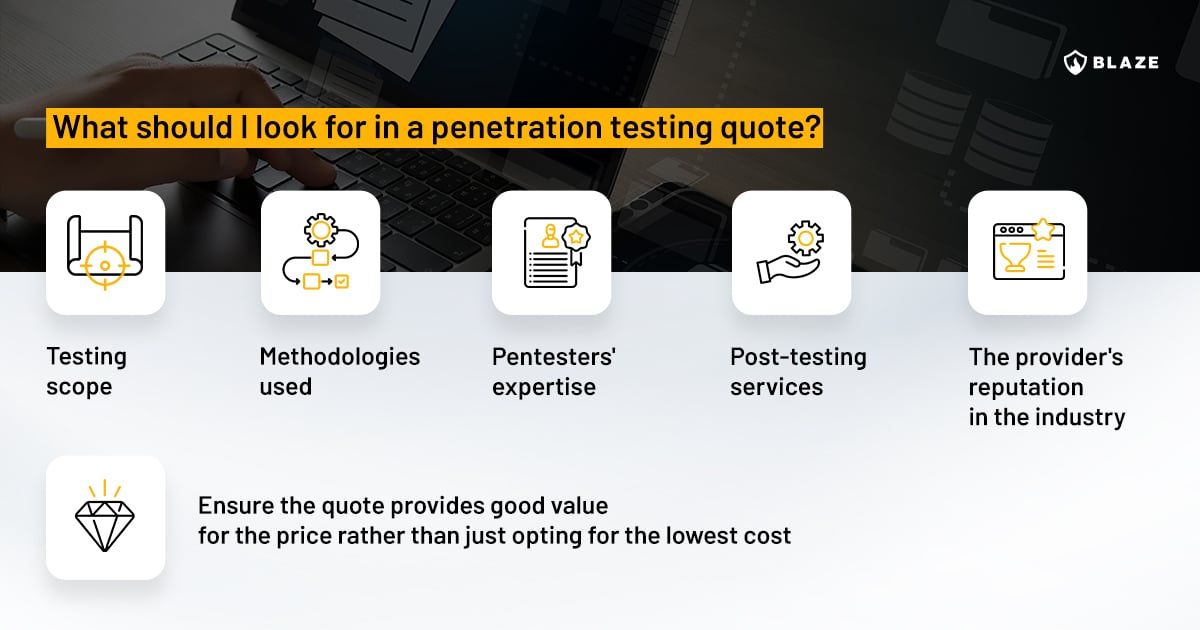
Infographic: What to Look for in a Penetration Test Quote
How to compare penetration testing quotes effectively
After receiving quotes from different providers, it’s important to understand how to compare them effectively. Here are some key considerations:
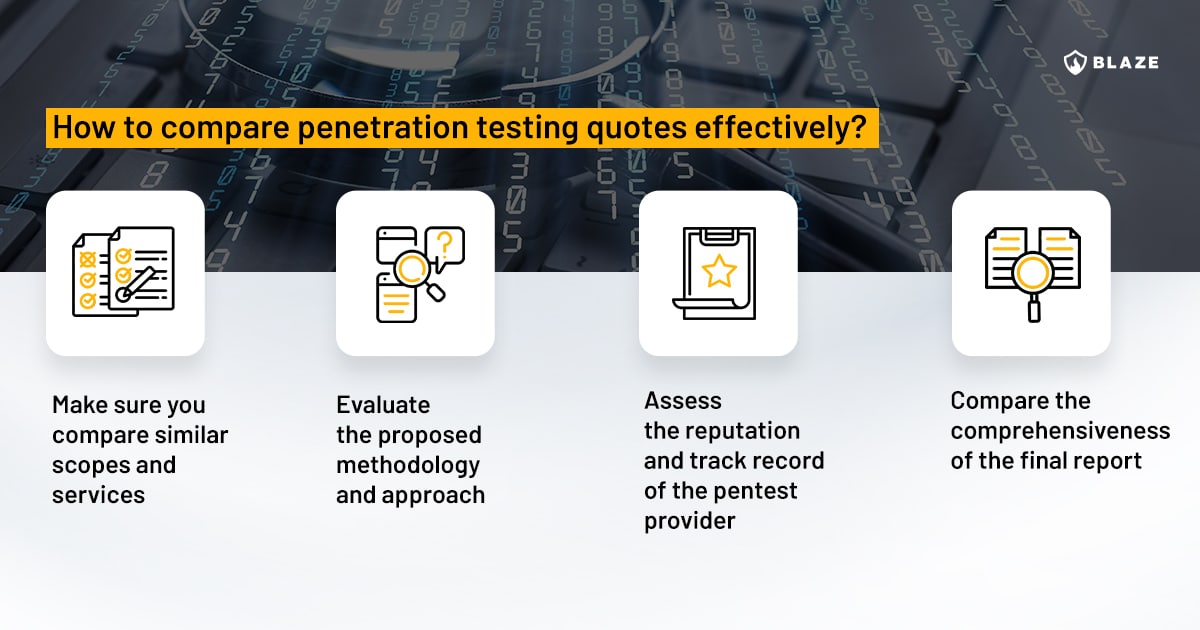
Ensuring similar scope and services are being compared
When comparing quotes, ensure that the scope and services are comparable. It’s not an apples-to-apples comparison if one quote includes post-testing services, such as detailed reporting and follow-up consultation, while another only includes the penetration test itself. Make sure to consider all aspects of the service when comparing quotes.
Evaluating the proposed methodology and approach
Consider the methodologies and approaches proposed by each provider. Do they follow industry best practices? Are they thorough in their testing processes? The approach taken can significantly affect the quality of the results and should be a key consideration when comparing quotes.
Assessing the reputation and track record of the pentest provider
It’s essential to evaluate the reputation and track record of the penetration testing (pentest) provider you’re considering for a quote. Request reviews, testimonials, customer references, and any other information that can provide insight into the reliability and quality of their services. Additionally, a provider with a proven track record in your specific industry may be a more valuable partner than one with a more generic service portfolio, such as an MSP or an audit firm that doesn’t focus on cybersecurity as its primary area of expertise.
We have written a comprehensive blog post outlining the top 10 tips for selecting a penetration testing company that suits your needs.
Comparing the comprehensiveness of the final report
The comprehensiveness of the final report should also be taken into consideration. A detailed report that includes an analysis of the findings, their potential impact, and suggested mitigation strategies provides more value than a simple list of vulnerabilities found, especially if the report is used for an audit or vendor security assessment. This difference in deliverables can be a determining factor when comparing quotes.
Infographic – Penetration test quote comparison chart
Conclusion
In a market saturated with penetration testing providers, understanding and comparing quotes for penetration testing services is crucial to selecting the right penetration testing partner for your specific needs. As we all know, quotes can vary significantly among providers due to several factors, including the complexity of your IT environment, the specific testing methods to be employed, the experience and expertise of the testing team, the use of automated tools versus manual testing, and the range of post-testing services offered.
Each quote is more than just a price tag; it’s a roadmap outlining the pentest provider’s approach to testing, the scope of work, the timeframes, and the final deliverables and reporting. Taking the time to dissect each quote, understand the nuances and compare them effectively can significantly impact the quality of the results and the value you receive.
Now that you understand and can compare penetration testing quotes, don’t hesitate to contact our experts to receive a customized quote tailored to your specific cybersecurity needs.
FAQ
Why are some penetration testing quotes more expensive than others?
Quotes can vary due to differences in the complexity of the IT environment, the testing methodologies used, the team’s expertise, and the range of post-testing services. Higher-priced quotes often involve more detailed and extensive testing processes.
What should I look for in a penetration testing quote?
You should look at the scope of testing, the methodologies used, the tester’s expertise, the post-testing services, and the provider’s reputation in the industry. Additionally, ensure the quote provides good value for the price rather than just opting for the lowest cost.
What is a reasonable penetration testing quote in 2026?
A reasonable quote depends on the scope. A focused web application, API or mobile app pentest may fall in the $5,000–$30,000 range, while larger cloud, internal network, product security or red team engagements can cost significantly more. The most important question is whether the quoted price matches the scope, depth of testing and deliverables.
Should I choose the cheapest penetration testing quote?
Not automatically. The cheapest quote may be appropriate if the scope is narrow and the provider clearly explains what is included. However, a quote that is much lower than the others can also indicate limited manual testing, fewer testing days, junior resources, weaker reporting or no retesting. Always compare the details behind the price.
Does a lower quote mean the provider will only use automated scanning?
Not always, but it is worth checking. If a quote is much cheaper than the others, ask how many testing days are included, whether authenticated manual testing is performed, which tools are used, and what the final report contains. A real penetration test should include manual validation and analysis, not just scanner output.