The energy sector is subject to growing critical infrastructure scrutiny, including under the NIS2 Directive, because cyber incidents in the sector can affect essential services. Blaze Information Security's 2025 penetration testing findings show where much of that risk appeared in practice: in IT-connected systems, exposed management interfaces, remote access paths, and administrative workflows close to operational systems.
Across the oil, gas and energy penetration tests included in the 2025 data, Blaze identified 112 vulnerabilities across 17 projects, averaging 6.59 per project. That average was higher than the overall pentest population, where the mean was 4.99 vulnerabilities per project. The sector also had a 25% High/Critical finding rate, which is also one of the highest shares of severe findings.
The most important distinction was impact. Compared with many other industries, oil and gas companies and energy providers showed a higher availability impact, which matters because disruptions to energy infrastructure can affect operational continuity, not only data confidentiality. The findings were still mostly network-reachable, commonly through management interfaces, exposed services, or cloud-connected systems.
This article breaks down the most common oil, gas and energy vulnerabilities found in Blaze's 2025 pentests, including sensitive data exposure, improper access controls, weak authentication controls, SQL injection, and cleartext transmission. It also explains what these findings suggest about segmentation, hardening, multi-factor authentication, remote access technologies, continuous monitoring, and the concentration of cyber risk in administrative and operationally adjacent systems.
What oil, gas and energy penetration tests usually cover
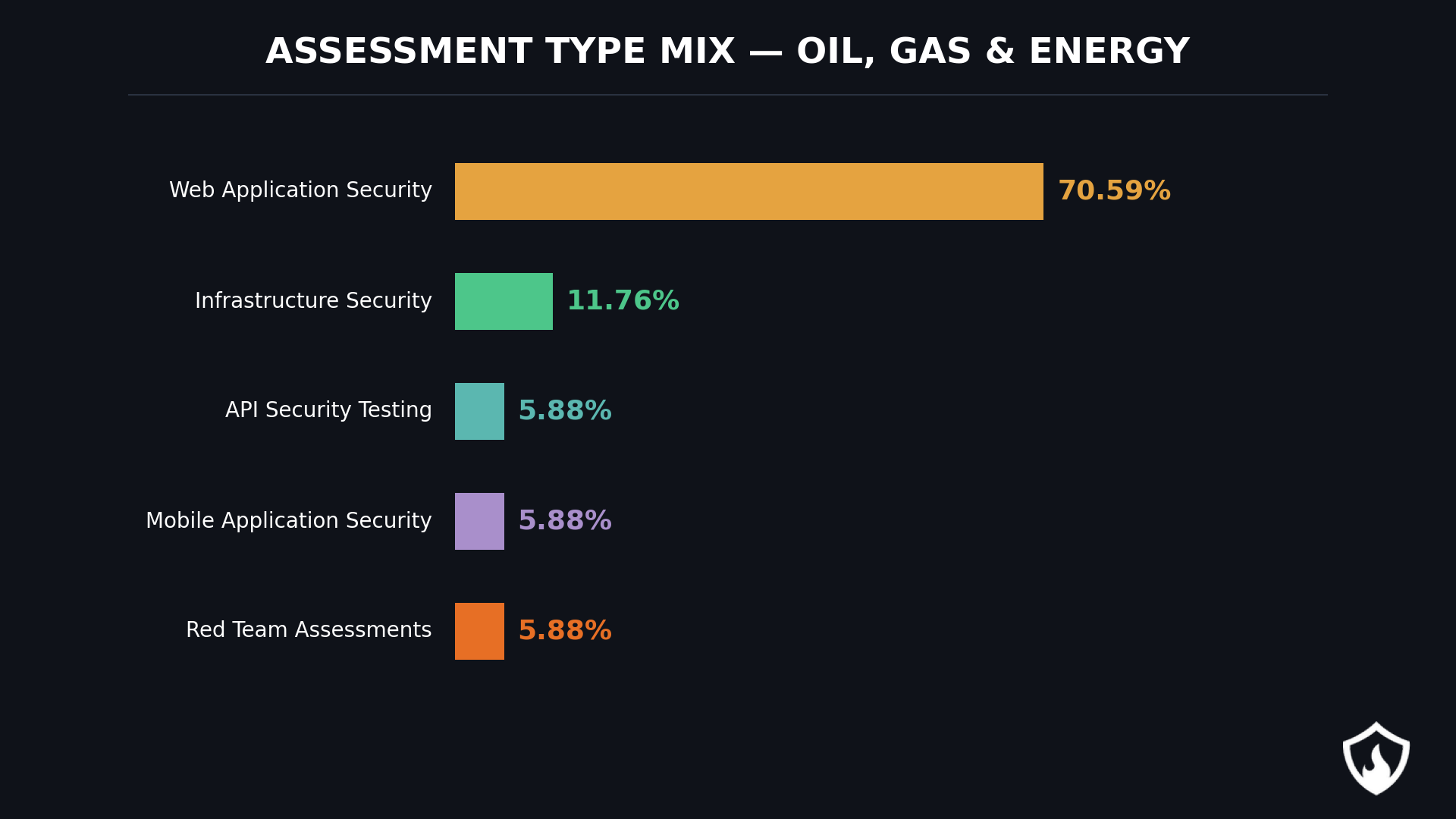
According to our data, Web Application Security Testing accounted for 70.59% of all energy, oil and gas engagements, followed by Infrastructure at 11.76%, with API, mobile, and cloud assessments each at 5.88%. The mix is narrower than that of most other sectors, reflecting a pattern in which organizations favor targeted work on a handful of clearly defined surfaces over broad, multi-track programs.
The energy sector's reliance on digital technologies has expanded the attack surface around SCADA-adjacent dashboards, management interfaces, cloud-connected services, and the IT systems that support operational workflows.
Modern companies in the energy industry operate a layered estate in which operational technology is rarely tested directly, and the IT systems built on top of it absorb most of the assessment effort. The surfaces that fall within scope are typically those that interact with operations rather than control them: SCADA and historian dashboards exposed through web interfaces, dispatch and scheduling portals, asset management consoles, partner and vendor portals, identity providers, and cloud-hosted management planes.
These systems share architectural traits. They are reachable from the internet, federate identity across employees, contractors, and third-party vendors, and often run on legacy systems or long-lived stacks that predate the current security baseline. That leaves authentication, session management, and authorization logic that no longer matches the threat model.
Infrastructure testing covered external network exposure, segmentation between corporate IT and OT-adjacent zones, remote access points, such as VPNs and jump hosts, and the trust relationships that connect business systems to operational environments. Engagements rarely touch the ICS itself, but they often test whether the IT-to-OT boundary is as clean as documentation suggests.
Business characteristics shape this scope as much as technical ones. Availability sensitivity runs higher than in most other industries — a downed management portal can interrupt dispatch, billing, regulatory reporting, or vendor coordination, with consequences that ripple into the physical layer. Third-party access is structural, not optional: drilling contractors, maintenance vendors, EPC partners, and software suppliers all hold credentials into systems that touch operational data, and those identities frequently outlive the engagements that justified them.
The convergence of Information Technology (IT) and Operational Technology (OT) has created cybersecurity gaps in the energy sector, increasing the risk of ransomware attacks and state-sponsored espionage. In that model, attackers do not always need direct access to OT systems to create operational risk; compromising the surrounding IT layer can be enough to affect visibility, coordination, or control-plane decisions.
Severity and finding volume
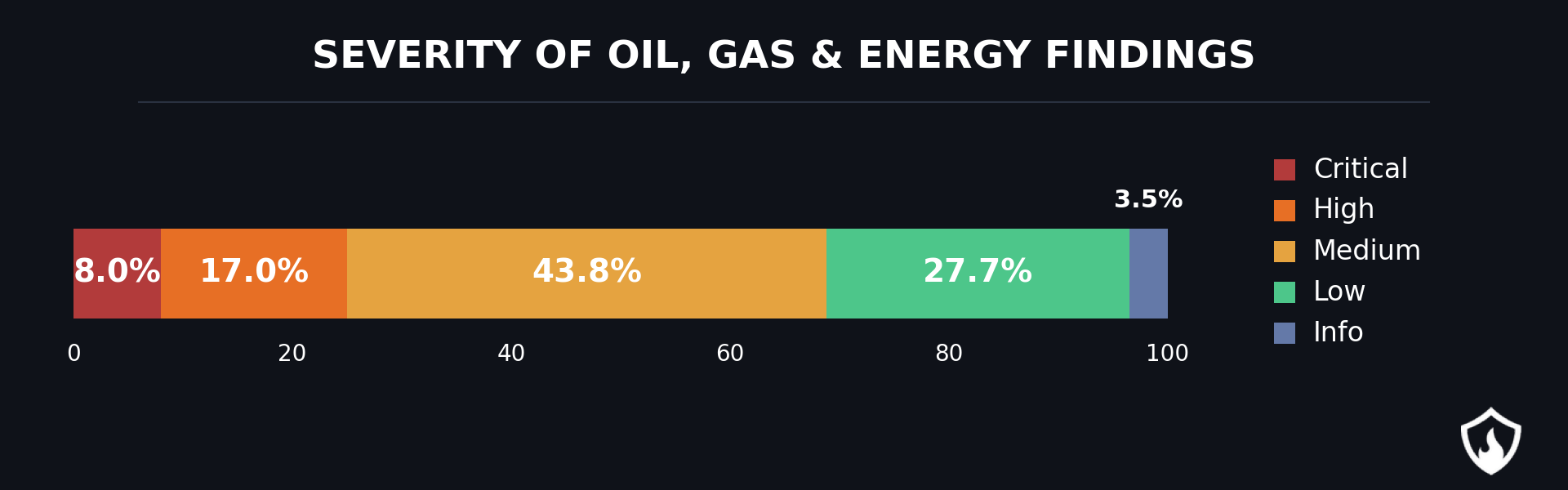
Oil, gas and energy assessments produced an average of 6.59 vulnerabilities per project in 2025, well above the overall pentest population average of 4.99. The severity profile is the more telling number: around 8% of findings were rated Critical and 17% High, putting the combined Critical/High rate at 25%. Medium-severity findings accounted for 43.8%, with Low at 27.7% and a small Informational remainder.
The numbers should not be read mechanically. A Critical finding in a SaaS multi-tenant database is not the same risk object as a Critical finding on a dispatch portal that, when compromised, halts scheduling at a refinery. CVSS scores describe technical severity in isolation; they say little about the operational tail of an availability impact or the regulatory consequences of a confidentiality breach in critical infrastructure.
The same caveat applies in the other direction. Medium and Low findings in energy environments routinely chain into higher-severity outcomes: an information-disclosure issue on an asset-management portal that exposes internal hostnames feeds reconnaissance for the next step; a missing rate limit on a contractor-facing API turns a weak-password problem into account takeover at scale.
Volume and severity together describe a sector that gets tested less often than e-Commerce or Finance, but accumulates a proportionally heavier risk inventory between assessments. Read alongside the assessment-type mix from the previous section, the numbers point to where defensive effort should sit: the management interfaces, partner portals, administrative systems, and remote access technologies that the pentest profile keeps highlighting as the dominant exposure surface.
The most common vulnerabilities in the energy sector
The top of the 2025 Energy Sector CWE list runs heavier than the cross-industry pattern. CWE-200 accounts for 17.0% of all findings, roughly double the share seen in Tech, Software & SaaS or Finance & Fintech. CWE-284 follows at 10.7%, and CWE-799 at 8.9%. Three CWEs account for more than a third of all vulnerabilities surfaced during the year.
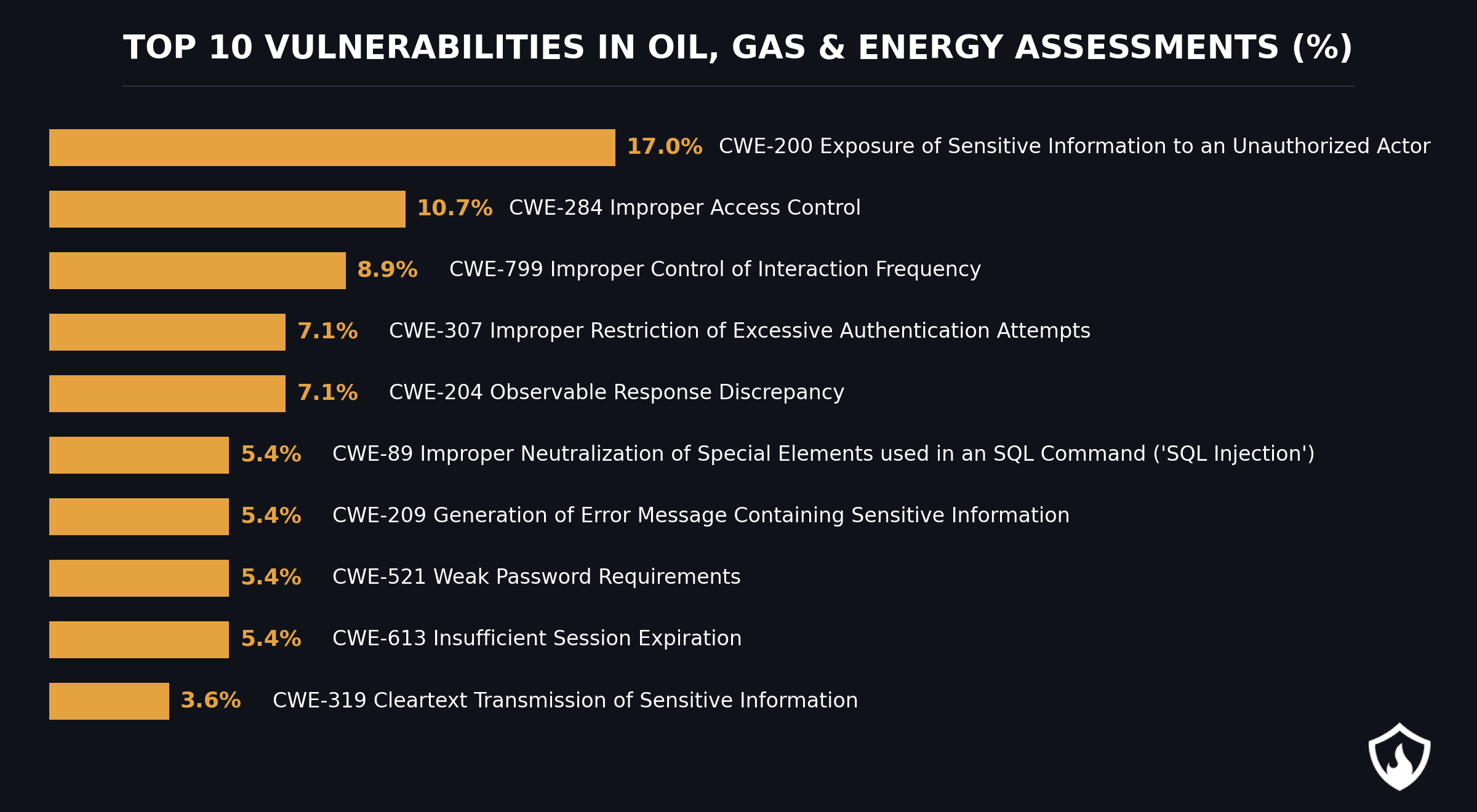
CWE-200, CWE-209, and CWE-319 form an information-exposure cluster that defines the sector's risk shape. In oil, gas and energy environments, those findings appear as portals leaking internal hostnames, dashboards exposing operator details, or legacy interfaces transmitting credentials over plaintext channels. None are exotic; they are the predictable seams of web stacks designed for internal networks and later pushed onto cloud or partner-facing surfaces.
The impact is not limited to data breaches in the conventional sense. Attackers can use these exposures to map internal systems, identify valid users, understand naming conventions, or steal sensitive data that supports later compromise. In environments connected to oil and gas operations, even partial disclosure can improve an attacker's ability to plan the next step.
CWE-284 is the access-control anchor. The pattern shows up as a vendor portal where one contractor reads another's work orders, an identity provider whose role checks run only on the client, or a partner API that returns full record sets when filtering should be restricted by organization. The trust model these systems were built on — a small set of internal users with similar privileges — does not survive contact with the federated, multi-tenant identities energy operators run today.
The anti-abuse cluster — CWE-799, CWE-307, CWE-204, and CWE-521 — is where the sector's exposed identity surfaces most clearly, revealing its weaknesses. Login and password-reset flows on contractor-facing systems routinely lack the controls that turn credential stuffing or enumeration into a non-event: rate limits, lockouts, uniform responses, multi-factor authentication, and a password policy aligned with the sensitivity of the system.
CWE-89, SQL Injection, still appears in the top 10 — a striking persistence for a class the industry has spent two decades teaching against. It surfaces most often in long-lived reporting interfaces, older dashboards, and integration endpoints that compose queries unsafely. Its continued presence in 2025 reflects the architectural reality the rest of the list describes: legacy systems and older stacks are still in production, still exposed, and still being shipped against.
The dominant weaknesses were not ICS-specific findings, but standard web, identity, and infrastructure issues applied to systems with operational consequences. The pentest profile is a web-and-identity one sitting on top of an environment where each finding carries weight that the CWE label alone does not communicate.
What these findings mean
These findings describe a sector whose security controls largely exist but are unevenly implemented. Authentication is present but not rate-limited. Authorization runs on identity but does not enforce object-level checks. Encryption is configured on external surfaces but not always on internal ones. The pattern is one of control quality, not control absence.
Trust boundaries break down most visibly at the identity layer. Energy operators run federated stacks that span employees, drilling contractors, EPC partners, vendor support engineers, and third-party software integrations. The authorization model behind those stacks was usually designed when the user base was smaller and more homogeneous, and it does not gracefully accommodate the multi-tenancy that arrives with federation.
Supply chains are therefore part of the technical attack surface, not just a procurement concern. Vendor accounts, maintenance providers, software suppliers, and third-party integrations all create paths into systems that support energy operations. Supply chain vulnerabilities often appear as excessive access, weak offboarding, shared credentials, poorly monitored vendor sessions, or inconsistent security protocols across partner-facing systems.
The second boundary breakdown sits between the IT-connected interfaces that pentests actually reach and the OT systems they overlay. The 2025 findings do not include ICS-specific weaknesses, but they describe management surfaces with weak authentication, exposed sensitive information, and missing anti-abuse controls — surfaces that often hold the credentials, configuration, or operational visibility a compromise converts into operational consequence at the physical layer.
CWE labels capture the technical mechanism of a vulnerability, not the risk it carries. A CWE-200 finding on a marketing analytics dashboard and the same CWE on a contractor portal leaking operator names, equipment identifiers, and partial network topology are entirely different risk objects. The CWE share signals where controls are weakest; the system it sits on signals what the weakness costs.
The implication for security programs in the sector is direct. Defensive effort focused on the management interfaces, partner portals, and administrative systems most likely to host the dominant CWEs closes the gap the data is pointing at. Segmentation between business IT and OT-adjacent zones, identity hygiene that survives federated multi-tenant use, continuous monitoring, and continuous validation of the boundary systems where compliance and safety overlap are the controls the 2025 findings argue for.
Primary attack vectors
Most findings are network-reachable and exploitable with low or no privileges, consistent with the cross-industry pattern. What differentiates oil, gas and energy is not the entry vector but the systems behind it: management interfaces, partner portals, and cloud-connected services that route into operational workflows.
Reconnaissance is the typical opening move. CWE-200, CWE-209, and CWE-204 weaknesses give attackers enough scaffolding — internal hostnames, valid usernames, response timing differences — to plan the next request precisely, most often on contractor- and partner-facing portals that disclose more than their owners expect.
Authentication and rate-limiting failures form the second stage. With valid usernames in hand, a weak password policy and missing brute-force protection, the next request turns into account takeover at scale. The barrier between unauthenticated and authenticated access is thinner than the system's design assumed, allowing an external actor to gain unauthorized access without relying on malware, phishing, or physical proximity.
After authentication, broken access control and session management issues extend the foothold horizontally: vendor portals exposing another contractor's work orders, partner APIs returning records outside the requesting organization, and sessions that survive longer than policy allows. These chains require iteration on what the application already returns, not sophisticated tradecraft.
User interaction is rarely required, which sets the sector apart from threat models built around phishing or office-worker compromise. The dominant attacker profile is the patient external probe working against APIs, login flows, file-upload endpoints, and error pages — a surface a remote actor can engage continuously without bait.
Physical and adjacent vectors remain marginal in the 2025 sample. The findings do not include compromises that required local proximity, USB-borne payloads, or insider physical access, even though physical security and insider threats remain important parts of the risk model for oil and gas facilities. The exploitation paths that worked in these pentests were the ones that work against any internet-exposed web stack; what changes is what those paths reach.
Conclusion
The 2025 energy, gas and oil pentest findings point to a clear pattern: the sector's most relevant exposure is not limited to OT systems or industrial control systems, but sits heavily in the IT-connected layer around them. Management interfaces, contractor portals, exposed services, and administrative workflows carried familiar web and identity weaknesses, but with a higher impact on availability and a shorter path to operational consequences than the same findings would have in many other industries.
For energy organizations, the priority is not only finding critical vulnerabilities in isolation. The larger task is hardening the systems that bridge business IT, third-party access, and operational workflows: enforcing segmentation, tightening access controls, reducing information exposure, strengthening authentication, and validating that remote access paths behave as designed. Penetration testing remains valuable in this context because it tests those boundaries under realistic conditions, where documentation often looks cleaner than the environment itself.